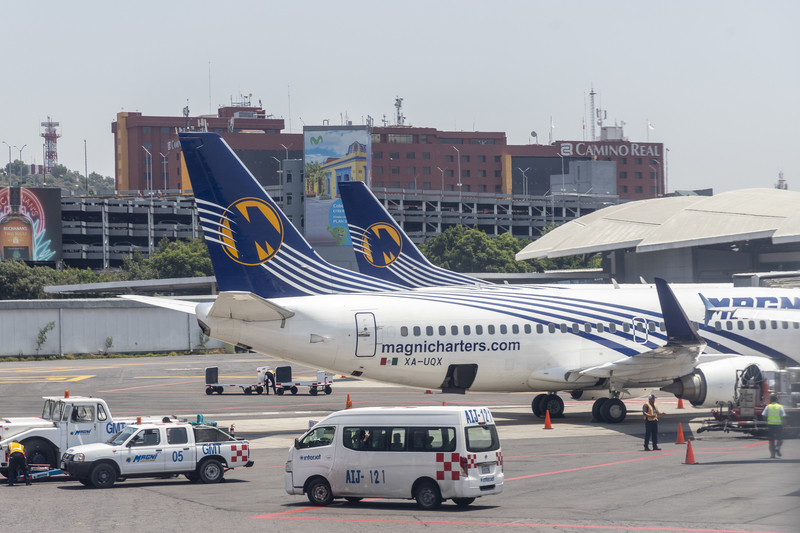
A Mexican federal court has declared Magnicharters bankrupt, moving the grounded leisure airline and related companies from insolvency proceedings into the liquidation stage.
The federal judiciary’s docket for case 46/2026 records a judgment dated October 30, 2026, declaring the companies in concurso mercantil “in the bankruptcy stage.” The court posted the entry on November 3.
Grupo Aéreo Monterrey operated under the Magnicharters brand. The proceedings also encompass companies associated with its vacation-package business, including Boma Inmobiliaria, Magnibus and Magnicun, according to Mexico’s consumer protection agency.
Read our stories in your inbox
Two aviation newsletters. Zero fluff.
The ruling ends any realistic prospect of Magnicharters returning through a financial restructuring. Under Mexico’s Commercial Bankruptcy Law, the bankruptcy stage is directed toward selling the debtor’s business, operating units or assets and distributing the proceeds among recognized creditors.
Collapse Followed April Grounding
Magnicharters stopped flying on April 11 after telling customers that logistical problems would prevent it from operating scheduled services for two weeks. The immediate disruption affected passengers at Cancún (CUN), Mérida (MID) and Huatulco (HUX), where the government asked Aeroméxico, Viva Aerobus and Volaris to provide assistance where possible.
The interruption quickly became permanent. Mexico’s Federal Civil Aviation Agency, or AFAC, said it had conducted an extraordinary inspection of Grupo Aéreo Monterrey from January 12 through January 16 and identified regulatory deficiencies. The carrier did not demonstrate that it had completed the required corrective actions.
AFAC therefore suspended Magnicharters’ operations on April 14 as a preventive measure. The regulator subsequently revoked the company’s air operator certificate after the documentation submitted by the airline proved insufficient to establish compliance with the applicable requirements.
The sequence is significant. Magnicharters did not initially enter insolvency as an airline continuing to fly while negotiating with creditors. Its commercial operation had already stopped, and the regulatory path back to service closed when AFAC revoked its certificate.
Traffic Was Falling Before Operations Ended
Magnicharters occupied a small but distinctive part of Mexico’s domestic market, combining charter-style flying with vacation packages to leisure destinations. That model placed much of its distribution through travel agencies and bundled products rather than relying entirely on conventional point-to-point ticket sales.
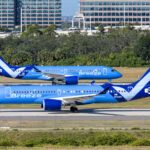
Official traffic figures show the business weakening before the grounding. Magnicharters carried 208,583 domestic passengers in 2025, down 4.2% from 217,813 in 2024. Its share of Mexico’s domestic airline market was about 0.3%.
For January through April 2026, the airline carried an estimated 40,037 domestic passengers, a 19.2% decline from the same period of 2025. April traffic fell 64.5% year over year to 6,274 passengers as flying stopped during the month, according to AFAC operational statistics.
Those volumes left Magnicharters far behind Mexico’s three large commercial airlines. Viva Aerobus and Volaris together accounted for nearly three-quarters of domestic passengers in 2025, while Aeroméxico held a further 19.1%. Magnicharters’ vacation focus differentiated its product, but its scale offered little protection when aircraft, labor, airport and distribution obligations came under pressure.
Passengers and Other Creditors Enter the Process
The bankruptcy estate will have to address claims extending beyond conventional airline suppliers. Mexico’s Federal Consumer Protection Agency, Profeco, had received 491 complaints by June 30 from customers affected by the suspension, including travelers holding fully paid vacation packages with air transportation.
Profeco directed affected consumers to case 46/2026 so they could seek recognition as creditors for services that were paid for but not provided. The court docket also records repeated attempts by prospective creditors to join the proceedings, as well as protective measures involving company assets and aircraft.
Airport-related liabilities were not new to the company. A Mexico City Airport (MEX) government management report said the airport recovered 72 million pesos in passenger facility charges, plus financing costs, from Grupo Aéreo Monterrey in May 2024 under a debt-recognition agreement signed the previous year. The official airport report shows that Magnicharters had already required a structured arrangement to clear a substantial public-sector obligation well before its 2026 collapse.
A Boeing 737 Classic Operator Reaches the End
Magnicharters built its flying program around Boeing 737 Classic aircraft, particularly the Boeing 737-300. The type was well matched to the airline’s domestic leisure sectors, providing mainline narrowbody capacity without requiring the passenger volumes needed to fill larger current-generation aircraft.
Magnicharters used varying layouts over its operating history. Government records for individual services show Boeing 737-300 configurations between 138 and 148 seats. Boeing’s reference material describes a representative mixed-class 737-300 with 126 seats, although leisure operators commonly used denser all-economy cabins.
The aircraft’s straightforward capacity and range suited routes linking Mexico City and Monterrey with beach destinations. Its age, however, also placed Magnicharters outside the fleet strategy followed by Mexico’s largest airlines, which have concentrated on newer Boeing 737 and Airbus A320-family aircraft with lower fuel and maintenance costs.
The court case had already turned toward preservation of the remaining estate before the bankruptcy judgment. Docket entries refer to precautionary measures, technical access to aircraft and arrangements for removing fuel from aircraft in storage. Those proceedings will now feed into the inventory and disposition of assets under the bankruptcy process.
Bottom Line
Magnicharters’ bankruptcy removes a specialized leisure operator rather than a major source of nationwide scheduled capacity. Its 0.3% domestic market share means Aeroméxico, Viva Aerobus and Volaris can absorb much of the displaced passenger demand without materially changing their fleet plans. Travel agencies and tour operators lose a supplier built specifically around bundled vacation traffic, however, and will have fewer alternatives to the large scheduled carriers.
The more consequential work now shifts from aviation operations to asset control and creditor recognition. Passengers with unused packages will compete within the same judicial process as employees, airports, tax authorities and commercial suppliers. The value and ownership status of the remaining Boeing 737-300s will be central to determining how much the estate can recover, particularly given the limited passenger-airline market for aging 737 Classics.
The case also shows how quickly an airline restructuring option can disappear once operations and regulatory approvals are lost. By the time the bankruptcy judgment arrived on October 30, Magnicharters had been grounded for more than six months and no longer held an air operator certificate. The court’s task is therefore not to preserve a functioning network, but to extract value from what remains of an airline whose commercial and regulatory foundations had already been removed.