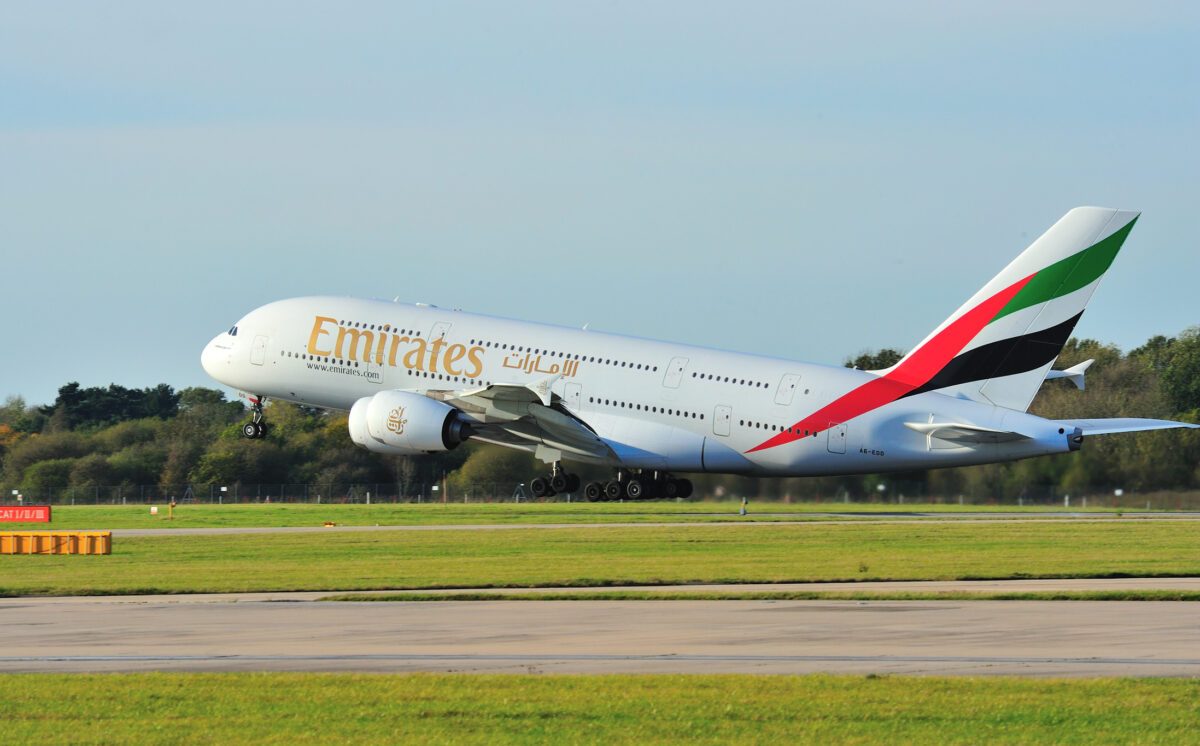
Emirates’ highest-capacity Airbus A380 configuration is entering its final months of service, with the airline’s schedules placing the 615-seat aircraft on eight routes between September 2026 and July 2027.

The two-class A380s are scheduled for 1,491 departures from Dubai (DXB) during that period. Most of the flying is concentrated on four high-volume routes, while Birmingham, Bali, Jeddah and Mauritius receive a small number of remaining or substitute appearances.
The contraction follows the start of Emirates’ program to convert all 15 of its two-class A380s into a three-class layout. The airline said in May that every aircraft in the subfleet would be completed by the end of 2026, making the dense configuration a finite part of its operation even where schedules still show it well into 2027.
Read our stories in your inbox
Two aviation newsletters. Zero fluff.
The Eight Remaining Routes
The eight destinations appearing in the schedule are:
- Bangkok Suvarnabhumi (BKK): The 615-seat layout returns October 25 on two daily rotations, accounting for 553 departures through July 2027. Emirates’ published Bangkok schedule has five daily flights, giving the airline room to assign different A380 and Boeing 777 configurations by departure.
- Birmingham (BHX): Two appearances remain, on September 9 and 11. Emirates uses EK39/40 for its A380 rotation to Birmingham, the same flight pair used when the first converted two-class aircraft entered service in May.
- Denpasar, serving Bali (DPS): The old configuration has 18 September departures in the schedule, ending September 29. Emirates currently lists both EK368 and EK398 as A380 services in its Dubai-Bali timetable, although the cabin assigned to individual departures varies as retrofitted aircraft enter the operation.
- Düsseldorf (DUS): Daily 615-seat service is scheduled from November 1, producing 147 departures. Emirates operates two daily flights on the route, with its Düsseldorf schedule mixing A380 and Boeing 777 capacity.
- Jeddah (JED): The configuration made a single scheduled appearance on September 1. Emirates’ current Jeddah timetable shows three daily A380 flights, but almost all use other cabin layouts.
- London Gatwick (LGW): Two daily departures move to the 615-seat configuration from December 1, generating 486 departures through July. The airline’s Gatwick schedule lists four daily flights, including three A380 rotations and one Airbus A350 service.
- Manchester (MAN): One daily rotation is assigned the configuration from October 25, totaling 280 departures through July. Emirates operates three daily A380 flights in its Manchester schedule.
- Mauritius (MRU): Four appearances are scheduled on September 4, 23, 26 and 30. Emirates has otherwise moved EK703/704 to a retrofitted A380 with 76 Business, 56 Premium Economy and 437 Economy seats, according to its Mauritius product announcement.
Schedules remain subject to aircraft substitutions, particularly while individual A380s cycle through Emirates Engineering in Dubai. The limited Birmingham, Jeddah and Mauritius appearances are better viewed as fleet assignments than long-term route commitments to the configuration.
Why the 615-Seat A380 Is Disappearing
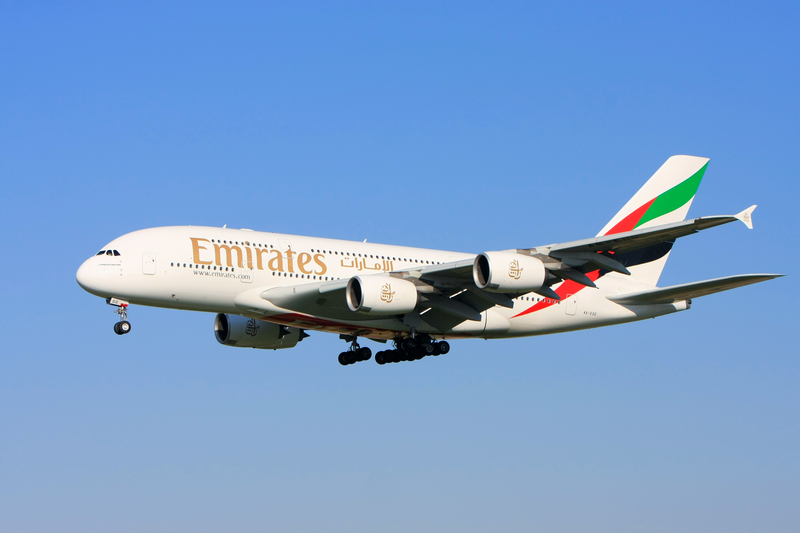
The two-class aircraft has 58 lie-flat Business Class seats and 557 Economy seats. It has no First Class cabin, and Economy extends onto the upper deck behind Business Class. Emirates introduced the arrangement in 2015 as the world’s first 615-seat A380 configuration.
The design gave Emirates an unusually large block of capacity for markets where demand and airport slots justified the A380 but the airline did not require First Class. The final route list reflects that purpose. Bangkok, Gatwick and Manchester are large connecting markets, while Bali and Mauritius generate substantial leisure demand. Jeddah can support very high loads over a short sector, particularly around pilgrimage periods.
Emirates still lists the two-class, 615-seat model among the configurations on its A380 fleet page, alongside 484-, 489- and 517-seat variants. The airline had 116 A380s in its fleet when it published its aircraft totals in November 2025.
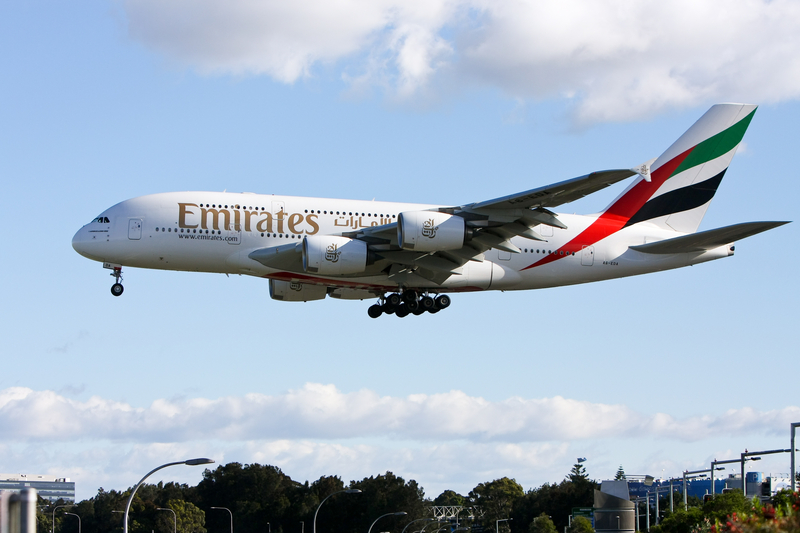
The replacement configuration carries 569 passengers: 76 in Business, 56 in Premium Economy and 437 in Economy. Converting each aircraft therefore removes 46 seats, but it creates a third revenue cabin and expands Business Class by 18 seats.
The most extensive work takes place on the upper deck. Emirates Engineering removes 120 Economy seats and installs 56 Premium Economy seats in a 2-3-2 arrangement, together with the additional Business Class capacity. Galleys, partitions, storage, overhead bins, electrical systems and plumbing require modification.
The first conversion, A6-EUX, took about 35,000 labor hours over two months. Emirates expects subsequent aircraft to require approximately 30 days as the engineering team applies lessons from the initial project.
A Small Part of a Much Larger Retrofit
The disappearance of the 615-seat model is one element of Emirates’ $5 billion cabin investment covering 219 A380s and Boeing 777s. By July 2026, the airline had completed 100 aircraft, including 47 A380s and 53 777s.

Emirates said approximately 20 more aircraft would be completed by the end of December. The next phase of the program begins in October with new lightweight Safran Z400 seats and 4K OLED HDR10+ seatback displays among the planned changes.
The work is not a retreat from the A380. Emirates continues to invest in the type’s cabins, connectivity and long-term maintenance, preserving a fleet that remains central to capacity at constrained airports. What is changing is the economics inside the cabin: fewer total seats, more segmentation and a larger inventory of higher-yield products.
Bottom Line
Passengers gain a more consistent three-class product as the conversion advances, particularly on markets where Premium Economy has previously been unavailable or confined to another daily frequency. Emirates also gains greater control over yield. Replacing 120 upper-deck Economy seats with Premium Economy and additional Business Class capacity allows the airline to sell more intermediate and premium options without giving up the A380’s fundamental volume advantage.
The trade-off is the loss of 46 seats per aircraft and one of the most distinctive Economy products in the fleet. Upper-deck Economy on the two-class A380 offered a smaller cabin than the main deck while allowing Emirates to deploy more than 550 Economy seats on a single departure. Its removal shows that absolute seat count is no longer the airline’s only priority, even on routes built around heavy connecting and leisure traffic.
The dates and individual rotations may move as aircraft enter the hangar, but the direction is fixed: Emirates intends to finish all 15 conversions by the end of 2026. The main point to watch is whether the 2027 schedule retains the 615-seat code while planning catches up with the retrofit sequence, or whether Bangkok, Gatwick, Manchester and Düsseldorf progressively switch to the 569-seat aircraft as the last conversions return to service.
Keep reading FlyMag
Get the Daily Brief in the morning or the Route Watch weekly recap on Fridays. Or both.