Thirty-five years after the original Dornier 328 made its first flight, Deutsche Aircraft is building an industrial system to return its basic design to serial production.
The program passed its clearest manufacturing milestone on September 29, 2026, when the company inaugurated the D328eco final assembly line at Leipzig/Halle Airport (LEJ). The more than €100 million facility gives Deutsche Aircraft the capacity to assemble as many as 48 aircraft annually, although output will depend on certification, customer commitments and the pace of the production ramp.
The development is often described as the Dornier 328 returning to production. That is broadly correct, but the aircraft entering the Leipzig system is not simply a restarted 1990s turboprop. The D328eco is a substantially updated, stretched derivative intended to retain the original aircraft’s field performance and handling qualities while replacing or redesigning many of the systems that determine operating economics and long-term supportability.
Read our stories in your inbox
Two aviation newsletters. Zero fluff.
A Proven Airframe Becomes the Starting Point
The original Dornier 328 prototype first flew on December 6, 1991, and the type entered commercial service in October 1993. Production ended in the early 2000s, after the program had passed through Dornier, Fairchild Dornier and subsequent ownership changes.
Deutsche Aircraft now holds the type certificate for the Dornier 328 series, covering the turboprop 328-100 and jet-powered 328-300. The European Union Aviation Safety Agency records Deutsche Aircraft as the certificate holder.
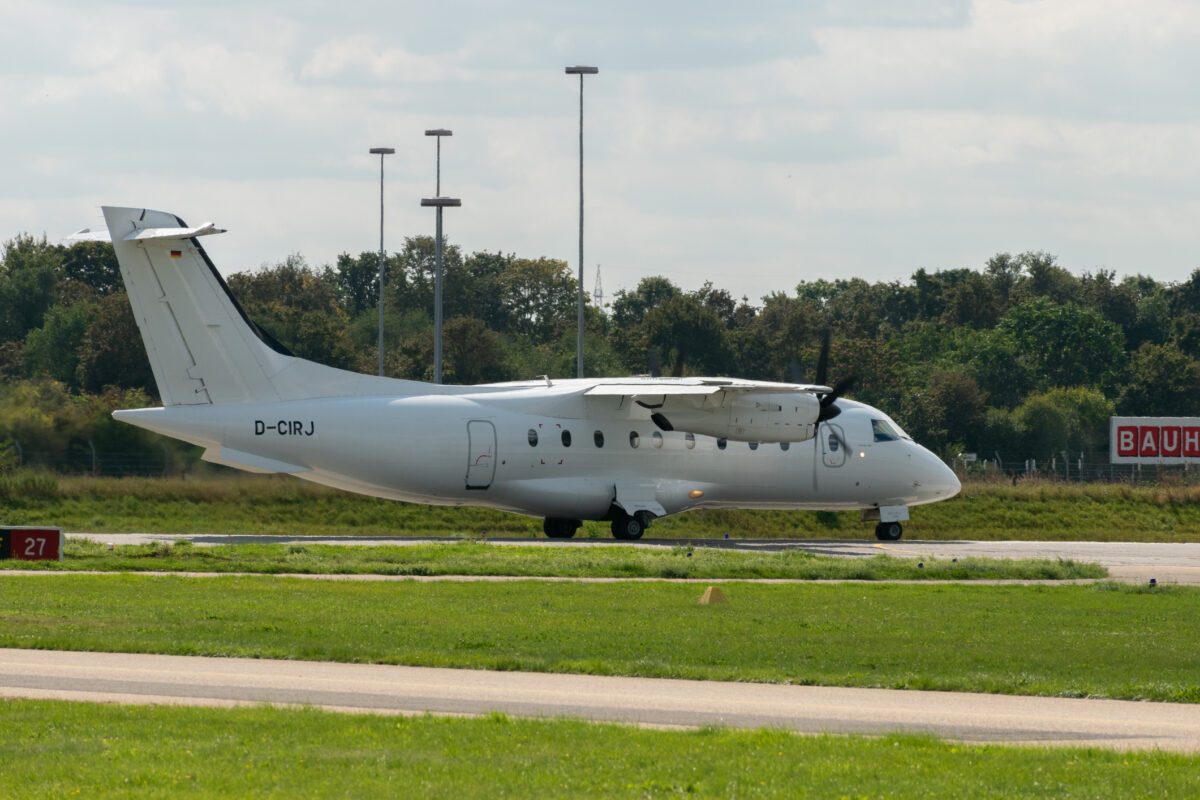
That ownership gives the company a different starting point from a clean-sheet manufacturer. It has the design data, certification experience and in-service knowledge accumulated from a fleet that Deutsche Aircraft says still includes more than 150 operating aircraft. Those airframes work across passenger, corporate shuttle, medical, cargo and special-mission roles.
The continuity also extends to personnel. D328eco chief engineer Thomas Ahn began working at Dornier in 1987 and helped shape the original aircraft concept. Deutsche Aircraft has presented his role as part of an effort to retain system-level knowledge that might otherwise have disappeared with the original production program.
The D328eco Is More Than a Restart
The new aircraft increases nominal capacity to 40 passengers, which Deutsche Aircraft describes as 25% more than the legacy platform. Its first test aircraft, TAC 1, was created by cutting and extending a Dornier 328 fuselage, providing a practical route to test the revised configuration before serial aircraft emerge from Leipzig. TAC 1 rolled out at Oberpfaffenhofen in May 2025.
Power comes from two Pratt & Whitney Canada PW127XT-S engines in place of the PW119C installation used on the original turboprop. Deutsche Aircraft says the newer engine provides a 3% specific fuel consumption improvement over its predecessor, alongside 40% longer time on wing and a 20% maintenance-cost reduction.
The flight deck is also being brought forward by a full generation. The aircraft will use the Garmin G5000 PRIME integrated flight deck, replacing the architecture of the original 328 with a touchscreen-based avionics suite designed for current navigation, surveillance and operating requirements.
Deutsche Aircraft gives the D328eco a maximum cruise speed of 324 knots, a 30,000-foot service ceiling and a range of 655 nautical miles with 40 passengers. It is targeting an 800-meter takeoff field length at a 70% load factor, while retaining the ability to serve short and unpaved runways. Those figures place the aircraft squarely in the thin-route market: sectors too small for a 70-seat turboprop or regional jet, but where speed, weather capability and passenger comfort still matter.
The manufacturer claims a 14% reduction in fuel consumption per passenger compared with the legacy Dornier 328. The aircraft is also being developed around compatibility with 100% power-to-liquid sustainable aviation fuel specifications at entry into service.
Production Returns Through a Global Supply Chain
Final assembly is German, but the D328eco is supported by an international industrial network. Akaer has opened a forward-fuselage line in São José dos Campos, Brazil, while other suppliers are responsible for the rear fuselage, wing, nacelles, empennage, flight controls and aircraft systems. Akaer’s production facility moved the forward fuselage package into industrialization during 2025.
Leipzig is where those major structures will come together. The 60,500-square-meter site includes the final assembly line, a flight-readiness hangar, logistics facilities and administrative space. Deutsche Aircraft expects the production ramp to support about 250 direct jobs.
The factory uses paperless production processes, automated material movement and digitally controlled storage. An automated logistics center handed over in October 2026 includes more than 6,500 small-parts storage positions and space for 624 pallets. The objective is not merely to reproduce the old Dornier manufacturing system, but to build a scalable line around current digital configuration control and traceability requirements.
Engineering, certification and flight testing remain at Oberpfaffenhofen, while Leipzig will handle assembly, flight-readiness work and customer deliveries. That division gives Deutsche Aircraft an end-to-end German aircraft program while allowing major structural suppliers to contribute from established aerospace centers outside the country.
Certification Work Is Advancing Alongside Manufacturing
The company is testing new systems before the complete D328eco enters its main flight-test campaign. A prominent example is the landing gear, which Deutsche Aircraft has brought under its own intellectual-property and engineering control to improve parts availability and lifecycle support.
A legacy Dornier 328 fitted with the new landing gear began flying on August 5, 2026. It completed five development flights and accumulated more than 15 hours of combined ground and flight testing during the first disclosed phase. The test campaign covers braking, steering, crosswind and unpaved-runway work, as well as structural and durability assessments.
That common landing-gear architecture is intended to benefit both the D328eco and the existing fleet. For current operators, it could improve access to spares and engineering support. For the new aircraft, it reduces dependence on legacy suppliers that may no longer regard a relatively small regional fleet as a priority.
Deutsche Aircraft is targeting certification and entry into service in the fourth quarter of 2027. The company shifted that date in 2024 after reviewing regulatory and compliance requirements.
Existing Operators Are the Natural First Market
The most visible prospective customer is Private Wings, a German charter and corporate-shuttle operator with extensive Dornier 328 experience. It signed a letter of intent for five D328eco aircraft in 2023. Deutsche Aircraft has also disclosed a separate letter of intent with an unidentified customer for as many as four aircraft.
Those commitments remain modest beside the Leipzig factory’s ultimate capacity, but operators already flying the 328 offer the lowest-risk route into service. They understand the aircraft’s operating niche, while the new model gives them additional seats, current-generation systems and a manufacturer-backed support path without forcing a move into a much larger aircraft.
Bottom Line
The D328eco’s opportunity comes from a segment that the major regional-aircraft manufacturers have largely left behind. Current-production turboprops are concentrated around 70 seats, while many Saab 340s, Embraer Brasilias, smaller Dash 8s and early Dornier 328s are approaching the point where maintenance, parts and dispatch reliability become decisive. A new 40-seat aircraft can serve routes where adding 30 more seats would damage frequency or load factor rather than improve economics.
Deutsche Aircraft’s main challenge is turning that market logic into a certifiable aircraft and a dependable production ramp. Opening a factory and industrializing structural work are significant commitments, but the program still has to complete its flight-test campaign, secure firmer commercial orders and demonstrate that a sub-50-seat aircraft can be produced economically in relatively small volumes. The next milestones to watch are TAC 1 flight testing, certification progress and the conversion of customer letters of intent into binding orders.
If Deutsche Aircraft succeeds, the D328eco will not represent nostalgia-driven production of an old turboprop. It will show that an established airframe, supported by retained engineering authority and redesigned around modern engines, avionics and manufacturing, can address a fleet-replacement problem that clean-sheet programs have largely ignored.