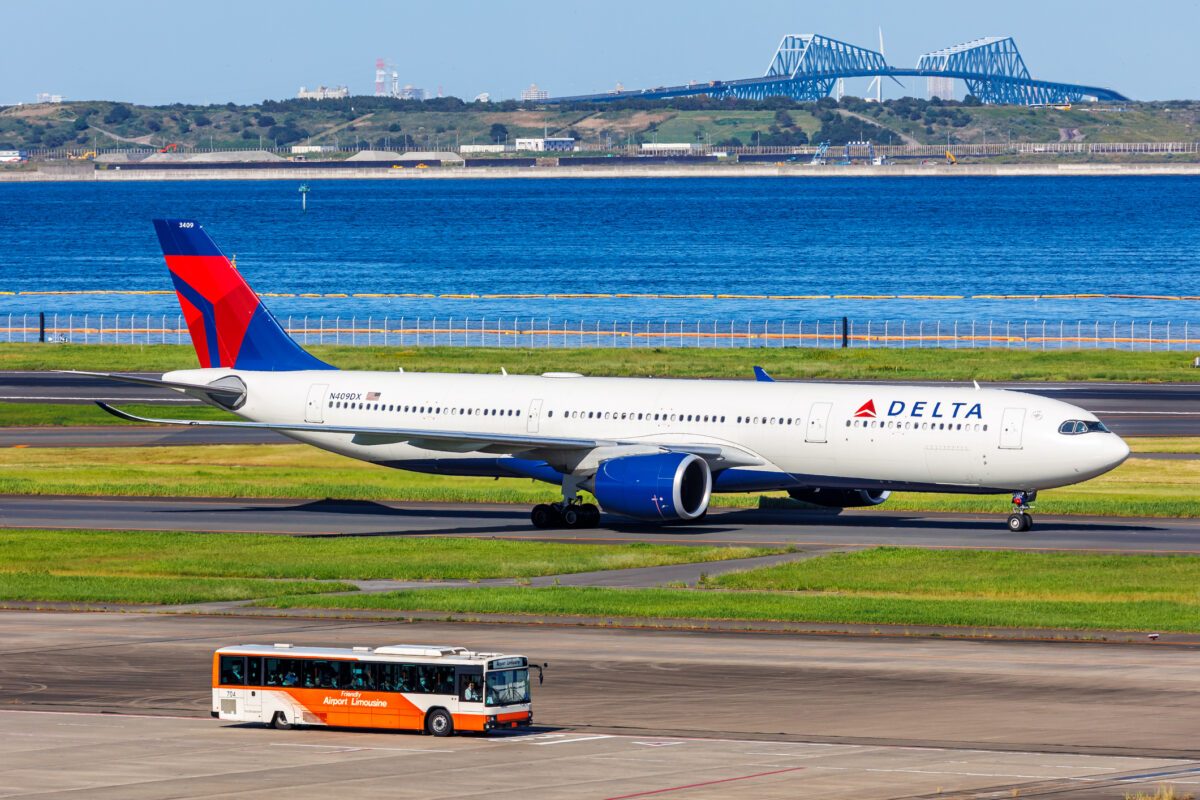
A Delta Air Lines Airbus A330-300 carrying 280 passengers and crew diverted to St. John’s International Airport (YYT) in Newfoundland and Labrador on Sunday night after developing an engine-related mechanical problem while crossing the North Atlantic.

Delta Flight DL182 was operating from New York John F. Kennedy International Airport (JFK) to Rome Fiumicino Airport (FCO) on August 23 when the crew turned back toward Canada roughly four hours into the transatlantic flight.
The aircraft, N823NW, landed safely at St. John’s International Airport (YYT) at approximately 11:20 p.m. local time, where emergency personnel were waiting. All 267 passengers and 13 crew members exited the aircraft safely, and no injuries were reported. Delta subsequently provided hotel accommodations and meal vouchers while arranging alternate transportation.
Read our stories in your inbox
Two aviation newsletters. Zero fluff.
DL182 Turned Back While Cruising At 35,000 Feet
Flight tracking and incident information indicate that DL182 was cruising at FL350, or 35,000 feet, approximately 240 nautical miles northeast of St. John’s (YYT) when the crew elected to divert because of a problem involving one of the aircraft’s General Electric CF6 engines.
The incident was described by Delta as a mechanical problem, while local authorities referenced an engine issue. Some passengers reportedly described the event more dramatically as an engine having “blown,” but there has been no indication from Delta that the engine suffered that type of catastrophic failure. The Aviation Herald incident details via Airportia
That distinction is important. An engine-related diversion does not necessarily mean an engine has failed completely. Modern twin-engine widebodies are designed with substantial redundancy, and flight crews have established procedures for handling engine abnormalities, including situations in which an engine may need to be shut down.
Delta said the pilots followed standard procedures and diverted out of an abundance of caution. The airline said the aircraft was being evaluated to determine exactly what occurred.
The flight had been scheduled to cover approximately 4,266 miles between New York (JFK) and Rome (FCO) with a scheduled block time of about eight hours and 35 minutes.
Why St. John’s Is So Important For Transatlantic Diversions
St. John’s International Airport (YYT) is particularly well positioned for an incident like this.
Located on the eastern edge of Newfoundland, YYT sits close to the North Atlantic tracks used by large numbers of flights traveling between North America and Europe. The airport itself has described its location bordering the Atlantic Ocean as making it an ideal stopping point for diverting transatlantic flights. St. John’s International Airport Authority annual report
Its primary runway is approximately 8,500 feet long, and St. John’s International Airport says it can accommodate aircraft of virtually all sizes. The airport also has Category III instrument landing capability, an important feature in a region where fog and rapidly changing weather can affect operations. St. John’s International Airport infrastructure information
For crews dealing with an aircraft abnormality over the western North Atlantic, St. John’s (YYT) can therefore provide a combination of geographic proximity, sufficient runway length and emergency-response infrastructure without requiring the aircraft to continue hundreds of additional miles toward Europe.

Calling it simply the “closest airport” can be misleading. A diversion involving a large widebody is based on finding a suitable airport, taking into account runway capability, weather, aircraft performance, available emergency services and the nature of the problem.
In DL182’s case, the aircraft was already several hundred miles east of Newfoundland when the crew reversed course toward YYT.
The Aircraft Was Delta A330-300 N823NW
The aircraft involved, N823NW, is an Airbus A330-302 with manufacturer serial number 1628.
The widebody first flew in January 2015 and was delivered new to Delta on August 26, 2015, meaning the diversion occurred almost exactly 11 years after the aircraft entered Delta’s fleet. Its original Airbus test registration was F-WWYY. N823NW aircraft history
N823NW is powered by two General Electric CF6-80E1A4 turbofan engines, according to Delta aircraft financing records filed with the U.S. Securities and Exchange Commission.
The CF6 family has been used extensively on long-haul widebody aircraft for decades. In Delta’s fleet, the engine is found on a portion of its A330-300 operation, while other A330-300s inherited from Northwest Airlines use Pratt & Whitney PW4000-series engines.
Delta operates 31 Airbus A330-300s, according to its current fleet information. The type remains an important part of the airline’s long-haul network even as newer Airbus A330-900neos and A350-900s increasingly take on international flying. Delta’s Airbus A330 fleet information
DL182 Was Nearly Full
Delta’s current A330-300 configuration contains 282 seats, which means the 267 passengers aboard DL182 represented a passenger load of nearly 95% of available seats.
The aircraft is configured with 34 Delta One seats, 21 Delta Premium Select seats, 24 Delta Comfort seats and 203 Main Cabin seats. Delta lists a range of approximately 6,330 miles and a typical cruising speed of 531 mph for the A330-300. Delta A330-300 seat map and specifications
Those figures also illustrate why the A330-300 remains useful on routes such as New York (JFK)-Rome (FCO). It provides substantial passenger capacity and cargo capability while offering a range well beyond what is required for the roughly 4,300-mile transatlantic sector.
For Delta, the A330-300 is now the older member of a growing Airbus widebody operation. At the end of 2025, Delta had 31 A330-300s alongside 39 newer A330-900neos and 40 Airbus A350-900s.
Delta Sent An A330-900neo To Rescue The Passengers
The operational recovery was somewhat unusual.
Rather than leaving 267 passengers in St. John’s (YYT) until they could be placed directly on another flight to Rome, Delta positioned a replacement aircraft to Newfoundland.
That aircraft was N428DX, an Airbus A330-900neo, according to flight and incident data. It transported the stranded passengers from St. John’s (YYT) back to New York John F. Kennedy International Airport (JFK), where Delta employees worked to reaccommodate them on new flights to Rome (FCO) and other final destinations.
The choice of aircraft was noteworthy. Delta’s A330-900neo carries 281 passengers, almost exactly matching the capacity of the older A330-300 involved in the diversion.
The A330-900neo is configured with 29 enclosed Delta One Suites, 28 Delta Premium Select seats, 56 Delta Comfort seats and 168 Main Cabin seats. It is powered by newer Rolls-Royce Trent 7000 engines and has a published range of 6,995 miles. Delta Airbus A330-900neo specifications
N428DX itself was delivered to Delta in July 2024, making it approximately nine years newer than N823NW.
The passengers were not continued directly from YYT to Rome on the rescue aircraft. Instead, Delta returned them to its major JFK international operation, where it had considerably more options to redistribute passengers onto available Italy-bound flights.
Delta told Canadian media that passengers were rebooked to their final destinations and apologized for the disruption.
A Twin-Engine Aircraft Can Safely Divert After An Engine Problem
Engine-related events over the Atlantic inevitably attract attention because of the distance involved from major airports.
However, the Airbus A330 was designed from the outset as a twin-engine long-haul aircraft and is certificated for extended operations over areas where suitable diversion airports can be a considerable distance away.
A modern twin-engine aircraft does not require both engines to remain operating in order to maintain controlled flight and land safely. Aircraft performance calculations, dispatch requirements, diversion planning and crew training all account for the possibility of an engine becoming unavailable.
The more important operational question becomes where to land and how quickly the aircraft should get there.
In this case, continuing east toward Ireland or continental Europe would have meant spending substantially more time over the Atlantic. Turning back toward St. John’s International Airport (YYT) gave the crew access to a capable airport on the eastern edge of North America.
There is currently no indication that passengers were ever in immediate danger, and no injuries were reported.
The Original A330 Remained In St. John’s
N823NW did not continue to Rome Fiumicino Airport (FCO) following the diversion.
Delta said the aircraft would undergo an evaluation following the mechanical issue, which is standard practice after an engine-related diversion. Depending on what maintenance personnel identify, an aircraft may require repairs, inspections, replacement components or an engine change before it is released back into service.
The fact that Delta dispatched another widebody to recover the passengers rather than attempting a quick continuation with N823NW indicates that the airline did not expect the original aircraft to be immediately returned to passenger service.
That does not, by itself, establish the severity of the problem. Even relatively contained technical faults can require specialized maintenance work or components that are not readily available at an outstation such as St. John’s.
Bottom Line
Delta Air Lines Flight DL182 from New York John F. Kennedy International Airport (JFK) to Rome Fiumicino Airport (FCO) diverted to St. John’s International Airport (YYT) on August 23 after developing a mechanical problem involving one of its engines over the North Atlantic.
The Airbus A330-300, registration N823NW, was cruising at approximately 35,000 feet about 240 nautical miles northeast of St. John’s when the crew turned back toward Newfoundland.
All 267 passengers and 13 crew members landed safely, with no injuries reported.
The aircraft involved is an 11-year-old Airbus A330-302 powered by General Electric CF6-80E1A4 engines. Rather than attempt to continue the journey, Delta positioned a newer Airbus A330-900neo, N428DX, to St. John’s to carry the passengers back to New York (JFK), where they were rebooked to Rome (FCO) and other final destinations.
The incident also demonstrates why St. John’s (YYT) remains such an important airport for North Atlantic operations. Its location on the eastern edge of Canada, 8,500-foot primary runway and ability to handle large widebody aircraft make it a valuable diversion point when a westbound or eastbound transatlantic flight needs to get on the ground quickly.