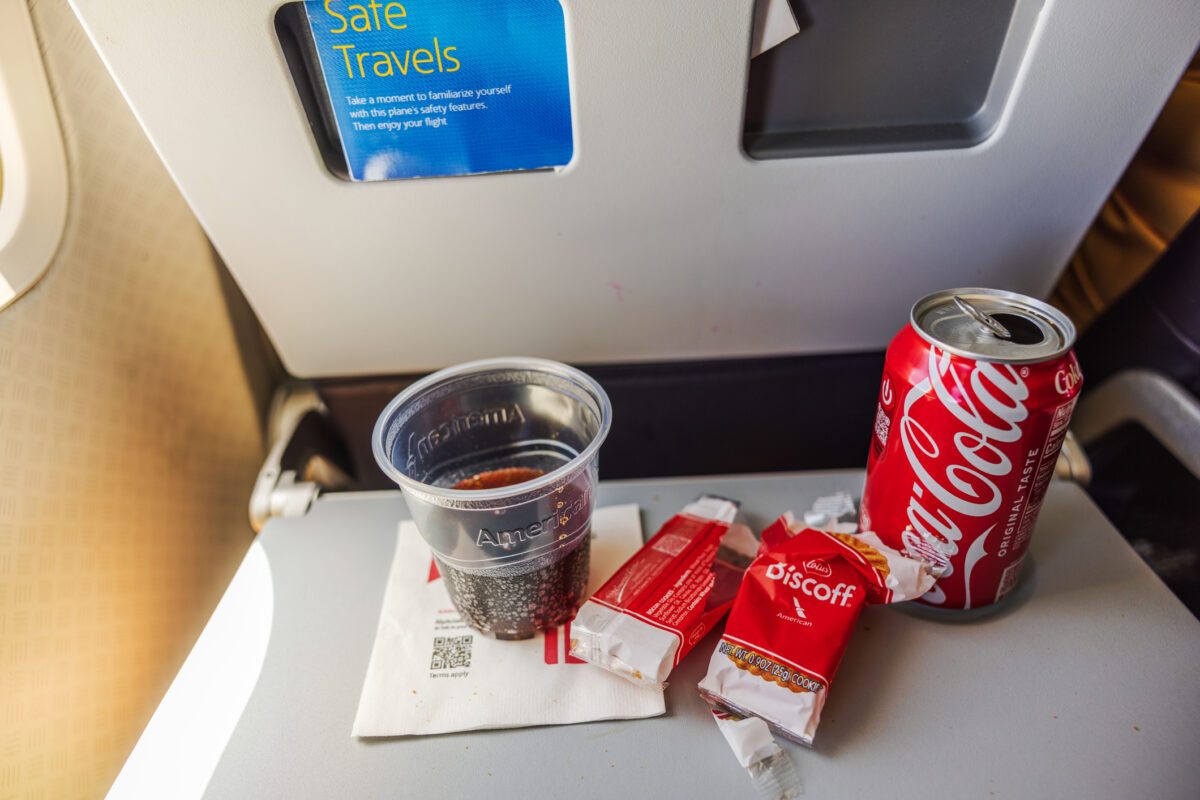
American Airlines will introduce a broader selection of complimentary Main Cabin snacks this fall, adding two products while retaining established items including Biscoff cookies and Goldfish crackers.
The revised snack lineup will begin appearing on select flights in early October. American said it developed the changes through passenger feedback and product testing, with the selection divided between morning and later departures.
Morning flights will continue to carry Biscoff cookies, which American pairs with Lavazza coffee in its service presentation. Goldfish will provide a savory alternative during the morning period.
Read our stories in your inbox
Two aviation newsletters. Zero fluff.
Later flights will feature Goldfish alongside new Tate’s Bake Shop chocolate chip cookies and Peterson’s savory and sweet snack mix. American has not presented the program as a fixed three-item choice on every eligible flight; the products form the lineup from which snacks will be offered as the rollout progresses.
American Moves Beyond a Single Standard Snack
The change broadens a complimentary service that has generally centered on Biscoff cookies and pretzels. American’s published Main Cabin food and beverage policy provides complimentary snacks on flights longer than 250 miles, together with coffee, tea, juice, water and soft drinks. On flights under 250 miles, nonalcoholic drinks are available by request.
The October program introduces more distinction by time of day without adding the complexity of a full meal service. Biscoff remains anchored to morning operations, while the later selection includes a conventional sweet product, a savory cracker and a mixed-profile snack.
That structure addresses a recurring limitation of mass-market inflight catering: one standardized item cannot suit every passenger or every departure time. A cookie may work naturally with an early coffee service, while travelers flying around lunch or in the evening may prefer something savory. The refreshed program gives cabin crews a wider mix while keeping the products individually packaged and compatible with beverage-cart service.
American attributed the decision to passenger feedback. Chief Customer Officer Heather Garboden said the airline wanted to preserve familiar products while introducing additional choices, describing small service elements as meaningful parts of the overall journey.
The carrier also intends to rotate snacks over time rather than treat the October selection as permanent. American said further choices are planned during 2027 as it monitors passenger preferences, indicating that complimentary catering will become a more actively managed part of the Main Cabin product.
Tate’s Moves From Premium Baskets to Main Cabin
Tate’s cookies are already familiar within American’s catering operation. The airline added Tate’s chocolate chip cookies to a midday snack basket for premium-cabin passengers in June 2025 as part of a wider food and beverage update.
Moving the brand into complimentary Main Cabin distribution gives it a much larger potential audience. It also illustrates how airlines can test packaged products in a smaller premium setting before considering them for high-volume economy service, where supply consistency, storage, loading and rapid distribution become more significant.
The complimentary products remain separate from American’s buy-on-board range. Food is sold on select flights longer than 1,100 miles, while alcoholic drinks are offered on domestic flights over 250 miles. Purchases can be made through contactless payment or with AAdvantage miles.
American expanded that paid menu again in 2026. Its May catering refresh introduced an Inflight Bites box, mixed nuts and kettle corn, followed by a turkey and Havarti sandwich and an updated fruit-and-cheese plate. The complimentary October selection serves a different purpose: delivering a small, consistent service touch across a substantially larger portion of the network.
Part of a Wider Catering Investment
The snack revision follows a series of dining changes during American’s centennial year. The carrier introduced 1920s-inspired premium menus in spring 2026, including Beef Wellington and Waldorf salad in domestic First Class and on international and transcontinental premium services.
American also began a broader premium wine refresh in May, placing new California labels in selected Flagship cabins. Those investments address a different segment from the complimentary snack program, but together they show the airline working on catering at multiple price points rather than concentrating solely on its premium cabins.
For Main Cabin passengers, the practical change is modest but highly visible. Beverage service is one of the few direct interactions many passengers have with cabin crews on shorter domestic sectors. Offering a recognizable choice can therefore carry more weight in the passenger’s assessment of the flight than its cost or size might suggest.
The early-October launch will be phased across select flights. With American planning continued rotation in 2027, the initial group of Biscoff, Goldfish, Tate’s and Peterson’s products is best viewed as the start of a more flexible complimentary snack program rather than a one-time replacement.
Bottom Line
The immediate beneficiaries are Main Cabin passengers on flights long enough to receive regular snack service, particularly those who previously had little interest in the standard cookie-or-pretzel model. A time-based mix gives American room to make morning service feel different from an afternoon beverage run without adding ovens, carts or meal trays.
Operationally, the more important signal is American’s plan to rotate products in response to passenger preferences. Complimentary snacks have often been treated as a fixed procurement exercise, but a regularly adjusted lineup can function as a relatively low-cost product differentiator. The test will be whether choice remains dependable across stations and aircraft rather than becoming inconsistent as catering stocks vary.
American’s next decisions in 2027 will show which products generate enough passenger support to remain and whether the rotating approach develops into a broader branded-snack strategy. If the airline can combine recognizable products with reliable loading and straightforward crew service, a small catering change could produce a disproportionately useful improvement in Main Cabin satisfaction.
Keep reading FlyMag
Get the Daily Brief in the morning or the Route Watch weekly recap on Fridays. Or both.