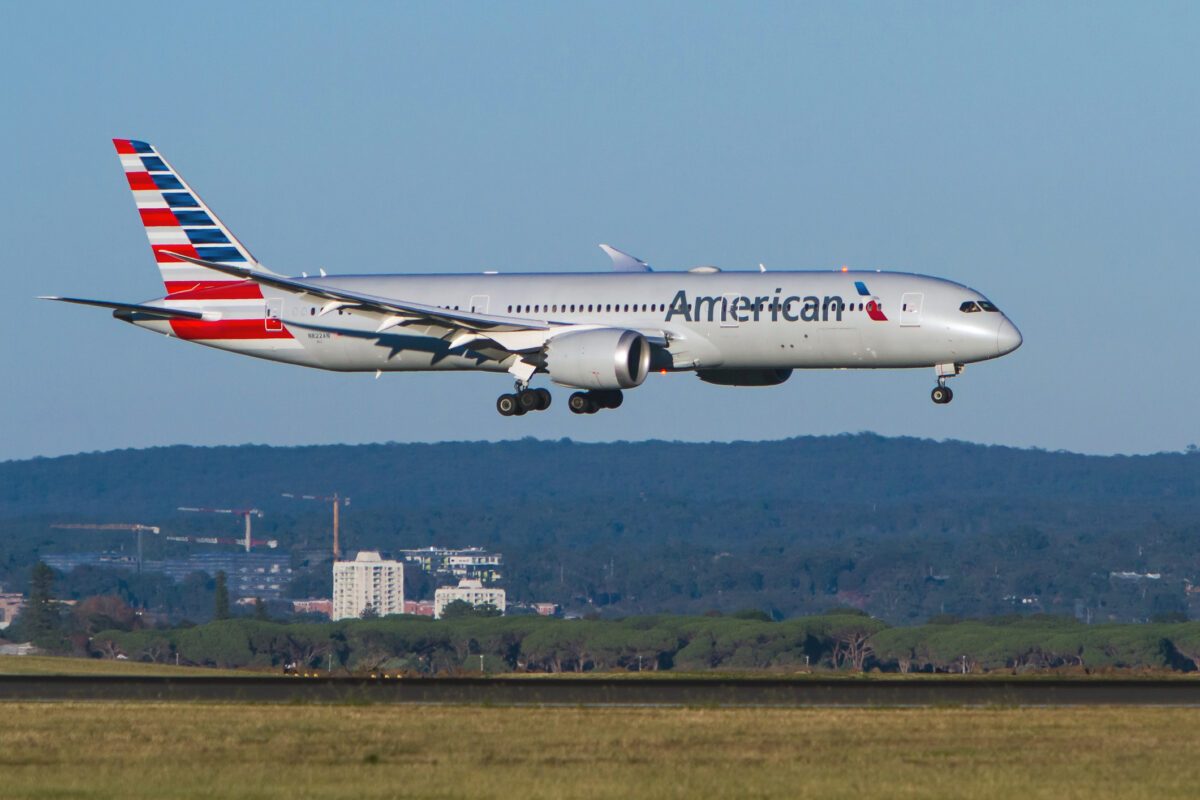
An American Airlines Boeing 787-9 Dreamliner diverted to Dublin Airport (DUB) after a reported odor developed onboard and most of the aircraft’s cabin crew began feeling ill during a transatlantic flight from Italy to the United States.

Flight AA719 departed Rome Fiumicino Airport (FCO) on July 25, 2026, for Philadelphia International Airport (PHL). Several hours into the flight, six of the nine flight attendants reportedly experienced symptoms that included dizziness and nausea.
The pilots abandoned the Atlantic crossing and diverted to Dublin Airport (DUB), where paramedics met the aircraft at the gate. American Airlines confirmed that flight attendants and one passenger were evaluated before being released.
Read our stories in your inbox
Two aviation newsletters. Zero fluff.
The airline has not identified the source of the odor or confirmed that the crew members were exposed to smoke, engine oil, hydraulic fluid or another contaminant.
American Airlines flight AA719

Trip Review: The Ritz-Carlton Philadelphia – Beautiful Building, Underwhelming Luxury
Six of Nine Flight Attendants Reportedly Became Ill
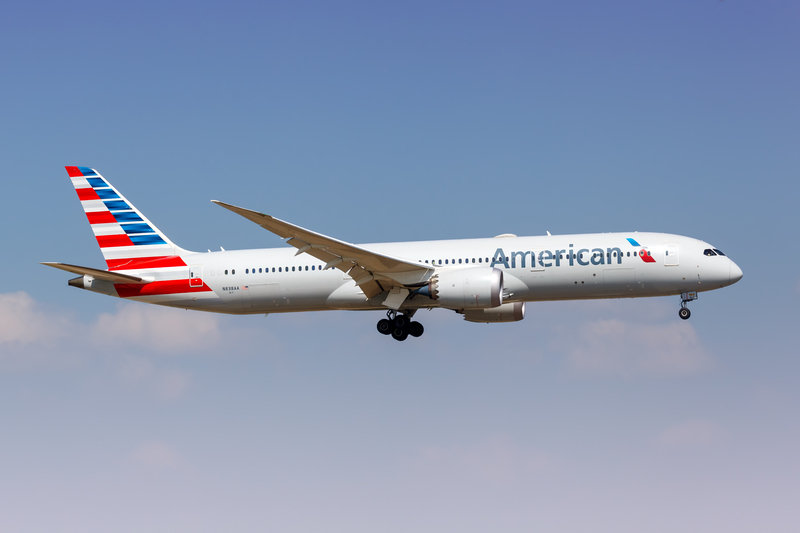
The aircraft involved was N840AN, a Boeing 787-9 operated by American Airlines.
Flight-tracking records for AA719 show that the Dreamliner departed Rome Airport (FCO) shortly before 1:00 p.m. local time and turned toward Ireland after several hours in the air.
Initial reports indicate that six of the nine flight attendants became dizzy or otherwise unwell. The flight crew advised air traffic controllers of a medical situation and requested a diversion to Dublin Airport (DUB).
The Boeing 787-9 landed safely on Runway 28L approximately six hours after leaving Rome Airport (FCO). There were no reports of injuries during the landing.

American Airlines provided the following explanation:
“American Airlines flight 719, from Rome (FCO) to Philadelphia (PHL), diverted to Dublin (DUB) due to a reported odor onboard. Paramedics met the aircraft at the gate out of an abundance of caution and the flight attendants and one customer were evaluated and subsequently released.”
The statement confirms that multiple flight attendants required medical evaluation but does not independently verify the reported figure of six affected cabin crew members. It also does not establish that the odor caused their symptoms.
Continuing to Philadelphia Was Not a Realistic Option
Flight attendants are not onboard primarily to provide meals and beverages. They are safety-critical crew members responsible for evacuations, firefighting, first aid, decompression response and managing emergencies throughout the passenger cabin.

Under Federal Aviation Administration cabin-crew requirements, an aircraft with more than 100 passenger seats must carry two flight attendants plus one additional flight attendant for every 50 seats, or portion of 50 seats, above 100.
N840AN is fitted with American’s original 285-seat Boeing 787-9 interior. That configuration requires a minimum of six flight attendants when passengers are onboard.
American assigned nine flight attendants to AA719, providing three crew members beyond the minimum regulatory requirement. If six were no longer capable of performing their safety duties, only three unaffected flight attendants would have remained—half the minimum required for the aircraft’s seating capacity.
Even if some of the sick crew members remained conscious and mobile, continuing for several additional hours over the North Atlantic would have presented an unacceptable operational risk. Their symptoms could have worsened, while the remaining crew might have been unable to manage a separate medical problem, cabin fire, decompression or evacuation.
Diverting to Dublin Airport (DUB) was therefore not simply a matter of making the affected employees more comfortable. The illness had the potential to compromise the aircraft’s required cabin-safety coverage.
American Cited an Odor, Not a Confirmed Fume Event
The terminology surrounding the incident requires care.
American Airlines said AA719 diverted because of a “reported odor onboard.” It did not describe the event as smoke, a chemical leak, contaminated cabin air or a toxic-fume exposure.
The FAA does not maintain a single formal definition of a “fume event”. It requires airlines to file Service Difficulty Reports when smoke, vapor or noxious odors enter an aircraft’s cockpit or passenger cabin.
An unusual odor can have numerous possible sources. These may include overheated electrical equipment, galley appliances, cleaning products, baggage contents, recirculation-fan components, lavatory systems or substances entering through the outside-air supply.
Odor alone does not identify the material involved or show that it was present at a harmful concentration.
The fact that several crew members developed similar symptoms makes the event significant and warrants a detailed investigation. However, no medical test results, air samples or maintenance findings have been released publicly.
Describing the incident as confirmed poisoning or toxic exposure would therefore go beyond the available evidence.
The Boeing 787 Uses a Different Cabin-Air System
The aircraft type is particularly relevant because the Boeing 787 does not supply cabin air in the same way as most commercial jetliners.
Conventional airliners typically draw compressed “bleed air” from their engines. That air is cooled, conditioned and mixed with filtered recirculated air before entering the cabin.
Under rare failure conditions, engine oil or hydraulic-fluid vapors can enter a conventional bleed-air system. The FAA says mechanical problems such as failed engine-oil seals or recirculation-fan bearings can introduce fumes into an aircraft cabin.
The 787 is the major exception.
Boeing designed the Dreamliner around a largely no-bleed architecture. Electrically powered cabin-air compressors draw fresh air through dedicated exterior intakes rather than taking the cabin’s air supply from the engines.
That design substantially reduces the possibility of engine-oil contamination entering the cabin through the traditional engine bleed-air route.
It does not mean an odor event is impossible on a 787. The aircraft still contains extensive electrical systems, ventilation equipment, galleys, lavatories, cargo compartments, cabin furnishings and recirculation fans. Outside odors can also be drawn through the dedicated air intakes.
The aircraft’s different architecture means investigators should not automatically assume that AA719 experienced the type of engine-related bleed-air contamination associated with other aircraft.
N840AN Is a 285-Seat Boeing 787-9
N840AN is a Boeing 787-9 with manufacturer serial number 40656. American Airlines received the aircraft in January 2019, making it approximately seven and a half years old at the time of the Dublin diversion.
The aircraft is powered by two General Electric GEnx-1B turbofan engines.
American’s 285-seat Boeing 787-9 configuration contains:
30 Flagship Business seats, 21 Premium Economy seats, 34 Main Cabin Extra seats and 200 standard Main Cabin seats.
Business Class is arranged with fully flat seats and direct aisle access, while Premium Economy uses a separate two-three-two cabin. Economy Class has the 787’s standard three-three-three layout.
Boeing lists the 787-9’s maximum range at approximately 8,300 nautical miles, although actual operating range depends on passenger load, cargo, weather, routing and fuel reserves.
The Rome Airport (FCO)-Philadelphia Airport (PHL) sector is well within the aircraft’s normal capabilities. There was no reported technical problem affecting the Dreamliner’s engines, flight controls or ability to remain airborne.
The diversion was driven by the cabin situation rather than the aircraft’s airworthiness being publicly declared compromised.
Why Dublin Was the Logical Diversion Airport
Dublin Airport (DUB) is one of the most suitable diversion points for westbound transatlantic flights departing continental Europe.
The airport has long runways, 24-hour operations, emergency services and extensive experience handling widebody aircraft. It is also an established American Airlines destination with local employees, contracted ground handlers and passenger-support arrangements.
For AA719, returning to Rome Airport (FCO) would have required flying back across a substantial portion of Europe. Continuing toward Philadelphia Airport (PHL) would have left the aircraft over the Atlantic for several more hours with much of its cabin crew unwell.
Dublin Airport (DUB) provided medical support while keeping the aircraft at a station familiar with American Airlines operations.
The flight landed normally rather than making an evacuation or stopping on the runway. Paramedics evaluated the affected crew members and one passenger at the airport, and American said everyone assessed was later released.
The Aircraft Remained in Dublin
AA719 did not continue to Philadelphia Airport (PHL) on July 25.
The onward Dublin Airport (DUB)-Philadelphia Airport (PHL) segment was canceled, leaving American Airlines to arrange alternative transportation and accommodations for affected travelers.
Flight records show that N840AN remained in Dublin through July 26. The aircraft departed Dublin Airport (DUB) for Philadelphia Airport (PHL) on July 27 as AA9601, an extra-section or recovery flight rather than the regularly scheduled AA719.
Its departure under a recovery flight number indicates that American’s maintenance personnel had inspected the aircraft and cleared it to return to service.
The publicly available information does not reveal what engineers found, whether any component was replaced or whether investigators identified the source of the odor.
N840AN was subsequently scheduled to return to normal passenger operations, including flights from Philadelphia Airport (PHL) to Miami International Airport (MIA) and Lisbon Airport (LIS).
A Diversion Creates More Than a Fuel Expense
A long-haul diversion creates costs extending far beyond the additional fuel used to reach the alternate airport.
American Airlines needed ground handling for a 285-seat widebody at Dublin Airport (DUB), medical assistance for crew members and a passenger, and support for travelers whose journey to Philadelphia Airport (PHL) had been interrupted.
The airline also lost the use of N840AN for its scheduled operations while the aircraft remained in Ireland.
Flight data shows that a planned Miami Airport (MIA)-Philadelphia Airport (PHL) operation assigned to N840AN on July 26 was canceled. Aircraft substitutions elsewhere in the network may also have been required.
Crew scheduling creates another complication. The original pilots and flight attendants were subject to duty-time and rest requirements, while several cabin crew members had become ill. A replacement crew needed to be available before the aircraft or passengers could continue.
A diversion involving an international flight also introduces immigration, customs, baggage and hotel-accommodation requirements. Passengers who had planned to connect at Philadelphia Airport (PHL) may have required completely new itineraries.
Those expenses are significant, but they are secondary to the decision to place the aircraft on the ground once the cabin crew’s ability to continue safely became uncertain.
Cabin-Odor Events Can Be Difficult to Diagnose
Investigating an odor event is not always straightforward.
By the time an aircraft lands, the odor may have disappeared. Ventilation can dilute a substance, while shutting down engines, electrical equipment or galley systems may remove the conditions that produced it.
Maintenance personnel may inspect air-conditioning equipment, cabin-air compressors, recirculation fans, electrical components, galleys, lavatories and cargo compartments. They can also review fault messages recorded by the aircraft’s onboard maintenance systems.
Investigators may compare where symptoms were first reported with the aircraft’s airflow zones. If one group of flight attendants became ill in a particular galley or cabin section, that location could help narrow the search.
Medical information can also be important. Similar symptoms among several people suggest a common exposure, but dizziness and nausea are not specific to a single chemical or mechanical problem.
The FAA says airlines must investigate reported smoke, vapor and noxious-odor incidents and correct identified problems before returning an aircraft to service.
N840AN’s departure from Dublin Airport (DUB) on July 27 indicates that American Airlines considered the aircraft safe to fly after completing its inspection. It does not reveal the investigation’s final conclusion.
The Crew’s Illness Was the Immediate Safety Issue
Much of the attention will focus on what produced the odor, but the immediate operational problem was the rapid reduction in available cabin crew.
With nine flight attendants assigned, AA719 began the journey with more crew members than the regulatory minimum. That additional staffing provided a valuable safety margin.
Had the flight operated with only the minimum six attendants and the same number become sick, the cabin could have been left without functioning safety personnel.
Even with three reportedly unaffected flight attendants remaining, the crew could not reasonably be expected to supervise a cabin with as many as 285 seats for the rest of a transatlantic flight.
The decision to divert demonstrates why long-haul flights frequently carry cabin staffing above the minimum requirement. Additional crew members support rest periods and service, but they also provide redundancy when illness or injury removes someone from duty.
Bottom Line
American Airlines flight AA719 diverted to Dublin Airport (DUB) on July 25 after a reported odor developed onboard and six of its nine flight attendants reportedly became ill.
The Boeing 787-9, registered N840AN, had been traveling from Rome Fiumicino Airport (FCO) to Philadelphia International Airport (PHL). It landed safely in Dublin, where paramedics evaluated the affected flight attendants and one passenger before releasing them.
American Airlines has not identified the source of the odor or confirmed that the incident involved toxic fumes, contaminated air or a specific aircraft system.
The 787’s cabin-air architecture is an important part of the investigation. Unlike most commercial airliners, the Dreamliner does not normally use engine bleed air for cabin pressurization. Electrically driven compressors bring fresh air into the aircraft through dedicated intakes, reducing the likelihood of a traditional engine-oil bleed-air event.
That does not eliminate other possible sources involving electrical systems, ventilation components, cabin equipment, cleaning chemicals or baggage.
The crew illness alone justified the diversion. A 285-seat Boeing 787-9 requires at least six flight attendants under U.S. regulations. If six of the nine assigned crew members were unable to perform their duties, the remaining three would have been insufficient for continued passenger operations.
N840AN remained at Dublin Airport (DUB) until July 27, when it returned to Philadelphia Airport (PHL) as recovery flight AA9601.
Until American Airlines releases its maintenance findings, the most accurate description remains a precautionary diversion caused by a reported cabin odor and the illness of multiple crew members—not a confirmed poisoning or identified fume event.
Keep reading FlyMag
Get the Daily Brief in the morning or the Route Watch weekly recap on Fridays. Or both.