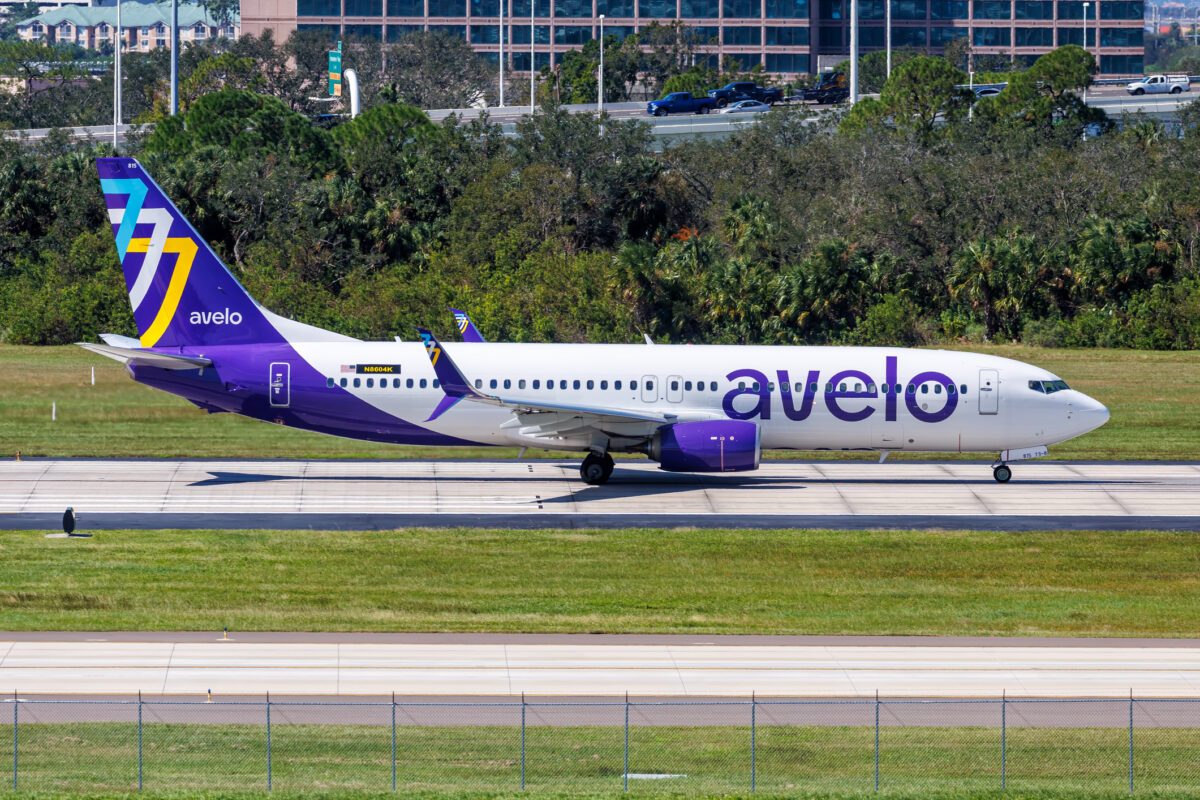
Avelo Airlines has eliminated its remaining international network, ending six routes from Hartford, Raleigh and Wilmington, North Carolina, as it shifts aircraft toward a smaller group of domestic bases.

The carrier’s current destination list covers the United States and Puerto Rico, with no foreign points. An August schedule extension through April 20, 2027, likewise listed only domestic and Puerto Rican destinations.
Avelo entered 2026 with six international routes in its network:
Read our stories in your inbox
Two aviation newsletters. Zero fluff.
- Hartford Bradley (BDL) to Cancun (CUN)
- Hartford Bradley (BDL) to Montego Bay (MBJ)
- Hartford Bradley (BDL) to Punta Cana (PUJ)
- Raleigh-Durham (RDU) to Montego Bay (MBJ)
- Raleigh-Durham (RDU) to Punta Cana (PUJ)
- Wilmington, North Carolina (ILM) to Punta Cana (PUJ)
The withdrawals leave Avelo without scheduled service beyond the United States and its territories. Flights to San Juan (SJU) and Aguadilla (BQN) remain domestic services for regulatory and operational purposes.

Hartford Accounted for Half the International Network
Avelo’s international expansion began at Hartford Bradley in November 2024, when the airline introduced twice-weekly flights to Cancun and Montego Bay. The routes were part of a broader plan to establish a two-aircraft operation at BDL alongside Avelo’s larger Connecticut base at New Haven (HVN).
Punta Cana followed in 2025, giving Hartford three Avelo international routes. The Connecticut Airport Authority said at the launch that the Punta Cana service would operate twice weekly and described it as Avelo’s third international route from BDL. At that point, the airport confirmed that the airline was also flying to Cancun and Montego Bay.
The Hartford flying was strategically different from Avelo’s core New Haven operation. BDL has full federal inspection facilities and can handle scheduled international arrivals, while HVN’s physical and operating constraints have kept Avelo’s network there focused on domestic points and Puerto Rico.
That made Hartford the practical gateway for Avelo’s Connecticut-based international ambitions, but it also required the carrier to support a separate operation at a larger airport. Once Avelo decided to concentrate around fewer bases, the three Caribbean and Mexican routes lost their place in the network.
North Carolina Base Closures Removed Three More Routes
Avelo launched Raleigh-Durham service to Montego Bay and Punta Cana in February 2025. Both were scheduled twice weekly and initially used a 149-seat Boeing Next-Generation 737. RDU said the flights took about three hours and were planned to operate seasonally from mid-November through September.
The two routes were notable because Avelo was the only airline providing nonstop service from RDU to either destination when they began. The Raleigh-Durham Airport Authority described them as a new phase for Avelo’s local base, where two aircraft and nearly 100 employees were stationed.
Avelo also briefly linked RDU with Nassau (NAS), beginning in June 2025. That service disappeared before the carrier’s final six-route international portfolio took shape, which is why Nassau is not included among the routes removed during the 2026 restructuring.
At Wilmington, Avelo announced twice-weekly Punta Cana flights beginning December 24, 2025. The route was ILM’s first scheduled commercial international service and followed preparations for processing arriving passengers through Customs and Border Protection. The airport’s original announcement said two Boeing 737s were then based at ILM and that Punta Cana would become the carrier’s 17th destination from the airport.
The service proved short-lived. Less than two weeks after its scheduled launch, Avelo announced that it would close both its RDU and ILM bases.
Fleet Simplification Drove the Network Reset
The international cuts form part of a much larger balance-sheet and fleet restructuring announced January 6. Avelo said it would close aircraft bases at RDU, ILM and Mesa (AZA), while concentrating operations around New Haven, Philadelphia-area Wilmington (ILG), Concord (USA) and Lakeland (LAL). The carrier also planned a new base at Dallas/McKinney (DTX).
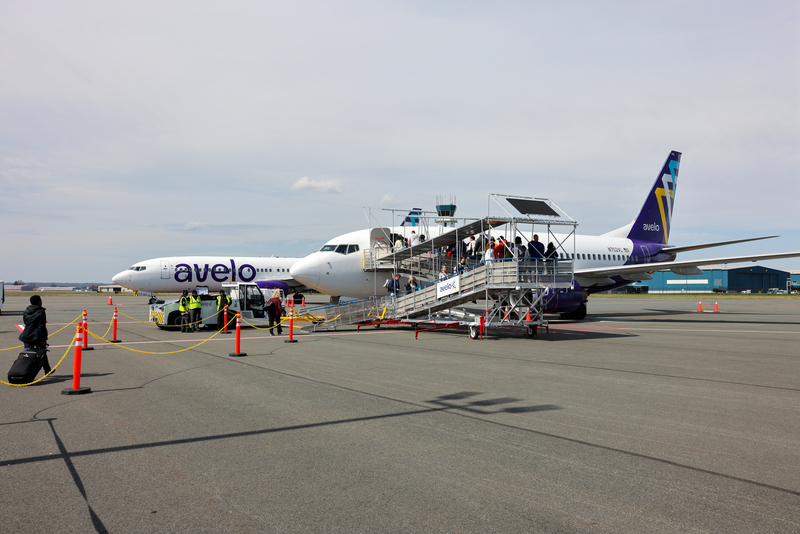
In the same announcement, Avelo said it would remove six Boeing 737-700s, leaving a fleet centered on the larger and more efficient Boeing 737-800. The airline described the changes as necessary to simplify its network and fleet following a recapitalization.
By April, Avelo reported a 15-aircraft fleet consisting of 14 189-seat Boeing 737-800s and one 149-seat Boeing 737-700. That compares with 22 aircraft cited in company material during 2025. The reduction removed much of the smaller-gauge capacity used on routes such as RDU’s Caribbean flights.
The 737-800 is well suited to Avelo’s high-density, low-frequency model, but its 189 seats raise the traffic requirement on thin leisure markets. Concentrating the type on domestic routes from established bases gives the airline more opportunities to rotate aircraft across multiple markets without the operational requirements attached to international flying.
Bottom Line
The withdrawal marks a sharp reversal for an airline that moved from no scheduled international service to four foreign destinations in less than a year. Avelo’s initial approach paired low frequencies with limited nonstop competition, but the routes were spread among three airports outside the four bases it ultimately chose to retain. Once RDU and ILM were removed as crew and aircraft bases and Hartford was dropped from the core structure, preserving the international schedule would have required aircraft to operate away from Avelo’s preferred network pattern.
The fleet decision is equally important. Avelo’s 149-seat Boeing 737-700s offered a more forgiving capacity level for twice-weekly leisure routes, particularly during shoulder periods. Building the operation around 189-seat Boeing 737-800s improves fleet commonality and lowers unit costs, but it also pushes the network toward markets capable of consistently absorbing more seats. Domestic routes from New Haven, Concord, Lakeland, Philadelphia-area Wilmington and the new McKinney base provide a broader mix of leisure, visiting-friends-and-relatives and regional demand.
Avelo can return to international flying without introducing a new aircraft type, and its eventual Embraer 195-E2 fleet could offer a different capacity profile for thinner markets. For now, however, the company is signaling that base scale, aircraft utilization and network simplicity take priority over maintaining a small international presence. Any future return is more likely to come from a mature core base than through another collection of isolated, twice-weekly routes.