Raleigh-Durham International Airport (RDU) is about to enter a new phase in its international development, with Aer Lingus launching nonstop service to Dublin Airport (DUB) on April 13. The five-weekly route will make the Irish flag carrier the fifth long-haul airline serving RDU and, more importantly, will give the Research Triangle its first direct connection to Ireland.

That matters because this is not a vanity route or a one-off seasonal experiment. It is a year-round strategic addition that strengthens RDU’s transatlantic relevance while giving Aer Lingus another well-targeted North American market built around business travel, visiting-friends-and-relatives demand, and onward European connectivity.
Why Raleigh-Durham Fits Aer Lingus So Well
Aer Lingus has spent the past several years expanding deeper into North America with a very specific playbook: underserved but high-value markets, strong local economic fundamentals, and aircraft capable of making thinner long-haul routes work without widebody risk.
Read our stories in your inbox
Two aviation newsletters. Zero fluff.
RDU fits that model extremely well. The airport sits at the heart of the Research Triangle, one of the most important life sciences, technology, and higher-education clusters in the United States. That gives the route a much broader base than leisure demand alone. Dublin does not just offer Ireland. It also offers a practical gateway into Britain and continental Europe through the Aer Lingus network and partner connectivity.
In short, this is the kind of market where Aer Lingus has increasingly found success: large enough to matter, but not so overserved that the airline is just becoming another player in an already crowded field.
The Airbus A321XLR Is the Real Enabler
The aircraft is a major part of the story.
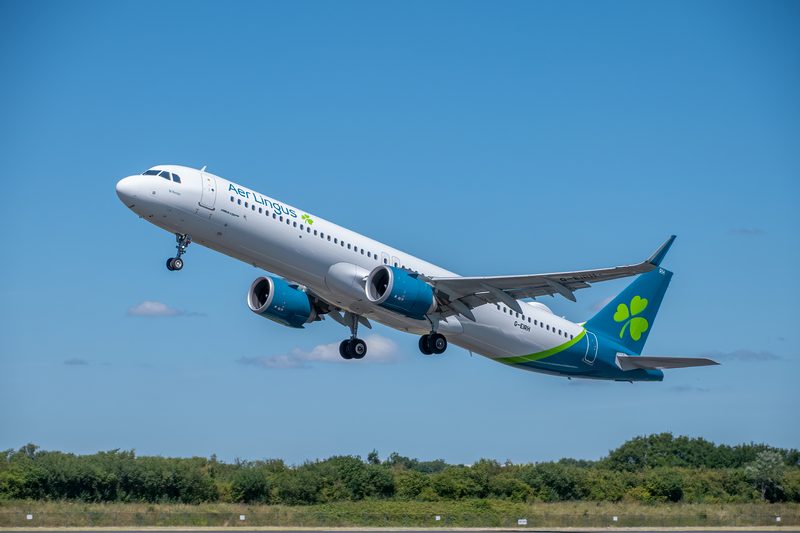
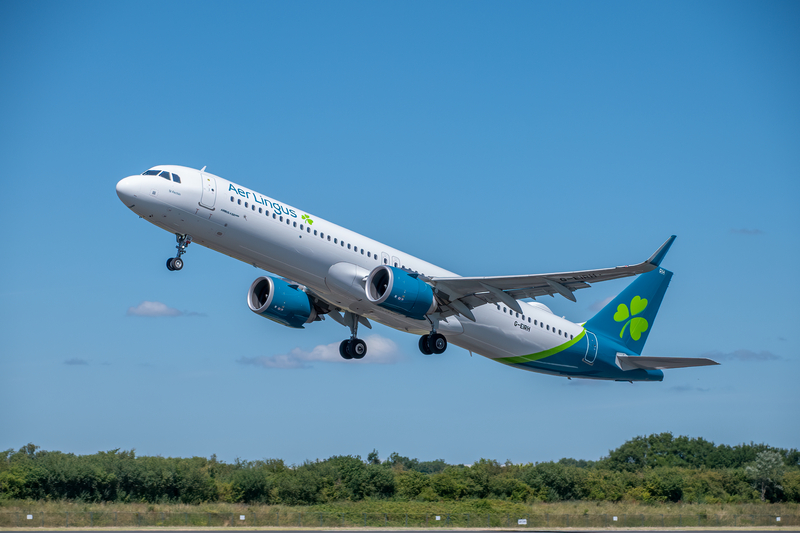
Aer Lingus will operate the route with the Airbus A321XLR, the newest long-range narrowbody in its fleet. In Aer Lingus configuration, the aircraft seats 184 passengers, with 16 full-flat Business Class seats and 168 Economy seats. Airbus lists the type with a range of up to 4,700 nautical miles, or about 8,700 kilometers.
That is exactly why the route works. The A321XLR gives Aer Lingus widebody-style reach with narrowbody economics, allowing it to launch routes like RDU-DUB without having to fill a much larger Airbus A330 every day. For airports like RDU, this aircraft is transformative. It makes long-haul service possible in markets that previously looked promising, but not quite large enough.
Dublin’s Preclearance Advantage Gives the Route Extra Value
The operational proposition is stronger because of what happens in Dublin before the aircraft even departs.
Passengers traveling from DUB to RDU will use the U.S. Customs and Border Protection preclearance facility at Dublin Airport. That means they clear U.S. immigration, customs, and agriculture checks before departure and arrive in North Carolina as domestic passengers. In Europe, only Dublin (DUB) and Shannon (SNN) currently offer full U.S. preclearance.
For travelers, that is more than a convenience. It makes arrival at RDU faster and simpler, and for business travelers in particular, that can be a meaningful competitive advantage.
The Schedule Is Built for Business and Connections
Aer Lingus has filed the route at five weekly frequencies, operating on Mondays, Tuesdays, Thursdays, Fridays, and Sundays.
The planned schedule is also well judged. Westbound, the service is set to leave Dublin in the mid-afternoon and arrive at RDU in the early evening. Eastbound, it departs North Carolina in the evening and reaches Dublin the following morning. That pattern is useful for both point-to-point traffic and onward connections across the Aer Lingus network.
It also reflects the typical transatlantic logic of the airline: daytime westbound, overnight eastbound, and connection opportunities at both ends.
RDU’s Long-Haul Portfolio Is Becoming Much More Credible
Aer Lingus is not arriving in isolation. It is joining an increasingly serious transatlantic lineup at RDU.
The airport already has nonstop service to London Heathrow Airport (LHR) on American Airlines, Paris Charles de Gaulle Airport (CDG) on Air France, Frankfurt Airport (FRA) on Lufthansa, and Reykjavík Keflavík Airport (KEF) on Icelandair. With Dublin now added, RDU’s European portfolio becomes broader, more balanced, and more useful for both corporate and leisure travelers.
That is why this launch matters beyond the route itself. It reinforces RDU’s position as one of the more interesting second-tier transatlantic airports in the United States, especially for a metropolitan area whose long-haul growth has accelerated materially over the past decade.
This Is a Better Story Than “Fifth New Long-Haul Airline”
One important correction to the original framing: Aer Lingus is becoming RDU’s fifth long-haul airline, not its “fifth new long-haul airline.”
That distinction matters because the airport’s international growth is not about novelty anymore. It is about accumulation. Each additional airline strengthens the network, improves the airport’s profile, and makes future long-haul service easier to justify. Aer Lingus is joining a market that is already proving it can support sustained transatlantic depth.
Bottom Line
Aer Lingus’ new RDU-DUB route is exactly the kind of long-haul addition that defines where transatlantic growth is heading.
It pairs a high-value U.S. market with a strong European gateway, uses the Airbus A321XLR in the way the aircraft was designed to be used, and gives Raleigh-Durham International Airport (RDU) its first nonstop connection to Ireland. Just as importantly, it strengthens RDU’s standing as a maturing long-haul airport rather than a one-route success story.
For Aer Lingus, it is another carefully chosen North American market. For RDU, it is another sign that the airport’s international growth is becoming structural rather than opportunistic.
Keep reading FlyMag
Get the Daily Brief in the morning or the Route Watch weekly recap on Fridays. Or both.