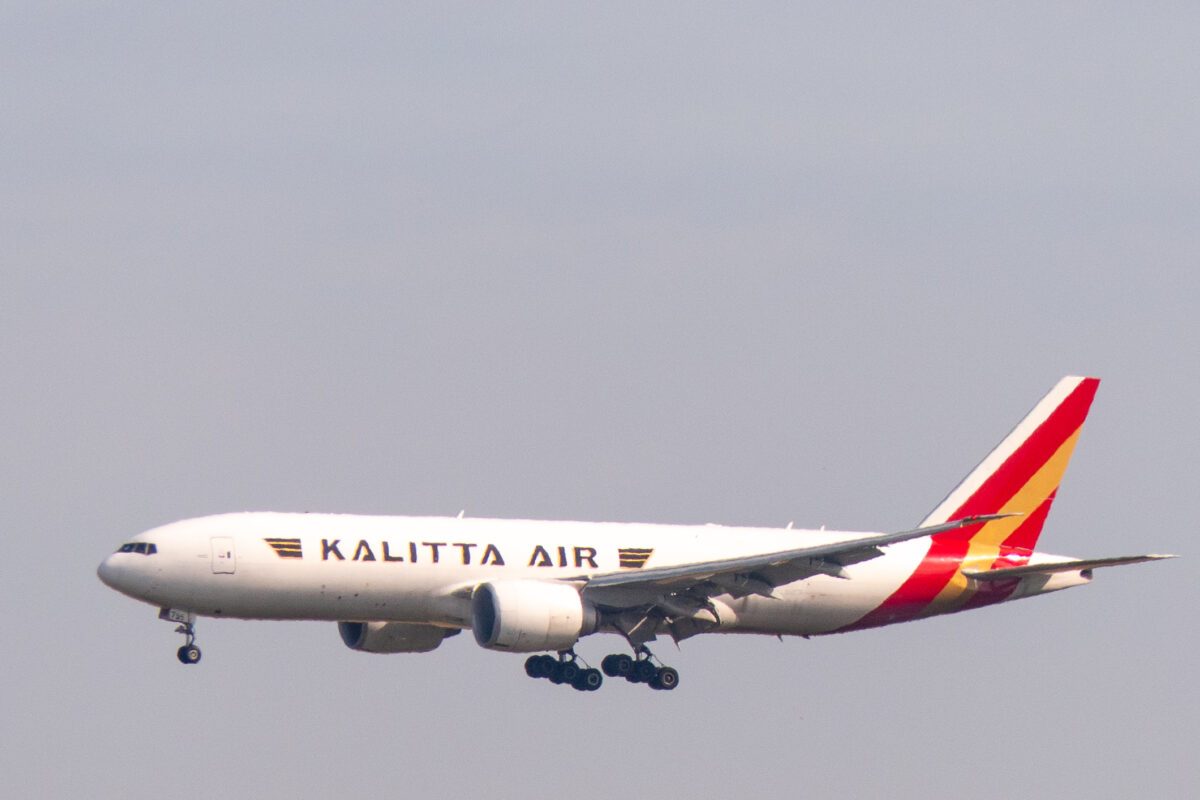
Kalitta Air has repositioned one of its Boeing 777-300ERSF converted freighters to its maintenance complex in Oscoda, Michigan, after the aircraft suffered a tail strike during an attempted landing at Cincinnati/Northern Kentucky International Airport (CVG).
The aircraft, registered N778CK, was operating Kalitta Air flight K4 264 from Brussels Airport (BRU) to Cincinnati Airport (CVG) on July 19, 2026. Its lower rear fuselage contacted Runway 36R as the crew initiated a go-around, producing a highly visible shower of sparks.
The Boeing 777 climbed away safely and returned for another approach, landing at Cincinnati Airport (CVG) approximately 25 minutes later. No injuries were reported among the flight crew.
Read our stories in your inbox
Two aviation newsletters. Zero fluff.
The Federal Aviation Administration has opened an investigation, while Kalitta Air removed the aircraft from commercial service for inspection and evaluation.
Tail Strike Occurred During the First Landing Attempt
N778CK departed Brussels Airport (BRU) at approximately 5:47 p.m. local time for the transatlantic cargo flight to Cincinnati Airport (CVG).
The service is displayed by flight-tracking platforms as K4264, representing Kalitta Air’s two-character K4 airline code followed by flight number 264. The aircraft spent approximately eight hours and 32 minutes in the air before reaching Cincinnati.
During the first landing attempt on Runway 36R, the crew initiated a go-around. Video recorded near the airport showed the underside of the rear fuselage contacting the runway as the aircraft transitioned back into a climb.
The FAA said Kalitta Air flight 264 landed safely at approximately 8:15 p.m. local time after returning for a second approach. Kalitta Air Chief Operating Officer Heath Nicholl confirmed that no crew members were injured and that the aircraft had been withdrawn from service for inspection.
Kalitta Air has not released details about the approach, aircraft pitch angle, touchdown sequence or cockpit indications. The cause therefore remains undetermined.
A tail strike during a go-around can occur under several different circumstances, particularly when the maneuver begins close to the runway and the aircraft’s pitch increases before it has established a positive climb. However, applying any specific explanation to N778CK before investigators release their findings would be speculation.
N778CK Flew to Oscoda Two Days Later
After remaining at Cincinnati Airport (CVG) for approximately two days, N778CK was repositioned to Oscoda-Wurtsmith Airport (OSC) in northern Michigan.
The aircraft operated as flight K4 9778, departing Cincinnati Airport (CVG) at 10:36 p.m. local time on July 21. It landed at Oscoda Airport (OSC) at approximately 11:44 p.m. following a flight of one hour and nine minutes.

The recorded flight history for N778CK confirms that it flew directly from CVG to OSC without carrying out another commercial cargo operation.
Oscoda is a logical destination because it is home to one of Kalitta Air’s principal maintenance operations. The company uses several hangars at the former Wurtsmith Air Force Base and employs personnel capable of supporting Boeing 747, 767 and 777 aircraft.
Kalitta’s Oscoda maintenance training center provides technical instruction covering Boeing 777 systems, avionics, engines, inspections and structural maintenance. The wider complex supports both Kalitta’s own fleet and aircraft maintained for other customers.
A Ferry Flight Does Not Mean the Aircraft Was Undamaged
Moving N778CK from Cincinnati Airport (CVG) to Oscoda Airport (OSC) does not necessarily mean the aircraft had already been fully repaired or cleared for normal commercial operation.
Before a damaged aircraft is repositioned, engineers must determine whether it can complete the flight safely. Operating restrictions can be imposed involving weight, altitude, pressurization, speed, weather or the number of people aboard.
The FAA can also issue a special flight permit, commonly called a ferry permit, for a U.S.-registered aircraft that does not currently meet every applicable airworthiness requirement but is still capable of safe flight.
It has not been publicly confirmed whether N778CK required such a permit. The flight to Oscoda could also have been conducted after temporary work or inspections established that the aircraft met the conditions required for the short repositioning sector.
The absence of cargo substantially reduces aircraft weight and gives engineers greater flexibility when planning a maintenance ferry flight.
Tail-Strike Inspections Can Extend Beyond Visible Damage
The sparks visible during the incident do not reveal the full extent of any damage.
The immediate inspection would likely begin around the tail-skid area, lower aft fuselage skin, frames, stringers and other structural components near the point of contact. Engineers may also examine the pressure vessel and nearby internal structure for deformation, cracking or loads transferred beyond the visibly affected area.
Damage to the external skin may be relatively localized, but the forces generated by runway contact can travel through supporting structural elements. Manufacturers therefore prescribe detailed aircraft maintenance manual procedures for inspecting an aircraft after a confirmed or suspected tail strike.
Depending on what engineers find, repairs could range from replacing sacrificial tail-skid components and damaged skin panels to completing more extensive structural work involving frames or internal reinforcement.
The 777-300ER’s long fuselage makes pitch management particularly important. At 242 feet and four inches long, the aircraft is nearly 33 feet longer than the 777-200F and has less geometric tail clearance at comparable pitch attitudes.
That does not make tail strikes common or inevitable, but it means crews must closely manage pitch during rotation, landing and low-altitude go-arounds.
One of the First Boeing 777-300ERSF Freighters
N778CK is not a factory-built Boeing freighter. It began its life as a passenger-carrying Boeing 777-300ER before undergoing a major passenger-to-freighter conversion.
The aircraft, manufacturer serial number 32789, made its first flight in March 2005 and was delivered to Emirates as A6-EBB. It spent much of its passenger career carrying travelers across the Dubai-based airline’s global network.
The airframe was later converted by Israel Aerospace Industries under the 777-300ERSF program, marketed as the “Big Twin.” The work involved removing the passenger interior, reinforcing the main deck, installing a large cargo door, strengthening the fuselage and floor structure, closing passenger windows and adding cargo-handling and fire-protection systems.
N778CK was among the first two 777-300ERSFs delivered to Kalitta Air in September 2025. One of those aircraft was the prototype used during the certification program.
The distinction between aircraft age and conversion age is important. N778CK is one of the world’s newest converted 777 freighters, but the underlying aircraft is more than 21 years old.
Passenger-to-freighter programs are specifically designed to give midlife aircraft a second commercial role. Before returning to service, the airframe undergoes extensive modification, inspection and certification intended to support many additional years of cargo operations.
Kalitta Was the Big Twin’s Launch Operator
Kalitta Air became the launch operator for the 777-300ERSF after committing to seven aircraft through lessor AerCap.
The first two were delivered to the carrier’s Oscoda Airport (OSC) facility in September 2025, with commercial operations beginning shortly afterward.
The aircraft is central to Kalitta’s longer-term plan to replace at least part of its Boeing 747-400 freighter fleet. Although the 747 retains advantages for extremely heavy, tall or oversized cargo, the twin-engine 777 offers substantially lower fuel consumption and maintenance requirements.
Israel Aerospace Industries says the 777-300ERSF offers 25% more cargo volume than the factory-built Boeing 777F while fitting within a similar airport footprint. IAI advertises a maximum payload of as much as 105 metric tons, depending on aircraft configuration and operating conditions.
Kalitta and AerCap have published a more conservative certified operating figure of approximately 100 metric tons, or 220,000 pounds, together with approximately 811 cubic meters of cargo volume.
The distinction between volume and payload is particularly important in the express freight business.
The shorter 777F can carry dense, heavy cargo extremely efficiently. The longer 777-300ERSF provides substantially more internal space, making it attractive for lower-density shipments such as parcels, e-commerce packages and consumer goods that can fill an aircraft before reaching its structural weight limit.
The Aircraft Was Supporting DHL Express Operations
N778CK has regularly operated on behalf of DHL Express, with Cincinnati Airport (CVG) serving as a major base for the aircraft.
Cincinnati is home to DHL’s principal hub in the Americas and one of the express carrier’s most important sorting facilities worldwide. Cargo arriving from Europe, Asia and other regions can be transferred at CVG to flights serving destinations throughout North and South America.
The Brussels Airport (BRU)-Cincinnati Airport (CVG) market is therefore an important cargo corridor rather than a conventional airline route built primarily around demand between two individual cities.
Brussels Airport (BRU) is one of DHL’s major European gateways, while Cincinnati Airport (CVG) provides access to the company’s extensive American network.
Removing a 777-300ERSF from that operation creates a meaningful capacity gap. Its volume is especially valuable to an express carrier handling large numbers of relatively lightweight parcels.
Kalitta can substitute another 777 or Boeing 747, but doing so may require changes elsewhere in its schedule. Cargo aircraft frequently operate multi-day rotations covering several continents, meaning the loss of one airframe can affect flights well beyond the route on which the incident occurred.
Exact Kalitta Fleet Figures Require Caution
Published fleet totals for Kalitta Air vary considerably depending on whether stored aircraft, aircraft operated under crew-maintenance-insurance agreements and recently delivered 777-300ERSFs are included.
Kalitta’s own website identifies the Boeing 747-400F, factory-built 777-200F and converted 777-300ERSF as its three principal fleet types. The company says it operates more than 25 aircraft, although some of the detailed figures on its fleet page appear not to reflect every recent delivery. (kalittaair.com)
For that reason, claims that the airline operates exactly 22 Boeing 747s and 15 Boeing 777s should be treated cautiously unless they specify active, stored, leased or managed aircraft.
What is clear is that the 777-300ERSF remains a small and strategically important part of Kalitta’s operation. Each aircraft represents substantial cargo volume and is intended to reduce the airline’s dependence on aging four-engine 747s.
No Cause Has Been Established
The FAA investigation will examine the aircraft’s flight path, cockpit data, crew actions, weather, approach stability and the point at which the go-around was initiated.
Investigators may also review information from the flight data recorder and cockpit voice recorder, along with runway markings, aircraft damage and operational documentation.
The original report included a reference to a tail strike caused by a significant takeoff-weight miscalculation. That description appears to concern a separate incident and should not be applied to N778CK.
There has been no public indication that the Kalitta aircraft was improperly loaded, that its takeoff weight was miscalculated or that cargo loading played any role in the Cincinnati Airport (CVG) event.
Similarly, the decision to send the aircraft to Oscoda Airport (OSC) does not establish that the damage is either minor or severe. It only confirms that Kalitta considered its specialized Michigan maintenance base the appropriate location for further work.
Bottom Line
Kalitta Air’s Boeing 777-300ERSF, registered N778CK, suffered a confirmed tail strike during a go-around at Cincinnati/Northern Kentucky International Airport (CVG) on July 19.
The aircraft had arrived from Brussels Airport (BRU) as flight K4 264. Its rear fuselage contacted Runway 36R, producing sparks before the crew climbed away and returned for a safe landing. No injuries were reported.
Two days later, N778CK operated an empty repositioning flight from Cincinnati Airport (CVG) to Kalitta’s maintenance facility at Oscoda-Wurtsmith Airport (OSC), where the aircraft can undergo a detailed structural inspection and any required repairs.
The incident is especially notable because N778CK is one of the first Boeing 777-300ERSFs placed into commercial service. Although the airframe was originally delivered to Emirates in 2005, it completed its conversion and joined Kalitta only in September 2025.
The FAA investigation remains underway, and neither the agency nor Kalitta Air has identified the cause. Until those findings are released, explanations involving aircraft loading, pilot technique or the timing of the go-around remain unconfirmed.
Keep reading FlyMag
Get the Daily Brief in the morning or the Route Watch weekly recap on Fridays. Or both.