American Airlines is about to turn a routine South America departure into one of the more unusual widebody operations on its network.

Between late October and mid-November, selected departures from Ministro Pistarini International Airport in Buenos Aires (EZE) will no longer launch nonstop to the United States. Instead, the airline has filed a short intermediate stop at Carrasco International Airport in Montevideo (MVD), creating a 142-mile sector that is tiny by Boeing 777-300ER standards and highly unusual for a flagship long-haul aircraft.
For airline professionals, the novelty is real, but the operational logic matters more. This is not schedule creativity for its own sake. It is a response to a short but severe runway constraint at Argentina’s main long-haul gateway.
Read our stories in your inbox
Two aviation newsletters. Zero fluff.
A 777-300ER hop that barely gets started before it ends
American’s latest filing shows two affected services from Buenos Aires (EZE). On one of its two daily departures to Miami International Airport (MIA), flight AA908 will operate EZE-MVD-MIA between October 25 and November 11. Over the same window, AA954 from Buenos Aires (EZE) to New York John F. Kennedy International Airport (JFK) will also operate via Montevideo (MVD).
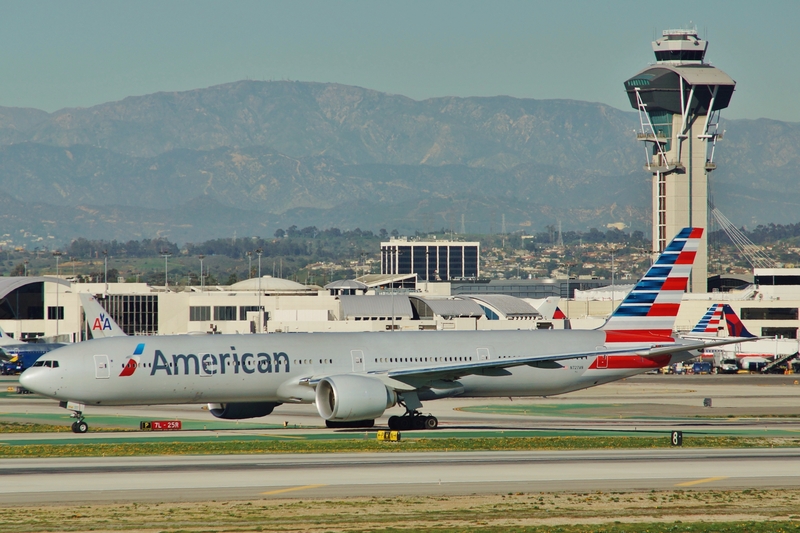
That makes the first leg the attention-grabber. EZE-MVD is only about 142 miles, or 229 kilometers, which is an exceptionally short sector for a Boeing 777-300ER. At American, the 777-300ER is not a marginal aircraft. It is the airline’s top-end long-haul passenger widebody, configured with 304 seats, including eight Flagship First suites and 52 Flagship Business seats. It is normally associated with dense premium-heavy international flying, not a brief tag flight across the Río de la Plata.
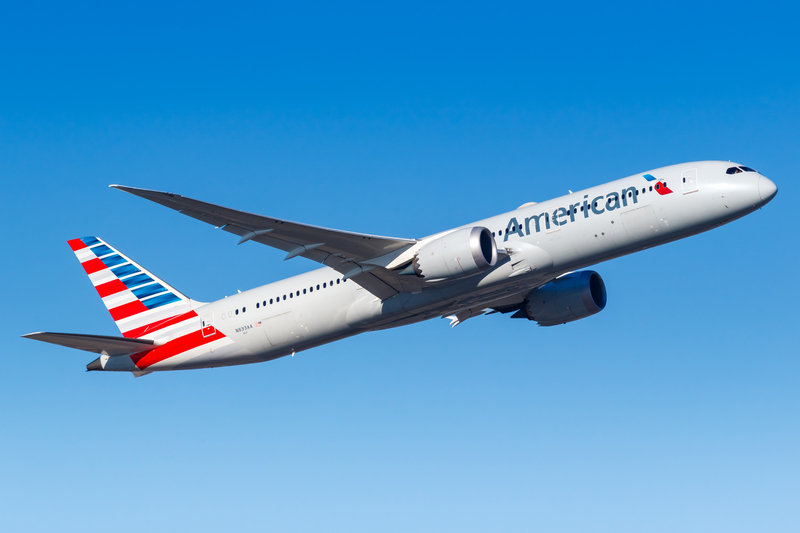
What makes the filing more interesting is what has not changed, at least not yet. American’s second Buenos Aires (EZE) to Miami (MIA) flight, AA934, remains filed nonstop with the Boeing 787-8. That aircraft is still a widebody, but at American it is materially smaller, with 234 seats, and gives the airline a lighter, lower-capacity option than the 777-300ER. The split suggests American believes the 787-8 can still be made to work nonstop from EZE, while the heavier 777-300ER needs a different solution.
Why Montevideo makes operational sense
The reason sits at Ezeiza.
Aeropuertos Argentina has already laid out the critical window for the airport’s runway works. From October 25 to November 11, operations at Ministro Pistarini International Airport (EZE) will be restricted to runway 11/29, and that runway will be available at a reduced usable length of 1,850 meters instead of its usual 3,300 meters. That is a dramatic reduction for an airport built around long-haul international flying.
In that environment, American’s Montevideo plan is easy to read. The airline can depart Buenos Aires (EZE) with a lighter fuel load, make the 142-mile hop to Carrasco International Airport (MVD), and then continue to Miami (MIA) or New York John F. Kennedy (JFK) after taking on the fuel it could not comfortably carry out of EZE during the runway restriction. It is not elegant, but it is practical.

And that is what makes this more than a curiosity. The EZE-MVD tag is a workaround for a runway-performance problem, not a network experiment.
The airport project is bigger than the detour
This is also why the American filing matters beyond one unusual sector.
The runway restriction is part of a much larger modernization program at Ministro Pistarini International Airport (EZE), with Aeropuertos Argentina investing more than $100 million in airside and terminal works. The package includes rehabilitation of the secondary runway 17/35 and its intersection with the main 11/29 runway, plus taxiway, lighting, apron, cargo and terminal upgrades.
For the airport, that investment is strategically important. For airlines, the timing is painful. The most disruptive phase falls squarely on a narrow but intense late-October to mid-November window, precisely when long-haul carriers need dependable runway performance for widebody departures.
That is why American’s reroute deserves attention. It is an early example of how airlines are deciding whether to preserve service through a nearby workaround or simply step away until the runway is fully available again.
American is choosing a workaround where others are choosing a pause
That contrast is one of the most important parts of the story.
Delta Air Lines and United Airlines have both filed short-term suspensions to Buenos Aires (EZE) over the same runway-work period. Delta is pulling its Atlanta Hartsfield-Jackson International Airport (ATL) and New York John F. Kennedy International Airport (JFK) services, while United is suspending its Houston George Bush Intercontinental Airport (IAH) route.
American, by contrast, is keeping more of its Buenos Aires operation alive. One Miami International Airport (MIA) flight remains filed nonstop with the Boeing 787-8. The 777-300ER departures to Miami (MIA) and New York John F. Kennedy (JFK) get the Montevideo (MVD) fuel stop. Operationally, that is a more complicated answer than a suspension, but commercially it preserves presence in the market and avoids abandoning Buenos Aires entirely during the restriction window.
That choice says something important about network priorities. Airlines do not add a 142-mile widebody sector unless they think the market is worth the extra complexity.
Why this small segment says something bigger about EZE
The real takeaway is not the mileage. It is what the mileage reveals.
When a major international gateway such as Ministro Pistarini International Airport (EZE) loses that much usable runway length, long-haul operations immediately become a performance problem. Some carriers can downgrade aircraft. Some can cut payload. Some can use a nearby station such as Montevideo (MVD) as a technical stop. Others simply suspend service because the economics stop making sense.
American has chosen the most operationally inventive of those options. It preserves the long-haul sectors, protects schedule continuity to Miami (MIA) and New York John F. Kennedy (JFK), and uses Montevideo (MVD) as a pressure valve. For passengers, it will look odd. For network planners, it is entirely rational.
Bottom Line
A 142-mile Boeing 777-300ER segment between Buenos Aires (EZE) and Montevideo (MVD) is exactly the kind of schedule filing that grabs attention. But the more useful reading is that it exposes just how disruptive Ezeiza’s runway works will be for long-haul airlines.
American Airlines is not flying a 777-300ER to Uruguay because it wants a novelty route. It is doing it because Ministro Pistarini International Airport (EZE) is about to become a constrained departure point for large widebodies, and Montevideo (MVD) offers a practical escape valve. In the same window, Delta and United have chosen to suspend flights instead.
That makes this less of a trivia story and more of an operations story. The short sector may be the headline. The real issue is runway performance, schedule resilience, and how different airlines choose to protect their South America networks when a major hub suddenly becomes harder to launch from.