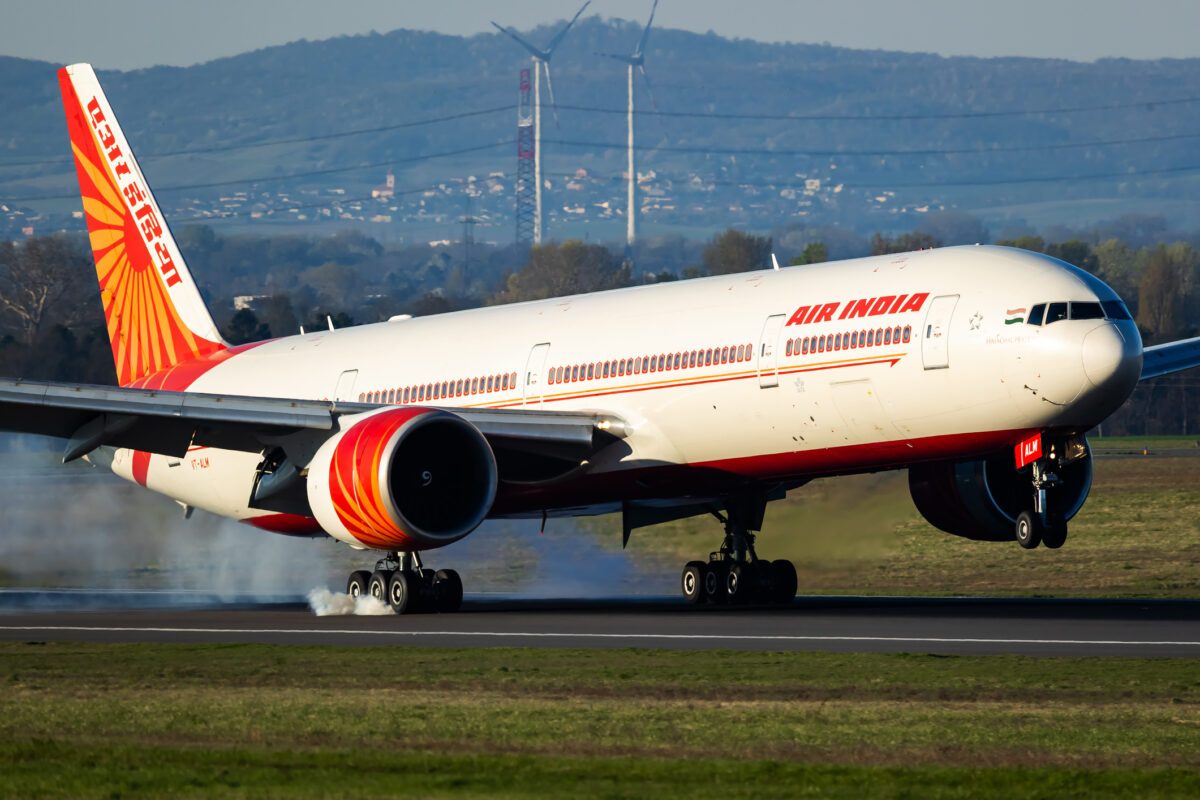
Air India will open a nonstop link between Mumbai and Toronto in October, adding a second Indian gateway to its growing operation at Toronto Pearson (YYZ).

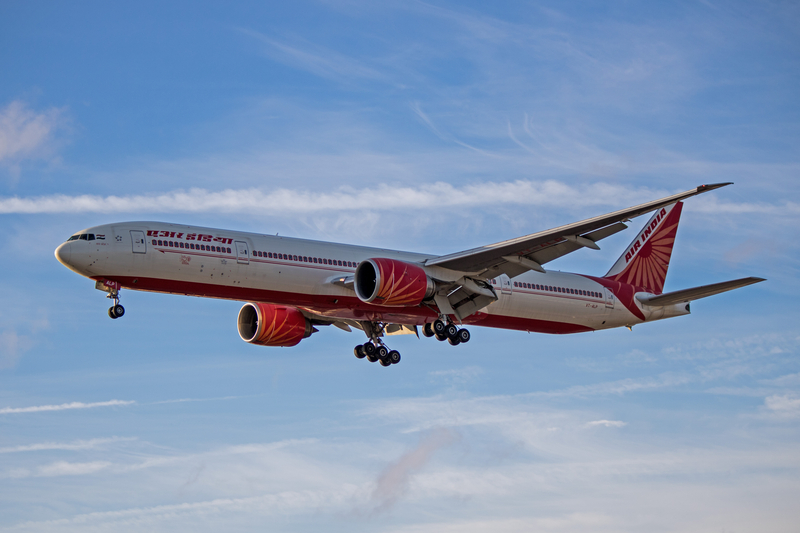
The seasonal Mumbai-Toronto service will begin October 25, 2026, and run through March 26, 2027. Air India will operate three round trips each week with an upgraded Boeing 777-300ER, placing nearly 2,000 additional seats into the market when both directions are counted.
Air India will be the only airline flying nonstop between Mumbai (BOM) and Toronto during the winter season. The route also gives the carrier a direct Mumbai entry into Canada rather than requiring passengers to connect over Delhi or another international gateway.
Read our stories in your inbox
Two aviation newsletters. Zero fluff.
Flights Will Run Three Times a Week
Flight AI193 will leave BOM at 4:00 a.m. on Wednesdays, Fridays and Sundays, arriving at YYZ at 10:00 a.m. local time. The return, AI192, will depart Toronto at 12:30 p.m. on the same three days and reach Mumbai at 2:10 p.m. the following afternoon.
The westbound block time will change when Toronto moves from daylight saving time to standard time. Based on the published local schedule, AI193 is timed at approximately 15 hours and 30 minutes at the beginning of the season and 16 hours and 30 minutes after the clock change. The scheduled eastbound journey is shorter, reflecting the prevailing winds on the North Atlantic sector.
The timing gives Air India an early-morning departure bank at Mumbai and a late-morning arrival in Toronto. In the opposite direction, the early-afternoon departure from YYZ reaches BOM in time for onward domestic and regional connections later in the day.
Air India has identified Ahmedabad, Amritsar, Bengaluru, Chandigarh, Chennai, Hyderabad, Kochi, Ludhiana and Vadodara among the markets that can connect through its Indian hubs. The Mumbai operation is particularly relevant for passengers whose journeys begin or end in western and southern India, reducing the need to route north through Delhi.
Upgraded Boeing 777 Brings 328 Seats
Air India has assigned a 328-seat Boeing 777-300ER to the route. The three-class aircraft has eight First Class suites, 40 fully flat Business Class seats and 280 Economy seats. Wi-Fi will also be available.

The cabin does not include Premium Economy, but it provides 48 lie-flat premium seats on each departure. Air India’s published Boeing 777-300ER specifications show 1-2-1 layouts in First and Business, with the main Economy cabin arranged 3-4-3.
The 777-300ER is a logical aircraft for a long, high-volume sector. Boeing lists the type with a range of up to 7,500 nautical miles and a maximum takeoff weight of 775,000 pounds. That combination of capacity, range and lower-deck volume has made the aircraft a mainstay on long routes where an airline expects substantial passenger demand while retaining room for cargo.
Air India’s choice also reflects the aircraft available within its refurbished long-haul fleet. The carrier has used the same 8-40-280 configuration on other intercontinental services, giving it a higher-capacity alternative to the Boeing 787 while preserving a dedicated First Class cabin.
At three weekly frequencies, the Mumbai route will offer 984 seats in each direction per week. The schedule is therefore large enough to serve concentrated visiting-friends-and-relatives demand without committing an aircraft to a daily operation throughout the quieter portions of the winter timetable.
Toronto Capacity Is Growing Beyond the New Route
The Mumbai launch forms part of a broader Air India expansion in Canada. During the 2026-27 winter season, the airline plans 20 weekly flights between India and Canada: 10 between Delhi and Toronto, three between Mumbai and Toronto, and seven between Delhi and Vancouver.
Air India increased Delhi-Toronto from daily to 10 weekly flights in March. It subsequently placed its new Boeing 787-9 on the daily portion of that schedule from August, introducing its latest three-class cabin and Premium Economy to the route.
The three additional weekly Delhi-Toronto rotations will initially remain on the Boeing 777-300ER. Air India intends to convert those flights to the 787-9 from January 2027 as more aircraft enter the fleet. At that point, every Air India service at Toronto is expected to use an aircraft with either a new or substantially upgraded interior.
Across its Toronto operation, the airline says the fleet changes will increase premium-seat capacity by 71% during the winter. That figure includes the First and Business capacity added from Mumbai as well as the Premium Economy cabin offered aboard the new 787-9s from Delhi.
Expansion Follows a Period of Network Reductions
The winter growth comes after Air India temporarily pared back parts of its international network during the summer. In May, the airline reduced or suspended several long-haul services, citing airspace restrictions and record international jet-fuel prices.
Those adjustments included a temporary reduction in Delhi-Toronto frequency, alongside changes elsewhere in the North American network. Air India presented the measures as an effort to improve schedule stability and reduce last-minute disruption rather than a permanent retreat from the market.
The Toronto plan now restores the 10-times-weekly Delhi schedule while adding Mumbai as a distinct origin. Air India expects its overall India-Canada capacity to rise by approximately 4,400 seats per month during the winter after accounting for the wider mix of frequencies and aircraft.
Beyond YYZ, Air India can feed its long-haul services through an interline agreement with WestJet introduced in April. The arrangement allows single-ticket itineraries and checked-baggage transfers to more than 30 destinations in Canada and the United States through Toronto and Vancouver.
Bottom Line
The Mumbai service broadens Air India’s Canadian proposition without the risk of an immediate year-round, daily commitment. Three weekly flights allow the carrier to test local demand, protect aircraft utilization and concentrate capacity around the winter travel period. If the route performs beyond peak family traffic, its seasonal structure leaves room for an extension or a higher frequency in a later timetable.
Toronto gains from a network strategy that combines more departures with a measurable improvement in product. Air India is not simply adding seats: it is moving the market away from older, inconsistent cabins and toward upgraded 777s and new 787-9s. The next question is whether the airline can maintain that deployment as additional Dreamliners arrive and competing demands emerge elsewhere in its long-haul network.
The route also reinforces Mumbai’s role as an intercontinental hub in its own right. Air India has historically concentrated much of its Canadian flying at Delhi, but a nonstop from BOM can retain passengers who might otherwise connect through the Middle East or Europe. A successful first winter would give the airline a credible basis for making Toronto a permanent part of Mumbai’s long-haul portfolio.
Keep reading FlyMag
Get the Daily Brief in the morning or the Route Watch weekly recap on Fridays. Or both.