Porter Airlines (PD) is sharpening its Canada–U.S. strategy with a two-part expansion that plays directly to its biggest structural advantage: operating two very different networks out of two very different Toronto gateways.

The airline will launch new year-round service between Toronto Pearson (YYZ) and Austin–Bergstrom (AUS), while also upgrading its long-standing downtown Toronto–Chicago operation by shifting from Chicago Midway (MDW) to Chicago O’Hare (ORD). Layer in a new seasonal Ottawa (YOW)–Deer Lake (YDF) link, and the message is clear—Porter isn’t just adding dots on a map; it’s building higher-quality access to markets that support connectivity, frequency, and business-friendly schedules.
Toronto Pearson (YYZ)–Austin (AUS): A Right-Sized Jet for a High-Value Market
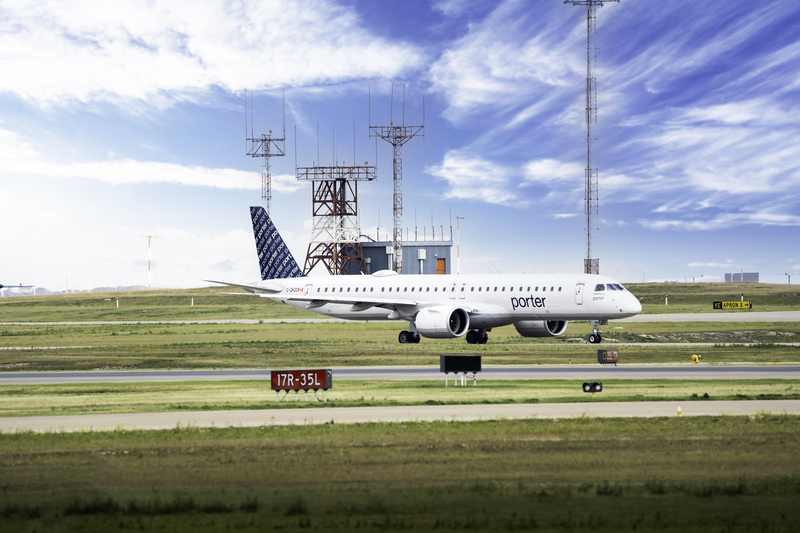
Porter will begin flying from Toronto Pearson (YYZ) to Austin (AUS) on May 21, operating five times weekly year-round. The route will be flown with the Embraer E195-E2, the aircraft that has become Porter’s growth engine for medium-haul North American flying.
Read our stories in your inbox
Two aviation newsletters. Zero fluff.
From an aircraft-program standpoint, the E195-E2 is a smart fit for Austin. Porter’s jets are configured at 132 seats in a 2–2 cabin, which eliminates the middle seat entirely—an important differentiator on a sector that will attract a mix of tech, government-related travel, events traffic, and premium leisure demand. The E195-E2’s geared turbofan engines are designed for lower fuel burn and reduced noise footprint versus previous-generation regional jets, while the airframe’s range capability gives Porter flexibility to schedule Austin (AUS) not as a one-off, but as part of a broader U.S. portfolio from YYZ.
Austin (AUS) also offers Porter something strategically useful: a year-round market with peaks that aren’t limited to winter sun seasonality. For YYZ, that matters because it helps Porter balance aircraft utilization across the calendar—keeping the fleet productive without relying solely on summer leisure or winter warm-weather demand.
Billy Bishop (YTZ)–Chicago O’Hare (ORD): A Hub Upgrade, Not Just an Airport Swap
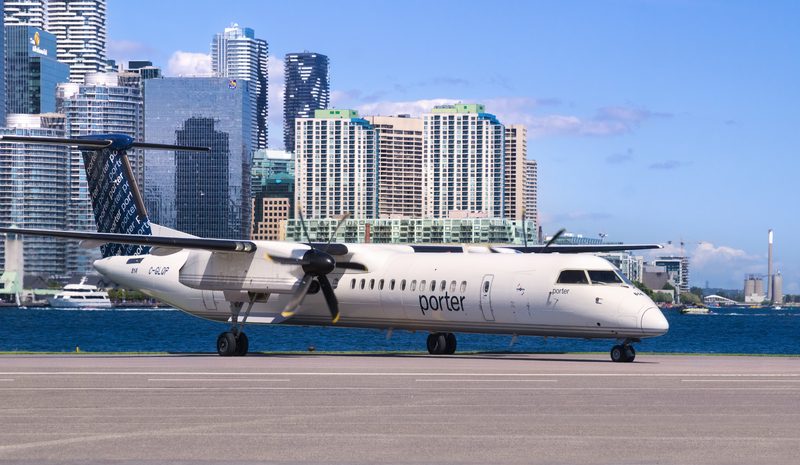
Starting September 1, Porter will move its Chicago flights from Midway (MDW) to O’Hare (ORD)—and increase the schedule to three flights per day. Service will be operated by the De Havilland Dash 8-400 (Q400), the high-speed turboprop that has long defined Porter’s downtown network.
For aviation professionals, the logic is immediately familiar:
-
YTZ is built around turboprops. Its runway environment and operating constraints favor the Q400’s performance profile, fast cycle times, and efficiency on short-to-medium stages.
-
ORD is built around connectivity. O’Hare’s scale—especially its hub structure—offers materially more onward options than Midway, which is heavily oriented toward point-to-point traffic.
That second point is the real commercial win. Moving to Chicago O’Hare (ORD) gives Porter access to the city’s primary airport and significantly expands the universe of viable connections. It also aligns neatly with Porter’s partnership strategy, because ORD is a powerful connecting platform for U.S. and beyond—exactly what you want when your origin airport is downtown Toronto (YTZ), where convenience and frequency are the product.
The Preclearance Catalyst at Billy Bishop (YTZ)
Porter’s Chicago shift also lands at a pivotal moment for Billy Bishop (YTZ): U.S. Customs and Border Protection preclearance is expected to launch in early 2026.
Preclearance is more than a passenger-experience upgrade. It’s a network unlock.
When travelers clear U.S. entry formalities before departure, they arrive in the United States as domestic passengers—reducing border-processing variability and making tight connections more reliable. It also enables service to certain U.S. airports that don’t routinely handle international arrivals in a traditional sense. For a downtown airport like YTZ, that’s a structural advantage: it expands what the airport can credibly support, and it raises the ceiling on the kind of business-focused flying Porter can sell.
Ottawa (YOW)–Deer Lake (YDF): Seasonal Lift With Real Network Utility
Beyond the transborder headlines, Porter is also adding a new domestic route: Ottawa (YOW) to Deer Lake (YDF) begins June 10, operating five times weekly on a seasonal basis, also using the Embraer E195-E2.
Deer Lake (YDF) is a key access point for western Newfoundland, and the YOW nonstop is the sort of route that often performs well in summer because it converts a traditionally connection-heavy itinerary into a clean, nonstop product. It also complements Porter’s existing Deer Lake (YDF) flying from Toronto Pearson (YYZ) and Halifax (YHZ), strengthening network redundancy and giving travelers more than one viable path depending on where they start and how they connect.
Bottom Line
Porter’s latest moves are a study in aircraft-and-airport matching. Toronto Pearson (YYZ) gains a new year-round U.S. destination in Austin (AUS) on the 132-seat Embraer E195-E2—right-sized capacity with a no-middle-seat cabin that fits the market profile. Downtown Billy Bishop (YTZ) improves its Chicago proposition by shifting to O’Hare (ORD), adding frequency, and positioning the route to benefit from imminent U.S. preclearance—an operational change that can materially improve connection quality and reliability.
Taken together, these are not flashy additions. They’re the kind of practical, network-building decisions that turn growth into something durable.
Keep reading FlyMag
Get the Daily Brief in the morning or the Route Watch weekly recap on Fridays. Or both.