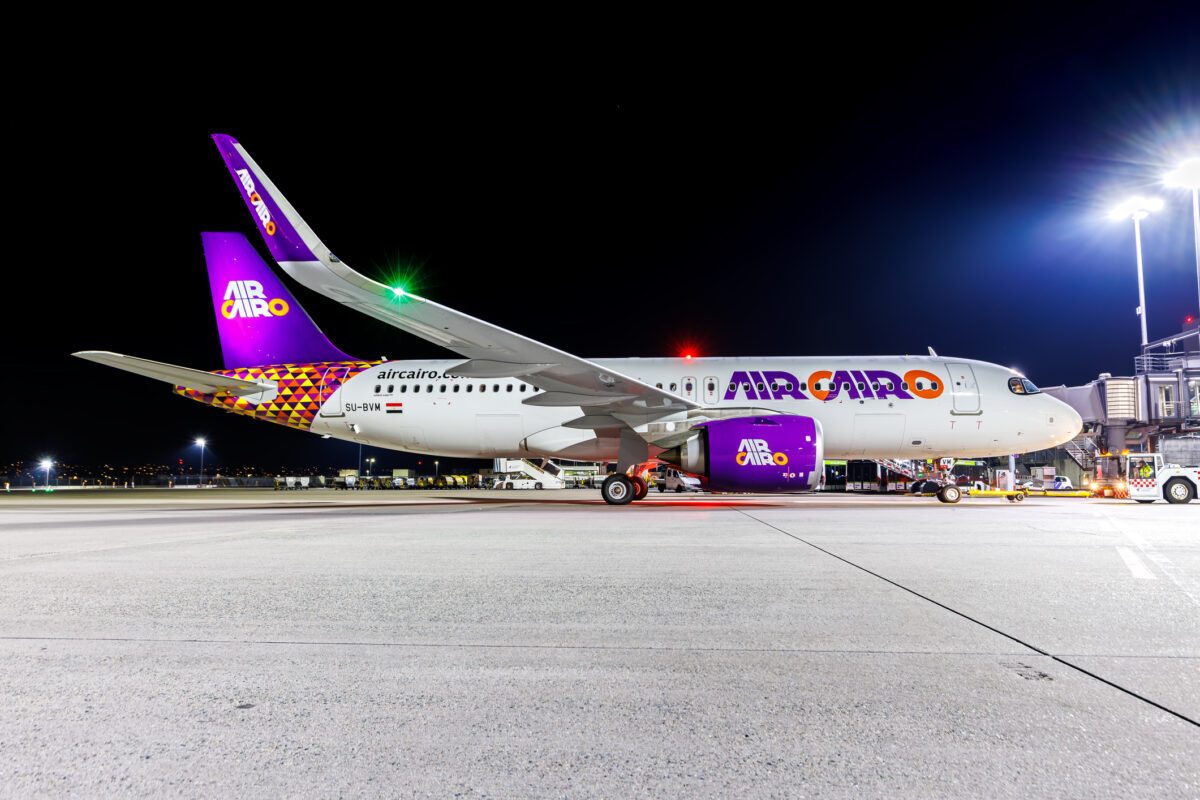
Air Cairo has placed a firm order for 15 Airbus A320neo aircraft, its first direct purchase from the European manufacturer and a significant change in how the fast-growing Egyptian carrier is building its fleet.
The agreement was signed on September 8 at the El Alamein International Airshow. In announcing the order, Airbus said the aircraft will introduce direct ownership alongside Air Cairo’s leased Airbus fleet.
Air Cairo has not disclosed a delivery schedule for the 15 aircraft. Financial terms were also not announced.
Read our stories in your inbox
Two aviation newsletters. Zero fluff.
Chairman and CEO Hussein Sherif said combining owned and leased aircraft would give Air Cairo greater operational flexibility and financial efficiency as it expands. The airline intends to deploy the additional A320neo capacity across its domestic, regional, and international networks.
Air Cairo Moves Beyond an All-Leased Airbus Fleet
The order is not a fleet-type decision so much as an aircraft-financing decision. Air Cairo already operates the A320neo, but its Airbus aircraft have entered the fleet through leasing companies. Placing a direct manufacturer order gives the carrier a second channel through which to secure aircraft and reduces its dependence on the availability and pricing of leased capacity.
Air Cairo received its first A320neo in April 2021. That aircraft was leased from ICBC Leasing, powered by CFM LEAP-1A engines, and fitted with 186 seats in an all-economy cabin. At the time, the airline operated seven aircraft.
Five years later, Airbus places the fleet at more than 45 aircraft. Air Cairo said on August 20 that it had received its 40th aircraft, an A320-251N, illustrating the speed at which additional capacity has been entering the operation.
That August delivery included an Airspace cabin, XL overhead bins, and Recaro seats. The airline said the aircraft helped reduce its average fleet age to 5.5 years. Air Cairo has not said whether the 15 directly ordered A320neos will use the same interior.
Ownership changes the fleet’s financial profile. Leases allow an airline to expand without committing as much capital at the outset and can make it easier to return or replace aircraft. Owned jets provide longer-term control over capacity and can remain in service without lease-extension negotiations, although the airline assumes the associated financing and residual-value exposure.
For Air Cairo, a mixed model should provide room to use leased aircraft for faster or more opportunistic growth while placing the directly purchased A320neos into the longer-term core fleet.

A320neo Order Supports a Much Larger Fleet Plan
Air Cairo plans to operate more than 130 aircraft by 2034, almost three times the fleet size cited by Airbus at the time of the order. The 15 A320neos represent only about 12% of that target, meaning the airline will require substantial additional commitments, lease placements, or both if it is to reach its stated goal.
Even using a base of 45 aircraft, Air Cairo would need to add more than 10 aircraft a year on average through 2034, before accounting for retirements and lease returns. The direct Airbus order therefore establishes one part of a broader acquisition program rather than completing it.
The scale of the plan also points to a larger role for Air Cairo within the Egyptian market. The airline has developed as a hybrid operator, combining scheduled services with traffic linked to Egypt’s tourism sector. Its published destination network stretches across Europe, the Middle East, Africa, and Central Asia, with domestic service linking Cairo and major leisure markets including Hurghada, Sharm El Sheikh, Marsa Alam, and Luxor.
The A320neo is suited to that mix. Its economics can support high-density leisure flying from European cities to Egyptian resorts, scheduled regional sectors within the Middle East and North Africa, and domestic trunk services. Keeping the same basic aircraft family also limits the training, maintenance, and spare-parts complexity that would accompany the introduction of another narrowbody platform.
A Familiar Aircraft With More Range Than Most Missions Require
Airbus lists the A320neo with a maximum range of 3,400 nautical miles, typical two-class seating for 150 to 180 passengers, and a certified maximum capacity of 194. The manufacturer says the neo delivers up to 20% lower fuel consumption and carbon dioxide emissions per seat than previous-generation aircraft.
Air Cairo’s established 186-seat layout places the type toward the high-density end of that capacity range. That configuration gives the airline substantial seat volume without stepping up to the larger A321neo, while the aircraft’s range comfortably covers the carrier’s principal markets from Egypt.
The direct order should also deepen fleet commonality as Air Cairo expands. Its operation has included A320ceos as well as A320neos, alongside smaller regional aircraft. Increasing the neo share can lower fuel use relative to older A320s while preserving common flight-deck and maintenance characteristics across the Airbus narrowbody fleet.
Airbus said the A320 Family had accumulated more than 20,200 orders worldwide by September 2026. Air Cairo’s purchase is modest in the context of that backlog, but strategically important for an airline that had previously sourced its Airbus capacity exclusively from lessors.
Bottom Line
The central significance of this order is not the introduction of the A320neo, which is already well established at Air Cairo, but the airline’s decision to become a direct aircraft buyer. That gives management more control over the timing and long-term disposition of part of the fleet while preserving leasing as a way to add capacity quickly.
The 2034 target is the more consequential figure. Fifteen aircraft will cover only a fraction of the growth required to exceed 130 jets, so further orders and leasing transactions are likely to follow. The balance among A320neos, larger A321neos, and regional aircraft will show whether Air Cairo intends mainly to add frequencies within its present network or pursue materially larger and longer-range markets.
Delivery timing will determine how quickly the order changes the operation. Until those aircraft begin arriving, leased jets will remain central to Air Cairo’s expansion. Over the longer term, however, the purchase establishes an owned fleet base around which the airline can plan capacity with less exposure to short-term competition for leased narrowbodies.