Air Astana has taken a formal step toward launching the first nonstop scheduled passenger service between Kazakhstan and the United States, filing an application with the U.S. Department of Transportation for authority to begin flights as early as 2027.

The Kazakh flag carrier’s application for exemption authority, filed on July 21, identifies potential service from Almaty International Airport (ALA) and Nursultan Nazarbayev International Airport in Astana (NQZ) to New York.
Air Astana plans to use the Boeing 787-9 Dreamliner, configured for 303 passengers. However, the filing does not identify a specific New York airport, proposed frequency, launch date or detailed routing.
Read our stories in your inbox
Two aviation newsletters. Zero fluff.
That means neither John F. Kennedy International Airport (JFK) nor Newark Liberty International Airport (EWR) has been confirmed. It also remains unclear whether Air Astana intends to serve New York from both ALA and NQZ, alternate between the two Kazakh airports or select one as the primary U.S. gateway.

Air Astana Is Seeking Economic Authority
Air Astana’s DOT application asks the United States to grant the airline the economic authority needed to transport passengers, cargo and mail between Kazakhstan and the U.S.
The carrier argues that the proposed service would be in the public interest because there are currently no nonstop commercial flights between the two countries. Passengers traveling between Kazakhstan and the United States generally connect through European, Middle Eastern or Asian hubs.
Air Astana also told the DOT that its maintenance, insurance and operational practices comply with the standards expected of airlines serving the United States.
However, receiving exemption authority would not by itself allow the airline to begin flying. Air Astana would still need additional operating, security and safety approvals, along with suitable aircraft, airport slots and a commercially workable route plan.

The filing should therefore be viewed as a serious regulatory step rather than confirmation that tickets will soon go on sale.
Kazakhstan Still Needs FAA Category 1 Status
One of the largest hurdles sits outside Air Astana’s direct control.
Under the Federal Aviation Administration’s International Aviation Safety Assessment program, commonly known as IASA, the FAA evaluates a country’s civil aviation oversight system rather than the individual safety performance of a particular airline.
The assessment examines whether the national regulator complies with International Civil Aviation Organization standards involving aircraft operations, airworthiness, personnel licensing, surveillance, technical guidance and the resolution of safety concerns.
Kazakhstan began working formally toward that goal in 2024, when the country’s Aviation Administration signed an agreement with the FAA covering a preliminary IASA assessment.
The Aviation Administration of Kazakhstan said the process was intended to help the country obtain Category 1 status in the future. That rating would allow Kazakh airlines to begin direct U.S. service once appropriate aircraft were available.
Air Astana’s own maintenance and safety standards may be strong, but the FAA assessment concerns Kazakhstan’s entire regulatory structure. The airline cannot independently grant its home country Category 1 status.
Consequently, even if the DOT approves Air Astana’s exemption request, the carrier cannot launch the proposed service until the necessary FAA safety requirements are satisfied.
The Boeing 787-9 Changes Air Astana’s Capabilities
The Boeing 787-9 is central to Air Astana’s U.S. ambitions.
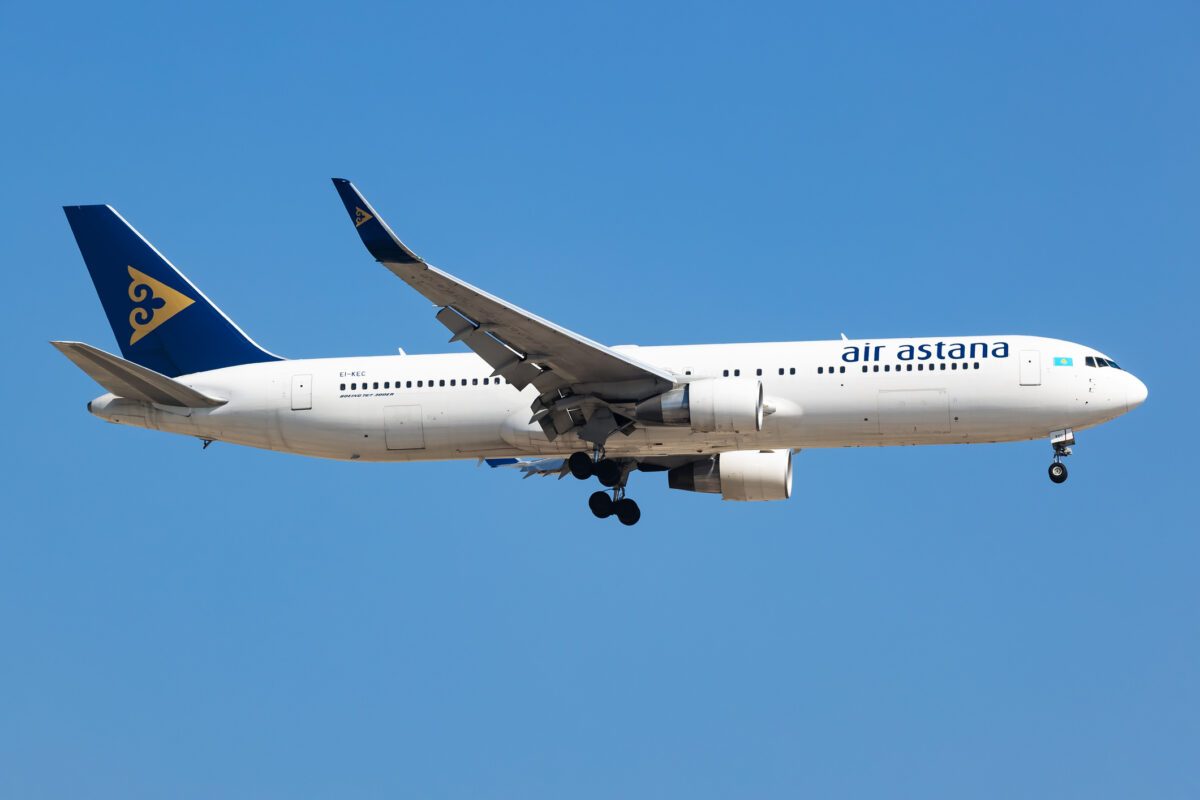
Air Astana currently relies on three Boeing 767-300ERs for its longest routes. Those aircraft are configured with 223 seats and are used on services from Kazakhstan to destinations in Europe, Asia and the Middle East.
The incoming 303-seat 787-9 will provide approximately 36% more capacity than the 767-300ER while offering a substantially longer range, improved fuel efficiency and a more modern passenger cabin.
According to Boeing’s 787 specifications, the 787-9 can accommodate approximately 250 to 325 passengers in a typical two-class layout and has a published maximum range of up to 8,300 nautical miles. The aircraft is 206 feet long, has a wingspan of just over 197 feet and can be powered by either the General Electric GEnx-1B or Rolls-Royce Trent 1000 engine.
Air Astana’s 303-seat configuration sits near the upper end of Boeing’s typical capacity range. That suggests the airline is prioritizing relatively high seat density while retaining a premium cabin suitable for long-haul business traffic.
The 787 also introduces lower cabin altitude, higher humidity, larger electronically dimmable windows and a composite-intensive airframe. Those features are particularly valuable on flights that could remain airborne for 13 hours or longer.
Air Astana Could Eventually Operate 18 Dreamliners
Reports that Air Astana has ordered up to 15 Boeing 787s tell only part of the fleet story.
The carrier already has agreements for three leased Boeing 787-9s. It later committed to purchasing up to 15 additional aircraft from Boeing, potentially increasing its total Dreamliner fleet to 18 aircraft.
The later commitment includes firm aircraft and additional purchase options and rights rather than 15 immediate firm deliveries.
Boeing said Air Astana’s planned 787 fleet could grow to 18 aircraft, including the three jets arriving through leasing companies. The manufacturer specifically identified North America as one of the markets the 303-seat aircraft could enable.
The first leased Dreamliners are expected to support Air Astana’s near-term expansion and replacement of the aging 767-300ER fleet. The additional purchased aircraft form part of a much longer fleet-development plan extending into the following decade.
That distinction matters for the proposed 2027 U.S. service. Air Astana will initially have only a small 787 fleet, limiting the amount of schedule flexibility available if an aircraft requires maintenance or is delayed elsewhere in the network.
A New York operation would consume a significant amount of aircraft time. Depending on routing and winds, a single round trip could keep a 787 away from Kazakhstan for well over a full day.
Russian Airspace Is the Route’s Biggest Operational Question
On paper, the Boeing 787-9 has more than enough published range to connect Kazakhstan with New York.
The practical calculation is more complicated.
The shortest routes between Almaty Airport (ALA) or Astana Airport (NQZ) and the New York area pass through a substantial portion of Russian airspace. Avoiding Russia would require Air Astana to operate a longer route, likely tracking farther south or north before crossing Europe and the Atlantic.
That increases flight time, fuel consumption, crew costs and aircraft utilization. It can also reduce the payload available for passengers, baggage and cargo when winds or weather are unfavorable.
Air Astana management previously acknowledged that its planned 787-9s could not operate Kazakhstan-New York nonstop under expected conditions without using Russian airspace. The airline’s official Capital Markets Day transcript stated that a nonstop New York operation was not possible at the time without overflying Russia.
The new DOT application suggests Air Astana is continuing to work toward a solution, but it does not explain whether the airline expects to obtain Russian overflight rights, operate a longer nonstop routing or introduce an intermediate stop.
This is one reason the word “connections” in the filing deserves attention. The application seeks broad authority, while the final operational structure may still be under development.
Why Air Astana Cannot Simply Use the Published 787 Range
Maximum aircraft range figures are not guarantees that every flight within that distance can operate with a full passenger and cargo payload.
A 787-9’s practical range depends on several variables:
- The number of passengers and amount of baggage
- Cargo weight
- Headwinds and seasonal jet-stream patterns
- Required fuel reserves
- Departure airport temperature and elevation
- Air traffic restrictions
- Diversion airport requirements
- The exact route permitted by national authorities
Almaty International Airport (ALA) sits at an elevation of approximately 2,200 feet. Nursultan Nazarbayev International Airport (NQZ) is lower, but both airports can experience significant seasonal temperature extremes.
Winter winds also make westbound and eastbound performance different. A flight from Kazakhstan to New York may face a different payload and fuel calculation than the return flight from New York to Kazakhstan.
The 787-9 is an exceptionally capable aircraft, but operating a route near the limits of the available airspace structure can erase some of the economic advantage provided by the type.
Almaty and Astana Serve Different Markets
The inclusion of both Almaty Airport (ALA) and Astana Airport (NQZ) gives Air Astana several possible network strategies.
Almaty is Kazakhstan’s largest city, its principal commercial center and Air Astana’s most important international hub. A route from Almaty Airport (ALA) would likely have access to the airline’s broadest pool of local passengers and connecting traffic.
Air Astana could feed a New York flight at ALA with passengers traveling from Central Asia, India, China, the Caucasus and other regional markets.
Astana is Kazakhstan’s capital and the center of the country’s government and diplomatic activity. Service from Astana Airport (NQZ) could attract government, energy-sector and corporate demand, while also fulfilling Kazakhstan’s long-standing policy objective of establishing a direct link between its capital and the United States.
Operating separate routes from both airports would spread the available demand across two services. Alternating the U.S. flight between ALA and NQZ could improve national coverage but would reduce frequency from each city.
Another possibility would be a triangular operation, although that would create additional complexity and could make the already long journey less attractive.
The DOT filing preserves Air Astana’s ability to consider both gateways without committing publicly to one operating model.
New York Is the Logical First U.S. Destination
New York is the most obvious entry point for Air Astana’s U.S. expansion.
The metropolitan area offers a large local passenger market, substantial corporate and diplomatic traffic, established Central Asian communities and extensive connecting opportunities. It also gives Air Astana access to one of the world’s largest air cargo markets.
John F. Kennedy International Airport (JFK) would be a logical candidate because of its extensive international network and established long-haul infrastructure. Newark Liberty International Airport (EWR) could provide different connecting and local-market advantages.
However, Air Astana has not named either airport. Treating JFK as the confirmed destination would go beyond what the airline submitted to the DOT.
Airport selection could depend on slot availability, terminal costs, ground-handling agreements, connecting partnerships and the level of financial support available from the airport or local tourism authorities.
Filling 303 Seats Will Require More Than Kazakhstan-New York Traffic
A 303-seat aircraft represents a substantial amount of capacity for a market with no existing nonstop service.
Air Astana would need to generate demand from several passenger groups rather than relying exclusively on travelers flying between Kazakhstan and New York.
Potential traffic could include passengers connecting through Almaty Airport (ALA) or Astana Airport (NQZ) from neighboring Central Asian countries, as well as travelers from India, China and the Caucasus. The airline could also pursue connecting passengers traveling beyond New York through an interline or codeshare partner.
Premium demand will be especially important. Ultra-long-haul routes are difficult to support with low-fare Economy Class traffic alone because of their fuel consumption, crew requirements and heavy aircraft utilization.
Cargo could provide another meaningful revenue stream. Kazakhstan occupies an important position between Europe and Asia, while New York offers access to a large market for pharmaceuticals, technology, express freight and other time-sensitive goods.
The route may initially require a limited frequency—perhaps two or three weekly flights—while Air Astana builds awareness and evaluates seasonal demand. The airline has not yet disclosed its intended schedule.
The Filing Is About Timing as Much as Permission
Applying now allows Air Astana to begin the U.S. regulatory process while Kazakhstan completes its IASA work and the airline prepares to receive its first 787-9s.
That sequence is logical. International route certification, airport negotiations, crew training, maintenance planning and commercial preparation can take many months.
The application also demonstrates to Boeing, leasing companies, government officials and potential airport partners that Air Astana is actively pursuing the North American expansion used to justify its Dreamliner investment.
However, a 2027 target leaves little room for delay. The airline must receive aircraft on schedule, complete pilot and maintenance training, secure FAA and DOT approvals, resolve the Russian airspace issue and establish a viable operating plan.
Any one of those factors could push the route beyond 2027.
Bottom Line
Air Astana’s DOT filing is the clearest indication yet that the airline intends to enter the U.S. market.
The carrier is seeking authority to connect Almaty International Airport (ALA) and Nursultan Nazarbayev International Airport (NQZ) with New York using a 303-seat Boeing 787-9, potentially beginning in 2027.
But this is not yet a confirmed route launch.
Kazakhstan still needs the appropriate FAA Category 1 safety status, Air Astana must receive and introduce its new Dreamliners, and the airline has not identified its New York airport, frequency or final routing.
Russian airspace presents the most difficult operational question. Although the 787-9 has sufficient nominal range, Air Astana has previously said that a nonstop New York flight would not be practical without overflying Russia.
The application gives Air Astana a place in the regulatory process. Whether the airline can convert that authority into a commercially sustainable nonstop service will depend on factors far beyond the aircraft’s published range.
Keep reading FlyMag
Get the Daily Brief in the morning or the Route Watch weekly recap on Fridays. Or both.