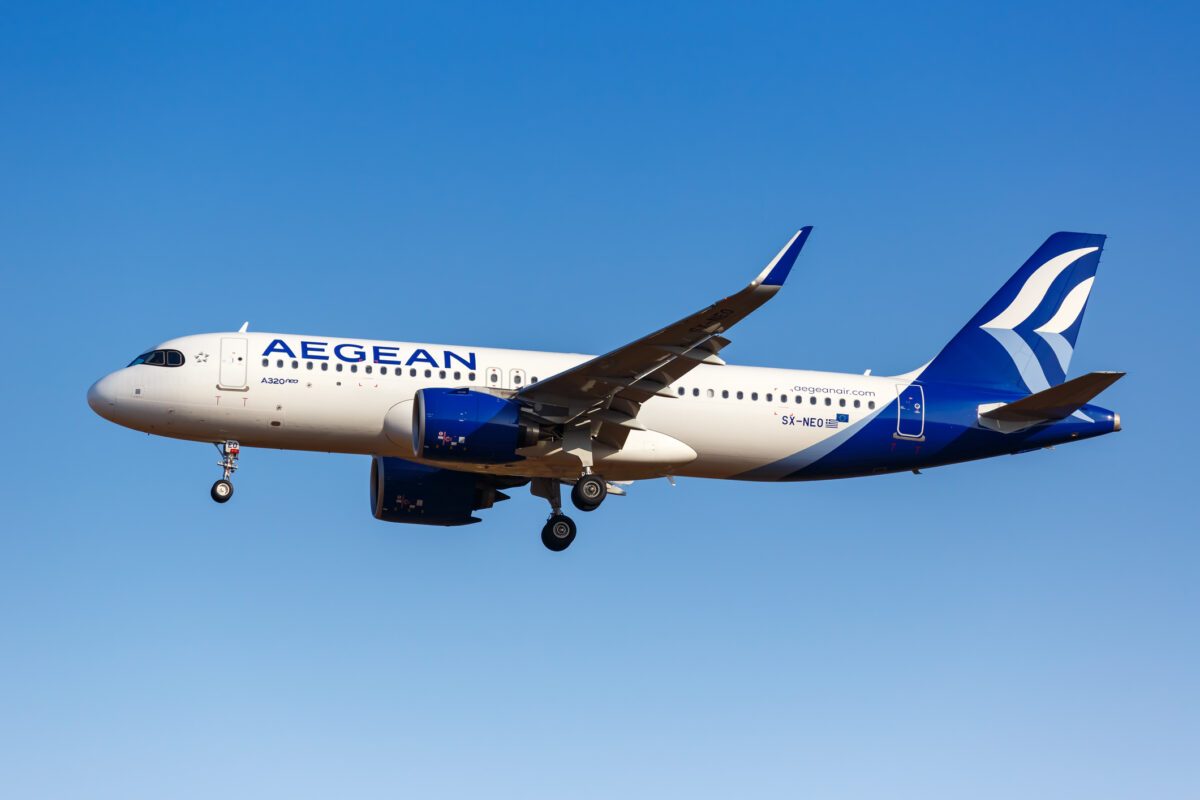
AEGEAN will open nonstop service between Athens (ATH) and Damascus (DAM) on December 2, 2026, adding Syria to the Greek airline’s international network.
The carrier’s published schedule calls for up to four flights per week during the winter season. Services are planned on Mondays, Wednesdays, Thursdays and Saturdays.
The route gives Damascus a direct link to AEGEAN’s Athens hub, where the airline can offer connections across Greece and its wider European network. It also adds another Middle Eastern point to a network that has faced repeated disruption from regional conflict during 2026.
Read our stories in your inbox
Two aviation newsletters. Zero fluff.
A Short-Haul Addition With Wider Network Value
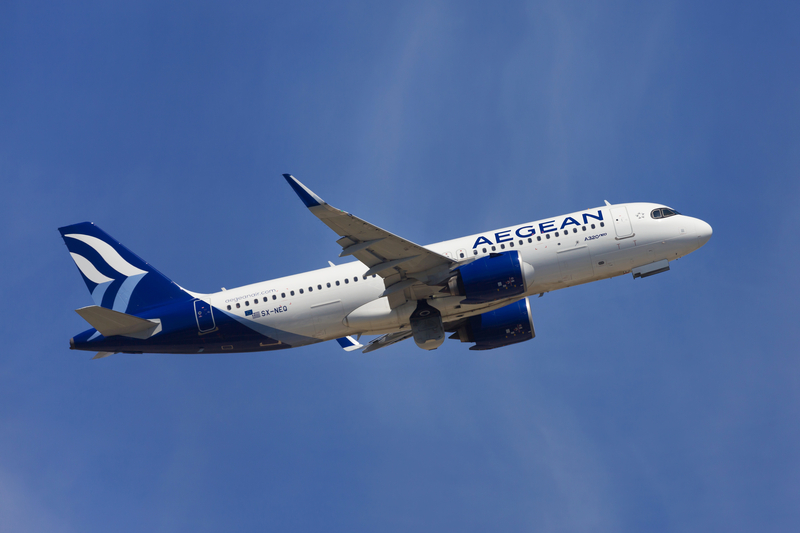
Athens-Damascus is a conventional short-haul sector for AEGEAN’s Airbus narrowbody fleet. The airline operates A320 and A321 aircraft across most of its international network, giving it flexibility to adjust capacity as demand develops.

AEGEAN’s Airbus A320neo, for example, carries up to 180 passengers and has a published maximum range of 2,700 nautical miles. That is substantially more capability than required for Damascus, making the type well suited to a route on which frequency and connection timing are likely to matter more than range.
The airline’s broader Airbus fleet also includes the larger A321neo. AEGEAN has been shifting more of its capacity toward that variant, but the mix of A320- and A321-family aircraft gives the carrier scope to match gauge to bookings without changing the basic operating model.
Four weekly flights provide more utility than the one- or two-weekly pattern often used to test thinner international destinations. Operating on four separate days also creates a workable schedule for visiting-friends-and-relatives traffic, business trips and connecting itineraries, while stopping short of the commitment required for a daily operation.
Launch Follows a Difficult Year in the Region
The Damascus announcement comes after Middle East instability materially affected AEGEAN’s 2026 operation. In its first-half results, the company said flights across parts of its international network were suspended for four months, from March through June.
International passenger traffic was broadly flat during the first half, while domestic traffic rose 6%. AEGEAN carried 7.8 million passengers across the group, up 3%, but reported that disruption in the Middle East affected both its ability to operate and connecting demand through Athens.
The Damascus opening therefore represents more than a single destination addition. It indicates that AEGEAN is again prepared to place targeted capacity into the region while retaining the ability to alter its program if operating conditions change.
That flexibility remains important. The European Union Aviation Safety Agency’s current Syria conflict-zone bulletin, revised October 1, remains valid through November 30, two days before AEGEAN’s planned inaugural flight. It recommends significant operating restrictions within the Damascus flight information region and calls for current risk assessments, contingency planning and close monitoring of regional developments.
The bulletin is subject to review, and the operational guidance in force nearer December will be central to the launch. The schedule establishes AEGEAN’s commercial intention, but the route will also require an acceptable safety and regulatory framework at the time operations begin.

Damascus Forms Part of a Broader Southward Push
AEGEAN is pairing the Syria announcement with further planned growth south of the Mediterranean. The airline said it intends to introduce direct Athens flights to Tripoli (TIP) and Benghazi (BEN) in May 2027, subject to the completion of its assessments and the required regulatory procedures.
The Libya plans remain less firm than the Damascus launch, but they show the direction of AEGEAN’s network development. Athens is geographically positioned to aggregate traffic between Europe, the eastern Mediterranean, North Africa and the Middle East, particularly on markets that may not initially support extensive nonstop service from multiple European cities.
The airline will also resume direct Athens-Dubai (DXB) flights on October 23, 2026. Taken together, Dubai, Damascus and the proposed Libyan routes would broaden AEGEAN’s presence beyond its core European and Greek markets without requiring long-haul aircraft.
The expansion comes alongside continued fleet investment. AEGEAN said it received five new Airbus A321neo aircraft during the first half of 2026, taking total A320neo-family deliveries to 43 at the end of June. Two additional A321neos were expected by the end of September.
Those deliveries provide additional capacity, but management has also emphasized discipline. Higher fuel costs and regional disruption reduced first-half profitability, and the airline said in September that it expected to maintain a controlled capacity outlook for at least the following six to eight months. Damascus fits that approach: a strategically useful destination introduced at a measured, sub-daily frequency.
Bottom Line
For AEGEAN, Damascus is an Athens-hub play rather than a large standalone capacity move. Four weekly frequencies can collect traffic from across the airline’s domestic and European network while limiting exposure during the route’s first winter. The A320-family fleet allows AEGEAN to keep the operating cost and capacity commitment proportionate to a market that is reopening but remains difficult to forecast.
The timing will attract close attention. AEGEAN has placed the inaugural flight immediately after the scheduled expiration of EASA’s current Syria conflict-zone bulletin, although that guidance may be revised or extended. The most important developments before December will be the next EASA assessment, national authority requirements and whether regional conditions permit a stable schedule into DAM.
The proposed Libya services show that Damascus is not an isolated experiment. AEGEAN is testing how far Athens can function as a practical European gateway for recovering eastern Mediterranean and North African markets. If the carrier can sustain those routes with disciplined frequencies and connecting traffic, it will have a template for adding strategically significant destinations without abandoning its short- and medium-haul fleet model.
Keep reading FlyMag
Get the Daily Brief in the morning or the Route Watch weekly recap on Fridays. Or both.