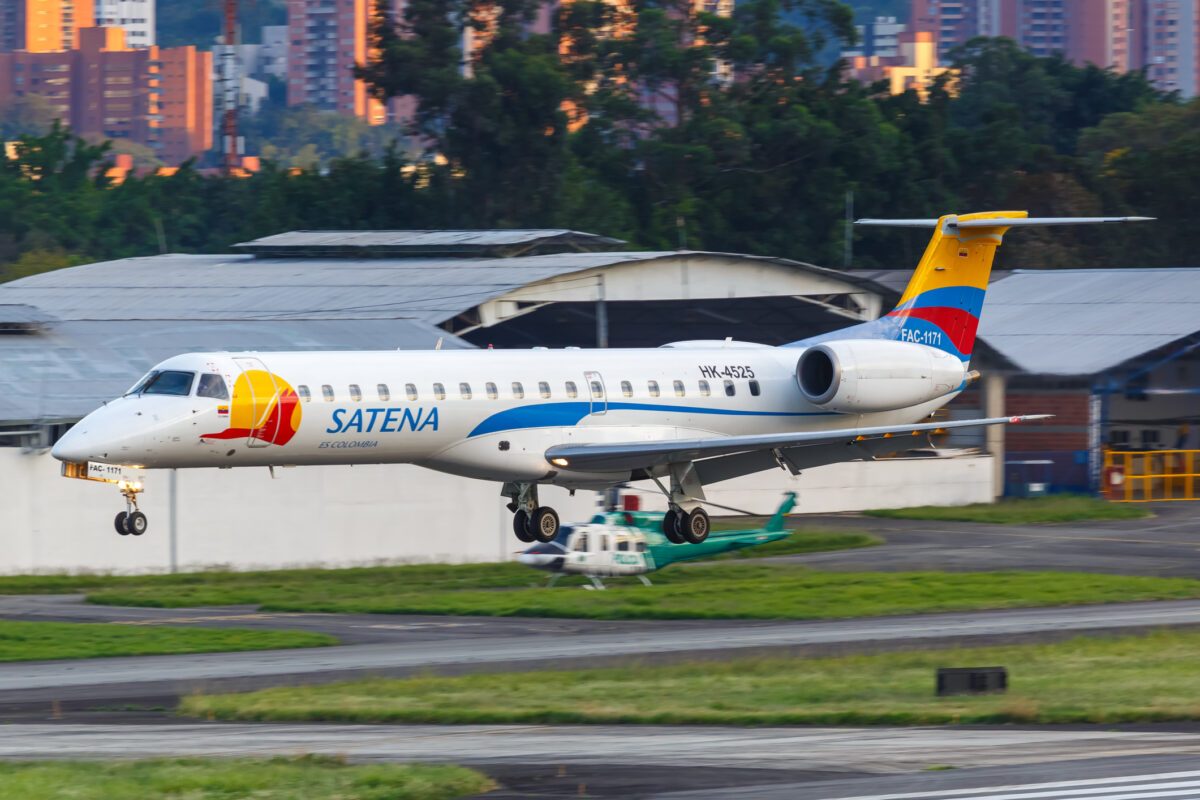
Satena will open Montería’s first scheduled international passenger route on October 26, linking the Colombian city with Panama City three times a week.
The state-owned airline will operate between Montería Los Garzones (MTR) and Panama City Tocumen (PTY) on Mondays, Wednesdays and Fridays. The service will also become the only international route in Satena’s current network.
Satena has already placed the route on sale and lists the Panama-Montería service alongside its domestic flights at MTR. The airline will use a 50-seat Embraer ERJ-145, giving the market 150 seats in each direction per week.
Read our stories in your inbox
Two aviation newsletters. Zero fluff.
A Short International Rotation From Montería
The outbound flight is scheduled to leave MTR at 9:55 a.m. and reach PTY at 10:59 a.m. The return will depart Panama City at 11:50 a.m. and arrive in Montería at 12:49 p.m. Colombia and Panama use the same time zone throughout the year.
The timetable gives Satena 51 minutes on the ground at Tocumen, allowing the airline to operate the international sector as a compact out-and-back rotation. At the advertised frequency, the route adds 300 one-way seats per week, or 15,600 seats in each direction over a full year.
The October 26 start date and three-weekly schedule were confirmed during the government’s October 3 route launch in Montería. Ticket sales began the same day.
Tocumen gives Córdoba direct access to Panama’s principal international airport. The route removes the need for passengers traveling between the two cities to connect elsewhere in Colombia, although its commercial base will initially depend heavily on local traffic, tourism sales and business travel between Córdoba and Panama.
The ERJ-145 Rightsizes an Unproven Market
Satena’s choice of the ERJ-145 limits the number of seats it must fill while retaining the speed of a regional jet. The aircraft’s three-abreast cabin has no middle seats, and the standard layout accommodates 50 passengers.

Embraer lists the ERJ-145LR with a maximum range of 1,550 nautical miles with a full passenger load, far beyond the requirement for the short Montería-Panama sector. The aircraft is therefore being selected for capacity rather than range.
That distinction matters at MTR. A narrowbody would place substantially more inventory into a market that has yet to demonstrate sustained scheduled demand. Satena can instead build the route around six weekly sectors while offering enough frequency for short business and leisure trips.
The 50-seat jet also gives Satena room to stimulate the market without committing the capacity of an Airbus A320-class aircraft. Three frequencies are sufficient to establish a regular presence while limiting the financial exposure attached to each departure.
Charters Came Before the Scheduled Service
The Satena operation will not be the first time MTR has processed international passengers. Aeroregional conducted charter flights during June on a Quito-Montería-Panama routing as local authorities worked to establish permanent international service.

Those flights began June 11 but were suspended before the end of the month as Aeroregional prepared to seek approval for a scheduled operation. Montería’s municipal government said the initial charters averaged only eight to nine passengers per sector, prompting the operator to use a smaller aircraft while it assessed demand.
The city subsequently said the charter suspension was intended to precede an application for regular commercial flights. Its June account of the Aeroregional project distinguished those temporary flights from the scheduled service authorities were attempting to secure.
Satena’s October launch therefore marks the scheduled milestone rather than the first international aircraft movement or passenger flight at Los Garzones. It also introduces a different operating model: a Colombian carrier flying directly to Tocumen with a regional jet, rather than a multi-stop charter operation linking Ecuador, Colombia and Panama.
Los Garzones Has Prepared for International Processing
Montería and airport concessionaire Airplan have spent several years preparing MTR to handle scheduled international passengers. Work has included immigration facilities, biometric processing equipment, X-ray systems and changes to passenger circulation areas.
The city delivered a Biomig unit for immigration processing in November 2025. Its internationalization program has involved Airplan, Migración Colombia, customs, agricultural authorities, police and the national government.
MTR is already a significant domestic station. Airplan recorded 1,478,610 passengers and 20,328 aircraft operations in 2024. The airport manager subsequently said more than 1.45 million passengers used the facility in 2025.
That traffic base has been generated overwhelmingly by domestic links. The challenge for Satena is not introducing scheduled air service to Montería, but converting an established domestic catchment area into enough direct international demand to support year-round flying.
Bottom Line
Satena is taking a more measured approach than the earlier charter project. The ERJ-145 cuts the number of passengers required on each departure and gives Montería a regular international schedule without flooding the market with narrowbody capacity. For an airport whose traffic has been built around domestic trunk and regional routes, that is a more credible starting point than relying on occasional high-capacity flights.
The route will also test whether Tocumen’s scale as a connecting airport translates into demand for a small Colombian regional carrier. The immediate opportunity lies in passengers whose journeys begin or end in Córdoba; broader connecting traffic will depend on how effectively Satena, travel agencies and tourism partners distribute the service beyond the local market.
What happens after the initial season will be more significant than the inauguration itself. Stable loads could support additional frequencies and establish MTR as a viable secondary international gateway. Weak demand, following Aeroregional’s short charter experiment, would show that airport readiness and political support cannot substitute for a sufficiently deep year-round passenger base.
Keep reading FlyMag
Get the Daily Brief in the morning or the Route Watch weekly recap on Fridays. Or both.