Emirates’ Longest Nonstop Flights In 2025
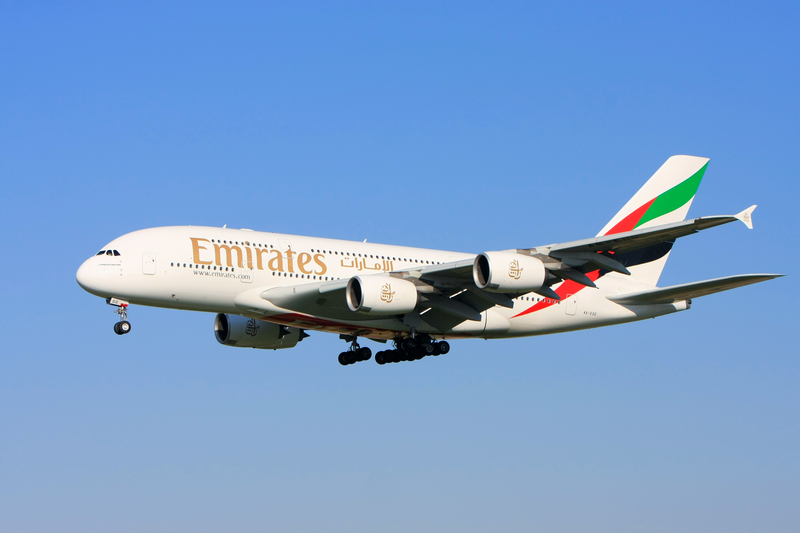
ID 12469944 © Gordon Tipene | Dreamstime.com

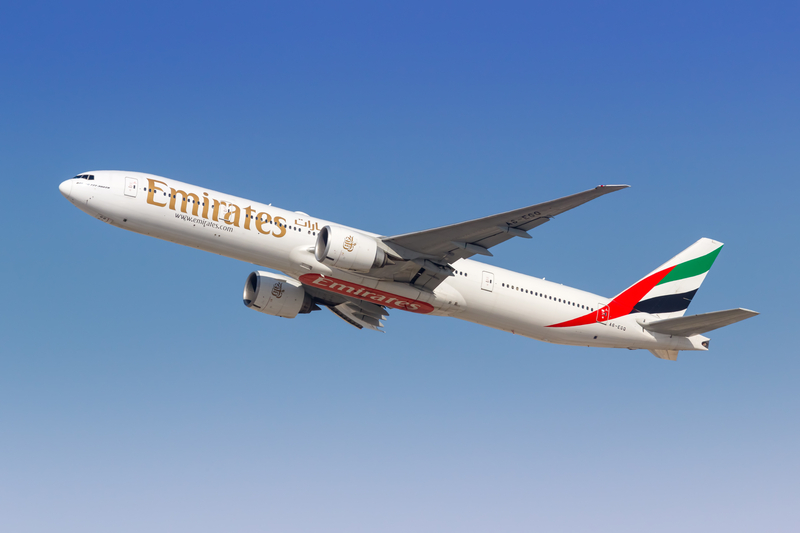
From Dubai (DXB), Emirates stitches together ultra-long-haul city pairs with a fleet composed entirely of widebodies—chiefly the Airbus A380-800 and Boeing 777-300ER. Filed schedules for 2025 show a dozen nonstop routes exceeding 7,400 miles, with Dubai (DXB) – Auckland (AKL) topping the list.
The 2025 ULH Board: Emirates Routes Above ~7,400 Miles
(Great-circle distances; representative equipment by schedule; returns omitted)
Read our stories in your inbox
Two aviation newsletters. Zero fluff.
| Route | Miles (avg) | Typical Aircraft |
|---|---|---|
| Dubai (DXB) – Auckland (AKL) | 8,810 | A380-800 |
| Dubai (DXB) – Los Angeles (LAX) | 8,334 | A380-800 |
| Dubai (DXB) – Houston Intercontinental (IAH) | 8,165 | A380-800 |
| Dubai (DXB) – San Francisco (SFO) | 8,101 | A380-800 |
| Dubai (DXB) – Dallas/Fort Worth (DFW) | 8,038 | 777-300ER |
| Dubai (DXB) – Miami (MIA) | 7,844 | 777-300ER |
| Dubai (DXB) – Orlando (MCO) | 7,754 | 777-300ER |
| Dubai (DXB) – São Paulo/Guarulhos (GRU) | 7,591 | A380-800 |
| Dubai (DXB) – Sydney (SYD) | 7,480 | A380-800 |
| Dubai (DXB) – Brisbane (BNE) | 7,442 | A380-800 / 777-300ER (select) |
| Dubai (DXB) – Seattle/Tacoma (SEA) | 7,425 | 777-300ER |
What the pattern tells us
-
Even A380/777 split at the very top end. The A380-800 shoulders the longest missions to Auckland (AKL) and the U.S. West Coast, while the 777-300ER features prominently to Texas, Florida, and Seattle (SEA).
-
U.S. demand dominates the ultra-long list—California, Texas, and Florida each field an Emirates route above 7,700 miles—while Australia remains a high-frequency stalwart with Sydney (SYD) and Brisbane (BNE).
-
Frequency vs. gauge: Australia sees the heaviest daily activity, with Sydney (SYD) often multiple times per day on the A380, while Orlando (MCO) typically runs fewer weekly rotations on the 777-300ER.
ID 331014914 © Boarding1now | Dreamstime.com
Why these two aircraft?
-
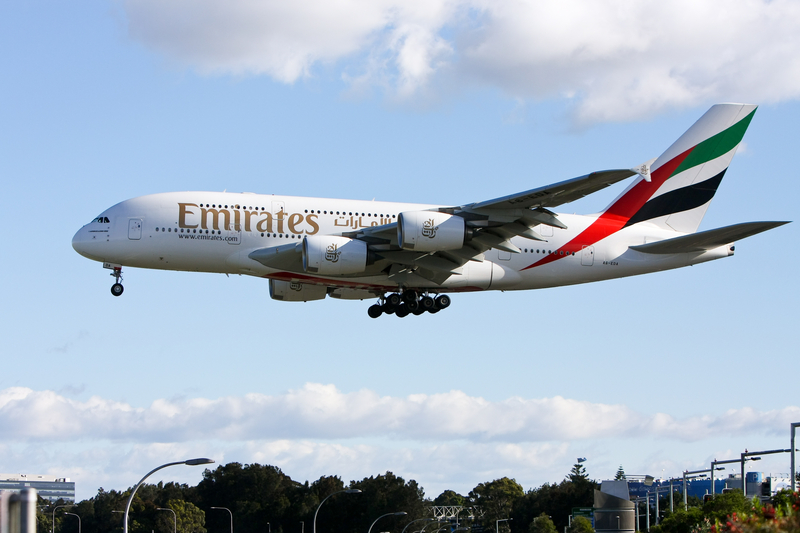
Airbus A380-800: Ideal where slot constraints and dense demand reward gauge. The double-decker’s volume (and premium cabin real estate) shines on trunk ULH markets like Dubai (DXB) – Auckland (AKL) and Dubai (DXB) – Los Angeles (LAX).
-
Boeing 777-300ER: A long-range twin with strong payload-range and per-seat economics, well-suited to high-demand ULH spokes that don’t require A380 capacity (e.g., Dallas/Fort Worth (DFW), Miami (MIA), Seattle (SEA)).
Fleet evolution: the A350 era begins (and 777X to follow)
Emirates remains the world’s largest operator of both the A380 and 777-300ER, but the long-haul mix is shifting. The carrier has begun inducting the Airbus A350-900 and holds sizable orders for the Boeing 777-9/-8 and 787 family. Expect the A350-900 to assume more long sectors over time where its lower fuel burn and range fit the mission without A380 gauge, while the 777X is poised to refresh the high-capacity twinjet role later in the decade.
The broader trend: twins rule the longest stage lengths
Efficiency gains—high-bypass engines, advanced wings, and lighter materials—have consolidated ULH work on twin-engine widebodies. The A380 remains beloved for space and quiet, but twins like the 777-300ER, A350-900, and forthcoming 777X generally deliver superior trip cost and flexibility (and allow multiple daily frequencies in lieu of single heavy waves).
Bottom Line
In 2025, Dubai (DXB) – Auckland (AKL) is Emirates’ longest nonstop, with a cluster of U.S. and Australia routes filling out the ultra-long-haul roster. The A380-800 and 777-300ER continue to share the marquee missions, while the incoming A350-900 (and, later, 777X) will gradually reshape how Emirates balances gauge, frequency, and unit costs on the farthest reaches of its network.
Keep reading FlyMag
Get the Daily Brief in the morning or the Route Watch weekly recap on Fridays. Or both.