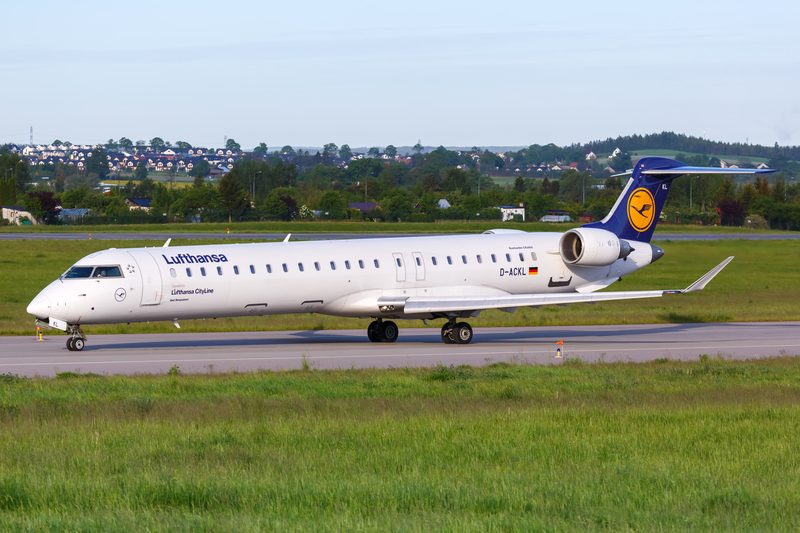
Lufthansa CityLine’s abrupt exit from operations was not really about one aircraft type in isolation. It was about what happens when a regional fleet built for thinner European hub flying runs into a sharp cost shock at exactly the moment a large airline group is trying to simplify itself.

That is why the Bombardier CRJ900 became the most exposed aircraft in the Lufthansa system.
For years, CityLine had played a very specific role inside the Lufthansa Group. From major hubs such as Munich Airport (MUC) and Frankfurt Airport (FRA), it operated high-frequency regional flights on sectors where a larger narrowbody would often have been too much airplane. That made it useful. It also made it vulnerable. Once fuel prices jumped and Lufthansa accelerated its restructuring, the CRJ900 fleet sat in the most dangerous place possible: essential enough to matter, but expensive enough to cut.
Read our stories in your inbox
Two aviation newsletters. Zero fluff.
CityLine Was Already Living On Borrowed Time
The first thing to understand is that Lufthansa CityLine was not a healthy standalone platform suddenly destroyed by fuel.
Its role had already been under pressure as Lufthansa shifted more of its short-haul future toward Lufthansa City Airlines and a more simplified Airbus-focused structure. CityLine’s fleet, labor setup, and cost base increasingly looked like legacy holdovers inside a group that wanted fewer fleet types and lower unit costs.
That meant the subsidiary was already strategically vulnerable before the latest fuel shock arrived. The spike in fuel prices did not create the problem from nothing. It accelerated a decision that Lufthansa had strong incentives to make anyway.
That is why the shutdown arrived so quickly. Lufthansa was not choosing between two equally strong models. It was choosing whether to keep carrying a cost-heavy regional platform at a moment when every inefficiency had become more visible.
The Fleet Exit Was Faster Than Planned
Lufthansa brought CityLine flying to an end in mid-April 2026, earlier than many expected.
That timing matters because airline fleet exits are usually phased, especially when the aircraft involved still operate an important part of feeder flying. But once Lufthansa decided to pull the trigger, it chose speed over gradualism. Around 27 aircraft were withdrawn with the subsidiary’s operational end, and that included the CRJ900 fleet that had long been central to CityLine’s regional work.
For network planners, that kind of move is disruptive. But it also reflects a clear judgment: better to absorb short-term turbulence than keep financing a structurally weak platform in a worsening cost environment.
Why Fuel Hurt The CRJ900 More Than Bigger Aircraft
The CRJ900 was never a bad aircraft for the mission it was designed to perform. The issue was the economics surrounding it.
Regional jets work best when they can charge enough yield to offset their structural disadvantage: they carry fewer passengers over each flight cycle. Even if their total fuel burn is lower than a larger aircraft’s, the cost has to be spread across far fewer seats. Once fuel prices rise sharply, that disadvantage becomes much more painful.
That is the core math.
A Lufthansa CityLine CRJ900 typically carried around 90 passengers at most. An Airbus A220-300 or Airbus A320-family jet can spread fuel, crew, and operating costs across far more seats. So even when the larger aircraft burns more fuel in absolute terms, it often wins decisively on a per-seat basis.
In a normal cost environment, airlines can live with that difference on thinner routes. In a stressed one, they often cannot.
Lufthansa’s Fuel Problem Was Not Just “More Expensive Oil”
The key problem was not simply that fuel became pricier. It was that the economics of marginal flying changed.
Large airline groups hedge a significant portion of their fuel needs, and Lufthansa had already secured much of its volume. But hedging does not make an airline immune. It only softens the blow. The remaining unhedged fuel becomes much more expensive, and every additional sector starts to look different in margin terms.
That is where a fleet like the CRJ900 becomes highly exposed.
If an aircraft already has weaker seat economics, then a spike in marginal fuel cost hits it disproportionately. Each additional regional departure starts to look less like a useful feeder flight and more like a loss-making use of scarce fuel and labor. Lufthansa did not need every flight to become unprofitable to justify action. It only needed enough of the network to become unattractive fast enough.
The CRJ900 Was Also On The Wrong Side Of Lufthansa’s Fleet Logic
Even without the fuel shock, the CRJ900 sat awkwardly inside Lufthansa’s future fleet direction.
The group has been moving toward simpler, more efficient fleet structures with stronger commonality and better seat economics. Airbus narrowbodies and new-generation aircraft such as the Airbus A220 fit that strategy much better than an older regional jet fleet.
That matters because airline restructuring is rarely about one cost line. It is about aligning labor, maintenance, training, scheduling, and fleet planning into something easier to run.
The CRJ900 did not fit that future especially well. It required its own pilot pipeline, maintenance support, and fleet complexity for an aircraft category Lufthansa increasingly seemed less interested in preserving at scale. Once the economics weakened, there was very little strategic protection left around it.
Labor Made The Problem Worse
Fuel may have been the trigger, but labor amplified the pain.
CityLine operated under a cost structure that was less flexible than the newer operating models Lufthansa wanted to emphasize. Legacy labor agreements, higher cost terms, and less efficient crew economics all made the subsidiary harder to justify when compared with newer group platforms.
That created a compounding problem. When fuel rises, airlines can sometimes survive with expensive labor if the fleet is highly efficient. Or they can survive with an older fleet if labor is unusually cheap. CityLine had neither advantage. It had a less efficient regional fleet and a less competitive labor structure at the same time.
That is a very hard combination to defend in a cost crisis.
The Real Comparison Was Not With Another CRJ Operator
The more useful comparison is not CityLine versus another regional airline. It is CityLine versus what Lufthansa could do instead.
A larger, more efficient aircraft can often replace multiple regional frequencies while lowering seat costs. A new subsidiary with leaner contracts can operate the same kind of short-haul feed more cheaply. A route can also simply be cut if the economics do not justify preserving it.
That is the choice Lufthansa was making.
It was not deciding whether the CRJ900 still flew well enough. It was deciding whether the aircraft made sense inside a group trying to reduce complexity and defend margins. By that standard, the answer became increasingly clear.
Why The A220 Keeps Coming Up In This Conversation
The Airbus A220-300 is often mentioned because it illustrates how much the economics of short-haul flying have changed.
An A220 carries materially more passengers than a CRJ900 while offering much better fuel burn per seat. It also provides a cabin more aligned with what larger European network carriers now want at the lower end of mainline flying. For an airline group like Lufthansa, that makes the A220 category much more appealing as a future bridge between regional and short-haul mainline operations.
That does not mean every CRJ900 route could simply be replaced one-for-one by an A220 tomorrow. Some markets will always be too thin, too slot-constrained, or too frequency-sensitive. But it does show why older regional jets struggle more in a world where airlines increasingly judge everything by seat economics, not just trip economics.
The CityLine Shutdown Was A Fleet Decision And A Strategy Decision
This is why the phrase “fuel math killed the CRJ900 fleet overnight” is only partly true.
Fuel math exposed the weakness brutally and accelerated the timing. But the fleet was not brought down by fuel alone. It was brought down by the combination of high fuel, weaker per-seat economics, legacy labor costs, and Lufthansa’s broader strategic desire to simplify and reallocate flying to more competitive platforms.
In that sense, the CRJ900 was not a victim of one bad month. It was the most vulnerable asset in a system that had already decided what its future should look like.
Bottom Line
Lufthansa CityLine’s CRJ900 fleet disappeared quickly because it sat at the intersection of every pressure point Lufthansa was trying to fix. The aircraft carried too few passengers to compete well when fuel costs surged, the subsidiary’s labor structure was less competitive than newer internal alternatives, and the fleet no longer fit the group’s longer-term simplification strategy.
Fuel did not create those problems. It made them impossible to ignore.
That is why the CRJ900s were the first to go. Not because they stopped being useful airplanes, but because they had become the least defensible ones in Lufthansa’s system.
Keep reading FlyMag
Get the Daily Brief in the morning or the Route Watch weekly recap on Fridays. Or both.