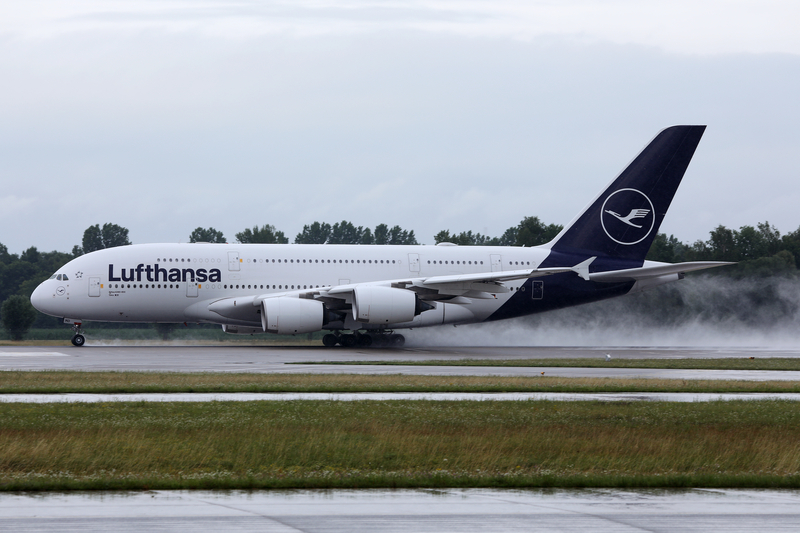
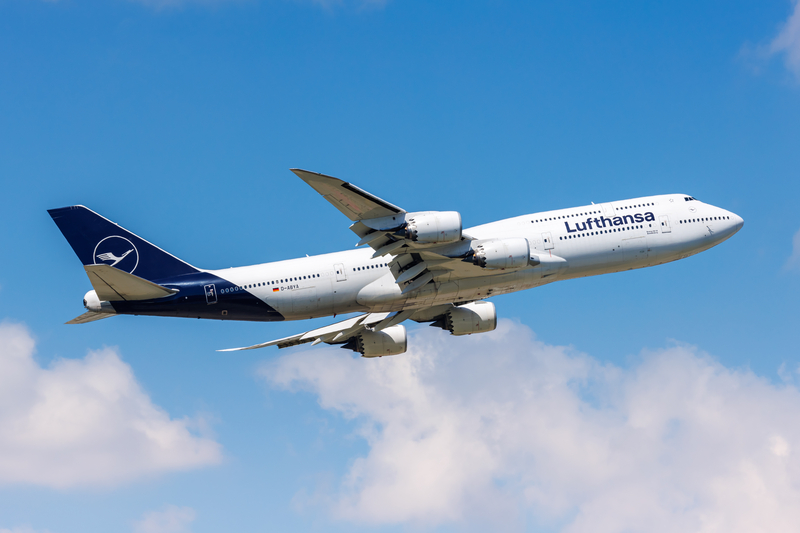
A Lufthansa Airbus A380 operating from San Francisco International Airport (SFO) to Munich Airport (MUC) diverted to Boston Logan International Airport (BOS) after an unruly passenger incident onboard.
The aircraft was operating flight LH459 from San Francisco (SFO) to Munich (MUC).
There were 508 passengers onboard, according to Lufthansa.
Read our stories in your inbox
Two aviation newsletters. Zero fluff.
Massachusetts State Police said a passenger allegedly attacked another passenger during the flight. The person was restrained and the aircraft diverted to Boston (BOS).
After landing, authorities removed the passenger from the aircraft. Lufthansa also removed the passenger’s luggage before the A380 refueled and continued to Munich (MUC).
The Flight Turned Back Over North America
LH459 departed San Francisco (SFO) on Wednesday night.
The flight was bound for Munich (MUC), a scheduled journey of roughly 11 hours.
According to People, the aircraft was about three hours into the flight and flying over northern Canada when the incident forced the crew to change course.
The aircraft initially turned back toward the United States. It later landed at Boston Logan (BOS).
That diversion added several hours to the trip. It also turned a routine overnight transatlantic service into a major operational disruption.
Lufthansa Said Safety Came First
Lufthansa said the diversion was caused by an unruly passenger who posed a threat to the safe continuation of the flight.
That wording matters.
Once a passenger becomes a safety or security risk, the crew must decide whether the flight can safely continue. On a long transatlantic crossing, that decision becomes even more serious.
The aircraft was still on the North American side of the Atlantic. Continuing to Europe would have meant spending several more hours with the situation contained but unresolved.
Diverting to Boston (BOS) allowed the crew to remove the passenger before the aircraft continued across the ocean.
Why Boston Was A Practical Diversion Point
Boston Logan (BOS) was a logical diversion airport.
It is a major international airport with long-haul handling capability, law enforcement support, customs facilities, and ground services.
It also has experience with large aircraft.
Lufthansa has operated scheduled Airbus A380 service between Munich (MUC) and Boston (BOS), so the airport is familiar with the type.
That is important. The Airbus A380 is not a typical widebody. It is the world’s largest passenger aircraft, with a full double-deck cabin and a wingspan of nearly 80 meters.
Not every airport can handle it easily. Gates, taxiway clearance, ground equipment, refueling, towing, baggage handling, and passenger processing all become more complex.
Boston was therefore a far better choice than a smaller airport that might have struggled to handle an unscheduled A380 arrival.
The Aircraft Was Lufthansa’s Largest Passenger Jet
The A380 involved was one of Lufthansa’s flagship long-haul aircraft.
Lufthansa Group lists its Airbus A380-800 with 509 seats. The cabin includes First Class, Business Class, Premium Economy, and Economy.
The aircraft is 73 meters long and 24 meters high. Lufthansa also notes that its A380s are powered by four Rolls-Royce engines.
That capacity explains why the diversion affected so many passengers.
A disruptive passenger incident on a narrowbody may delay 150 to 200 people. On an A380, the number can be more than double that.
In this case, 508 passengers had their journey interrupted.
A380 Diversions Can Become Very Expensive
Lufthansa has not disclosed the cost of this diversion.
Still, the bill was likely significant.
A diversion can involve extra fuel, landing fees, air navigation charges, ground handling, refueling, police response, passenger care, baggage removal, catering, crew planning, and schedule recovery.
The aircraft type adds another layer.
An A380 requires more airport resources than a smaller aircraft. It also carries far more passengers, which increases the scale of customer handling.
Emirates has previously said a single flight diversion can cost anywhere from $50,000 to more than $600,000. The final amount depends on the nature of the diversion and the recovery operation.
That estimate was not specific to this Lufthansa incident. But it shows why large-aircraft diversions can quickly become expensive.
The Flight Continued After Refueling
After the passenger was removed, the aircraft did not remain in Boston.
Lufthansa said the A380 refueled and continued to Munich (MUC).
That suggests the aircraft itself was not the problem. The disruption was tied to the passenger incident.
The process still took time.
For an aircraft carrying more than 500 people, even a straightforward diversion requires coordination. The airline had to manage the passenger removal, baggage offload, refueling, paperwork, crew considerations, and a new departure from Boston (BOS).
The aircraft later continued to Germany with a substantial delay.
Passenger Compensation May Be Limited
Passengers experienced a major delay, but standard compensation may not apply.
Because the flight was operated by an EU airline and arrived in the European Union, EU air passenger rights are relevant.
However, EU rules do not require standard compensation when a delay is caused by extraordinary circumstances that could not have been avoided even if the airline took all reasonable measures.
Unruly passenger incidents are usually treated as safety or security events.
That means Lufthansa may not owe the standard EU261 compensation payment solely because the flight arrived late.
That does not remove all obligations. Airlines may still need to provide care and assistance when delays require it. That can include meals, refreshments, communication, or hotel accommodation, depending on the circumstances.
Each case depends on the details.
Unruly Passenger Cases Remain A Safety Concern
Unruly passenger incidents are more than customer-service problems.
They can become safety events.
In the United States, the Federal Aviation Administration tracks unruly passenger reports and investigates cases involving violations of federal rules or laws.
The FAA can pursue enforcement action when passengers interfere with crew members, refuse crew instructions, threaten others, or behave violently onboard.
This Lufthansa case involved an international flight, a German airline, and a diversion to a U.S. airport. Massachusetts State Police said the incident remained under investigation.
For airlines, the priority is simple. Once a passenger threatens the safe continuation of a flight, the crew must protect the aircraft, passengers, and crew.
That can mean diversion, even when the financial and operational cost is high.
Why Crews Do Not Simply Continue
It may seem tempting to continue if a passenger has already been restrained.
But that is not always the safest option.
A restrained passenger still requires monitoring. The cabin crew must protect nearby passengers. The flight deck must also consider whether the situation could escalate again.
On a long oceanic sector, diversion options become more limited once the aircraft crosses deeper into the Atlantic.
That is why timing matters.
LH459 was still over North America when the crew made the decision. Diverting to Boston (BOS) gave the airline access to police, medical support if needed, ground services, and A380-capable airport infrastructure.
Waiting longer could have reduced the crew’s options.
The A380 Makes The Disruption More Visible
This incident also stands out because the aircraft was an A380.
The superjumbo is rare in today’s airline industry. Many airlines retired the type during or after the pandemic, but Lufthansa returned several A380s to service as long-haul demand recovered.
The aircraft remains popular with passengers. It also gives Lufthansa high-capacity lift on premium long-haul routes from Munich.
But the A380 is less flexible than smaller twin-engine widebodies.
A Boeing 787, Airbus A350, or Airbus A330 can usually be handled at more airports with less complexity. An A380 diversion narrows the list of practical alternate airports.
That does not make the aircraft unsafe. It simply means operational recovery is more complicated when something goes wrong.
A Costly Reminder For Airlines
This incident shows how one passenger can disrupt a full long-haul operation.
The aircraft left San Francisco (SFO) for Munich (MUC), turned back, landed in Boston (BOS), removed the passenger and baggage, refueled, and then continued to Germany.
That sequence affects passengers, crew, airport teams, airline operations control, baggage staff, police, ground handlers, and downstream scheduling.
It also creates cost that the airline may never fully recover.
Lufthansa’s exact bill is unknown. But the size of the aircraft, the number of passengers, and the transatlantic routing all point to a costly disruption.
Bottom Line
Lufthansa flight LH459 from San Francisco (SFO) to Munich (MUC) diverted to Boston (BOS) after an unruly passenger allegedly attacked another passenger onboard.
The Airbus A380 was carrying 508 passengers. The passenger was restrained during the flight, removed by authorities in Boston, and the aircraft continued to Munich after refueling.
The diversion was disruptive and likely expensive. A380 diversions require more coordination than smaller aircraft diversions because of the aircraft’s size, passenger count, and airport-handling needs.
Lufthansa has not disclosed the cost. However, industry estimates show that major diversions can run from tens of thousands to several hundred thousand dollars, depending on the case.
For passengers, it meant a long delay. For Lufthansa, it meant an expensive operational recovery. For the crew, the decision was clear: once the passenger posed a threat to the safe continuation of the flight, landing at a suitable airport was the right call.
Keep reading FlyMag
Get the Daily Brief in the morning or the Route Watch weekly recap on Fridays. Or both.