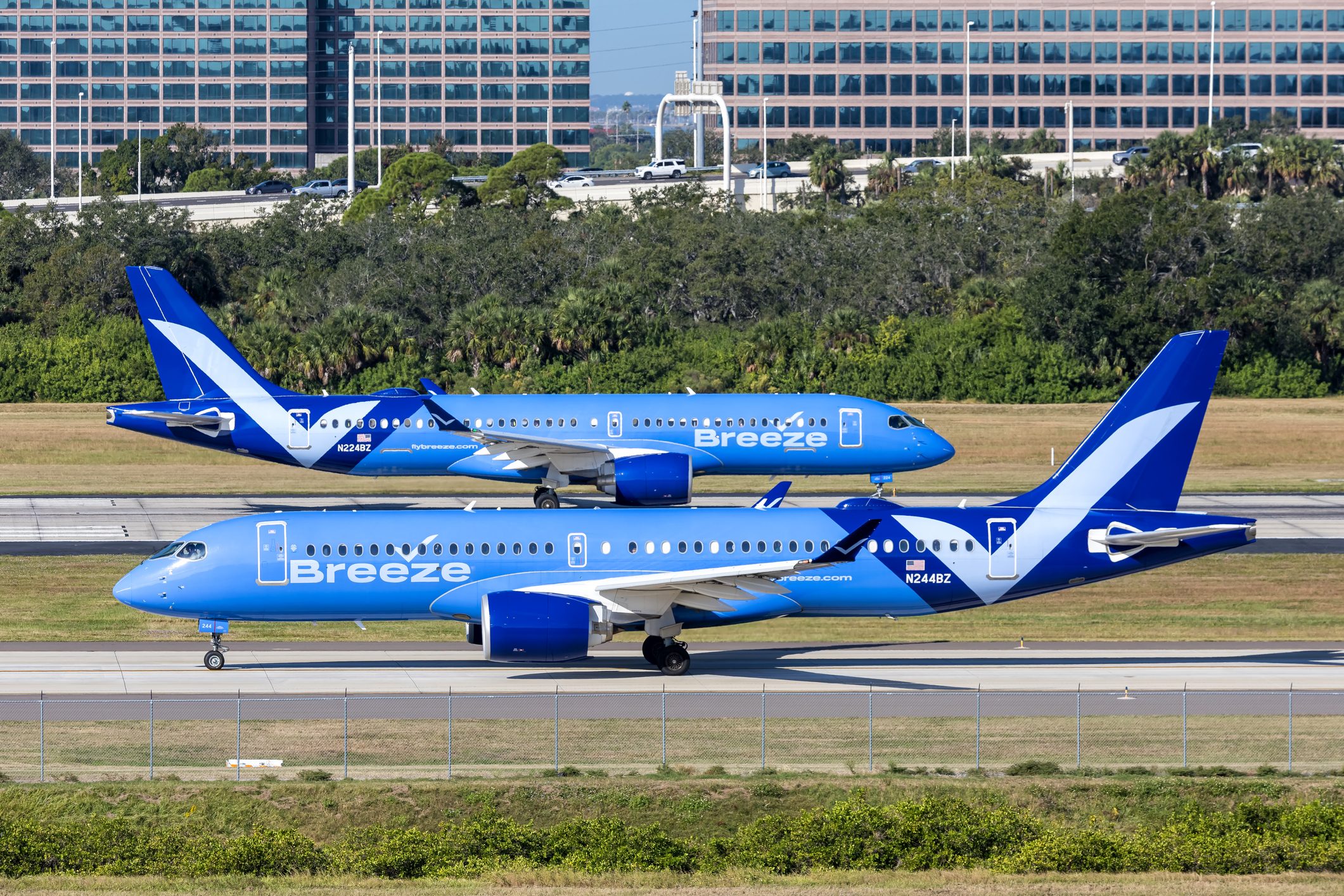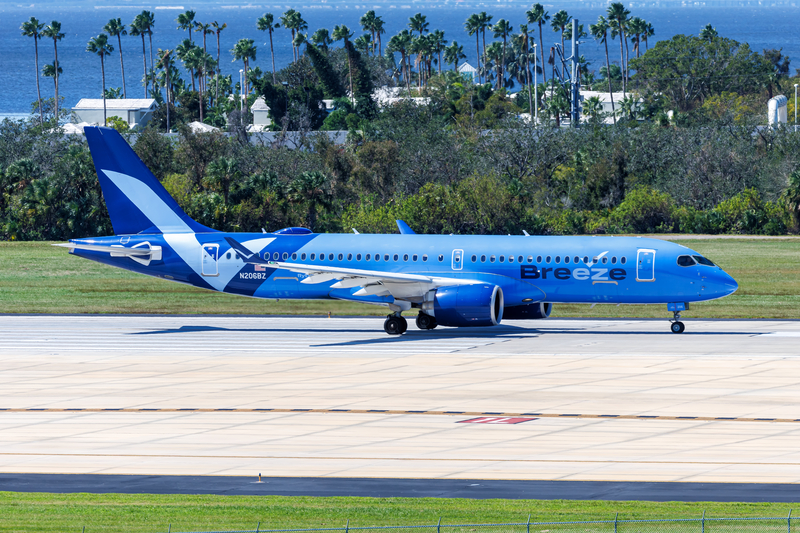
Breeze Airways has dropped nine routes from its network when comparing its spring and summer 2026 schedule with the same April-to-September period last year. On its own, that sounds like a significant retrenchment. In context, it is much more consistent with how Breeze has always built its network: launch aggressively, test quickly, and pull out of markets that do not fit.

That is the key to understanding these cuts. Breeze is not behaving like a traditional hub airline defending every route for strategic visibility. It is behaving like a newer-point-to-point carrier that treats network flexibility as part of the model.
The 9 Routes Breeze Has Ended
The routes no longer operating in the comparable April-to-September window are:
Read our stories in your inbox
Two aviation newsletters. Zero fluff.
- Raleigh/Durham to Los Angeles
- Greenville/Spartanburg to Westchester
- Akron/Canton to Los Angeles
- Huntsville to Los Angeles
- Norfolk to Syracuse
- Tampa to Orange County
- Stewart to Vero Beach
- Orlando to Plattsburgh
- Louisville to New Orleans
Some of these ended in 2025 and therefore disappear from the 2026 spring-summer map. Others ran into early 2026 before being removed. The common thread is that Breeze no longer sees enough value in carrying them into the current comparable season.
This Is Not A Full Retreat
The headline route cuts need context.
Breeze remains one of the most expansion-minded airlines in the United States. Over the same broad comparison period in which it dropped these nine routes, it also introduced or resumed dozens of others. That matters because the route cuts are not evidence of a carrier shrinking back wholesale. They are evidence of a carrier continuing to prune while it grows elsewhere.
This is one of the defining features of Breeze’s model. It enters underserved or unserved markets, often at low frequency, and keeps only the ones that prove durable enough.
Raleigh/Durham–Los Angeles Is The Most Revealing Cut
Of the nine, Raleigh/Durham to Los Angeles is arguably the most interesting.
On paper, it is a large and healthy market. The broader RDU–Los Angeles basin supports substantial traffic, and Breeze was not trying to invent demand from nothing. But that is also exactly the problem. Breeze entered a market already dominated by stronger incumbent airlines with deeper schedules and much larger customer bases.
That meant Breeze’s share remained relatively small, even though the route itself had volume. In other words, the market was attractive, but not necessarily attractive for Breeze.
This is a good reminder that strong traffic alone does not guarantee a route works for every airline. Competitive position matters just as much.
The California Pullbacks Suggest Selectivity On Longer A220 Missions
Several of the discontinued routes involve longer flying to California, especially Los Angeles and Orange County.
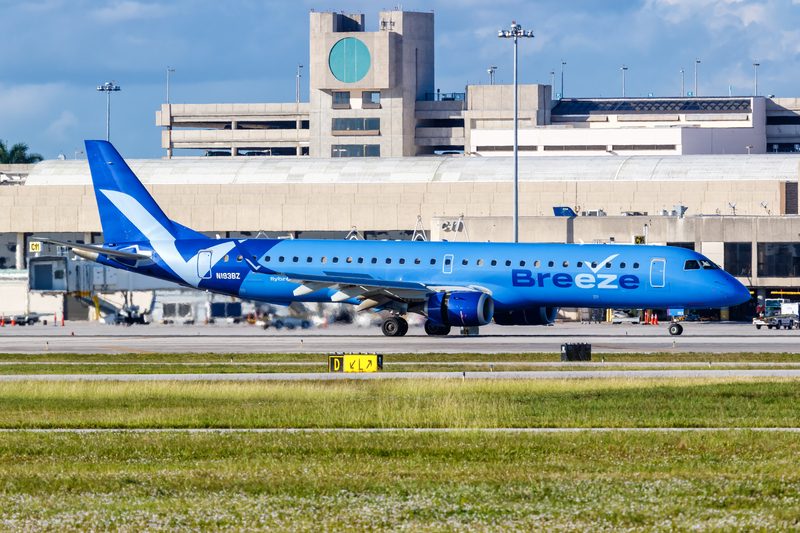
That stands out because Breeze has used the Airbus A220-300 to do things most U.S. low-cost carriers historically avoided: relatively thin, long domestic sectors. The aircraft makes that possible, but “possible” does not always mean “best use of the airplane.”
Longer sectors tie up aircraft for more block hours and can become less attractive if yields are not strong enough or if the route depends too heavily on a single daily pattern. That appears to be part of what happened with some of these transcontinental markets. Breeze may simply see better returns using its A220s elsewhere.
Tampa–Orange County Shows How Thin Some Of These Bets Were
Tampa to Orange County is a good example of the kind of route Breeze was willing to try.
It connected two attractive markets, but it also depended on a constrained California airport, a long stage length, and an aircraft pattern that did not necessarily give the route much operational slack. Routes like this can work, but they often need a very specific mix of local demand, timing, and aircraft utilization to hold up.
When a carrier like Breeze cuts such a route, it usually does not mean the concept was irrational. It means the margin for success was narrower than the airline wanted.
Louisville–New Orleans And Some Smaller Markets Reflect Early-Network Cleanup
A route like Louisville to New Orleans tells a slightly different story.
This was one of Breeze’s earlier routes, and its disappearance shows how newer airlines often cycle through their first-wave network ideas once real operating data arrives. Early routes are sometimes as much about testing a model as they are about long-term certainty.
That makes these cuts unsurprising. Breeze is now old enough as an airline to start cleaning up some of its earliest experiments.
Breeze Still Thinks Like A Market Tester, Not A Legacy Carrier
That may be the most important conclusion.
Traditional airlines often treat route exits as reputationally negative and therefore move cautiously. Breeze seems more willing to accept churn as part of the strategy. It launches a lot, keeps what works, and exits what does not fit the network or fleet plan.
That can make the route map look unstable from the outside. But it is also one reason the airline has been able to grow into so many niche markets so quickly.
Bottom Line
Breeze Airways has cut nine routes from its spring-summer network, including Raleigh/Durham–Los Angeles, Tampa–Orange County, and Louisville–New Orleans. But the broader takeaway is not that Breeze is retreating. It is that Breeze is continuing to refine its network the way it always has: rapidly, selectively, and without much sentiment.
Some of these markets were too competitive. Some were too thin. Some simply did not justify the aircraft time. For Breeze, that is not failure. It is fleet and network discipline.
Keep reading FlyMag
Get the Daily Brief in the morning or the Route Watch weekly recap on Fridays. Or both.