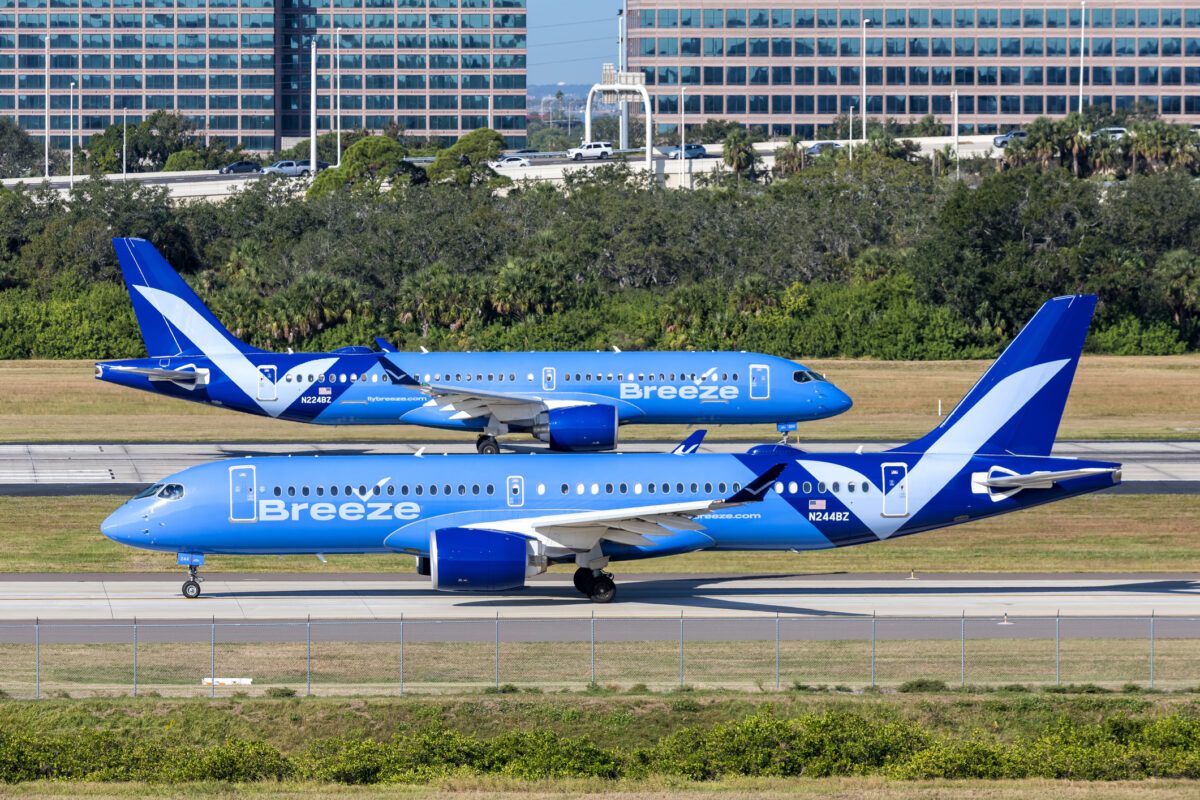
Breeze Airways has expanded rapidly since operating its first commercial flight in May 2021, building a network focused largely on nonstop routes that larger U.S. airlines have ignored.

The low-cost carrier expects to serve more than 90 cities during its currently published August 2026 through February 2027 schedule. It has also carried more than 17 million passengers through April 2026, according to U.S. Department of Transportation data cited in a review of Breeze’s network.
However, Breeze’s growth has not been uninterrupted. Six airports that previously received scheduled service no longer have flights in the airline’s current booking window:
Read our stories in your inbox
Two aviation newsletters. Zero fluff.
- Will Rogers International Airport (OKC) in Oklahoma City
- Nashville International Airport (BNA)
- Tulsa International Airport (TUL)
- Mobile International Airport (BFM)
- Plattsburgh International Airport (PBG)
- Montrose Regional Airport (MTJ)
The list should not necessarily be interpreted as six permanent withdrawals. Breeze frequently adjusts seasonal routes, and the absence of future inventory does not prevent an airport from returning later. Nevertheless, these six markets illustrate how aggressively the airline tests, modifies, and removes routes while expanding elsewhere.
Breeze’s Early Oklahoma Network Did Not Last
Oklahoma City and Tulsa were among the airports Breeze tested during its first years of operation.
From Will Rogers International Airport (OKC), Breeze offered service to destinations including Nashville International Airport (BNA), Louis Armstrong New Orleans International Airport (MSY), San Antonio International Airport (SAT), and Tampa International Airport (TPA).
Tulsa International Airport (TUL) received an even broader collection of routes, including service to Nashville Airport (BNA), Orlando International Airport (MCO), New Orleans Airport (MSY), San Antonio Airport (SAT), and Tampa Airport (TPA).
Some of those routes were launched during the difficult operating environment of 2021, when travel patterns were still being affected by the COVID-19 pandemic. Breeze’s Oklahoma City Airport (OKC)–San Antonio Airport (SAT) and Tulsa Airport (TUL)–San Antonio Airport (SAT) services operated between July and November 2021, with both reportedly filling fewer than 34% of available seats.
Low load factors do not provide a complete picture of route performance because ticket prices, ancillary revenue, operating costs, and aircraft utilization also matter. However, filling fewer than one-third of the seats would make it difficult for a new route to remain financially sustainable without unusually strong fares or other strategic benefits.
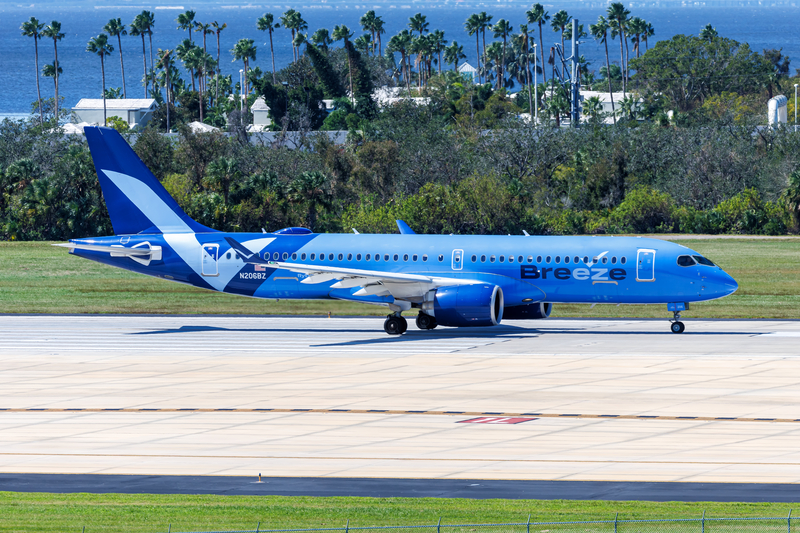
Breeze later introduced its Airbus A220-300 on selected Tulsa routes, including Tulsa Airport (TUL)–Tampa Airport (TPA). The aircraft offered a more efficient platform than the Embraer regional jets used during the airline’s initial launch period, but improved aircraft economics could not guarantee that every thin nonstop market would support year-round service. Tulsa International Airport documented the A220 introduction in May 2022.
Breeze has since returned to San Antonio Airport (SAT) with other routes, but Oklahoma City Airport (OKC) and Tulsa Airport (TUL) remain absent from its currently published destination schedule.
Nashville Was a Short-Lived Breeze Market
Breeze announced four new routes from Nashville International Airport (BNA) in March 2022, connecting the Tennessee airport with Akron-Canton Airport (CAK), Bradley International Airport (BDL), Oklahoma City Airport (OKC), and Tulsa Airport (TUL).
The services were designed around Breeze’s core strategy of linking medium-sized cities that lacked convenient nonstop flights. Nashville Airport (BNA) appeared to be a logical addition because of the city’s growing population, tourism sector, and business market.
However, Nashville is also one of the most competitive airports in the United States. Southwest Airlines has a particularly large operation at Nashville Airport (BNA), while several other carriers have continued adding flights and seats. Breeze’s four routes disappeared after a relatively brief operating period, leaving the airline without scheduled Nashville service.
The withdrawal demonstrates that a large and fast-growing airport is not automatically an ideal market for Breeze. The airline performs best when it can stimulate demand on routes with limited nonstop competition, rather than entering airports where travelers already have numerous schedules and fare options. Nashville International Airport’s original announcement detailed the four-city Breeze operation.
Mobile International Lost Its Only Scheduled Passenger Service
Breeze began flying between Mobile International Airport (BFM) and Orlando International Airport (MCO) on April 10, 2024.
The twice-weekly service operated on Wednesdays and Saturdays using an Airbus A220-300. The aircraft continued beyond Orlando Airport (MCO) to Rhode Island T. F. Green International Airport (PVD) as a BreezeThru flight, allowing passengers to remain aboard during the stop.
Mobile International Airport (BFM) is located closer to downtown Mobile than Mobile Regional Airport (MOB), but it had not yet become the city’s principal commercial passenger airport. Breeze’s arrival was intended to demonstrate the potential of the downtown facility ahead of a much larger planned terminal development.
The experiment lasted less than a year. Breeze ended the Orlando Airport (MCO) route on January 31, 2025, leaving Mobile International Airport (BFM) without scheduled passenger flights. Airport officials attributed the withdrawal primarily to insufficient passenger volume. Mobile Airport Authority announced the original Breeze service, including the planned use of the A220.
Breeze’s departure does not mean Mobile International Airport (BFM) has been abandoned as a commercial aviation project. The airport’s new passenger terminal remains scheduled to open in fall 2026, with American Airlines, Delta Air Lines, and United Airlines expected to transfer their Mobile operations from Mobile Regional Airport (MOB).
The new Mobile International Airport terminal is therefore expected to transform BFM into the city’s main passenger gateway. Breeze simply left before that transition occurred.
Plattsburgh’s Canadian Snowbird Strategy Fell Short
Breeze launched service at Plattsburgh International Airport (PBG) in November 2023 with flights to Orlando International Airport (MCO). Seasonal service to Tampa International Airport (TPA) followed in February 2024.
Plattsburgh Airport (PBG) is approximately 65 miles south of Montreal and has historically marketed itself to Canadian travelers seeking lower U.S. airfares. Breeze’s Florida routes were aimed heavily at Quebec residents traveling south during the winter.
The concept generated passengers, but apparently not enough revenue to maintain the operation. The Orlando Airport (MCO) route reportedly achieved a load factor of 68.2%, while Tampa Airport (TPA) reached 73.4%. Those results were not disastrous for a developing route, but load factor alone does not show whether fares were high enough to cover costs.
Breeze’s Tampa service operated for only a short period, while the broader Plattsburgh operation was paused at the end of April 2025. The airline initially described the move as a seasonal suspension and indicated that flights might return in 2026, but no Plattsburgh Airport (PBG) service appears in its current schedule.
The timing also coincided with weaker cross-border travel. Local officials said Canadians represented approximately half of Breeze’s Plattsburgh passengers, making the routes particularly sensitive to exchange rates, border-crossing trends, and Canadian demand for U.S. leisure travel. Local reporting on the Plattsburgh suspension noted that cross-border traffic had declined before the airline’s exit.
Montrose Is Breeze’s Most Recent Airport Exit
Montrose Regional Airport (MTJ) is the most recent addition to the list.
Breeze connected Montrose Airport (MTJ) with Orange County John Wayne Airport (SNA), targeting travelers heading between Southern California and the mountain resorts of western Colorado. The route was particularly useful for passengers visiting Telluride and surrounding ski destinations without connecting through Denver International Airport (DEN).
The service ended in April 2026, and no additional flights are currently available for booking. Breeze still maintains destination-related pages for Montrose, but its published schedule does not show an active return.
Montrose Airport (MTJ) is a highly seasonal market. Winter demand can be strong because of nearby ski resorts, but traffic outside peak periods is much thinner. Routes of this type can perform well during holiday and ski-season peaks while remaining difficult to support across a longer schedule.
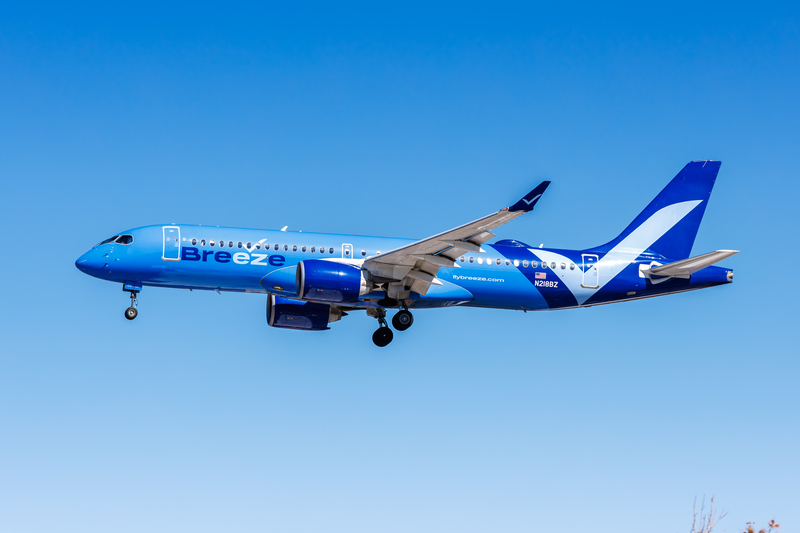
The Airbus A220-300 was well suited to the market because it combines transcontinental range with lower capacity than many Boeing 737 or Airbus A320-family aircraft. Breeze configures its Airbus A220-300 with 137 seats, allowing the airline to serve thinner long-distance routes that might not support a larger narrowbody.
Even so, the A220 cannot make a route successful if seasonal demand, fares, or aircraft utilization do not meet the airline’s targets.
Denver Is a Seasonal Gap, Not a Confirmed Exit
Denver International Airport (DEN) should not be added to the six-airport list.
Breeze has significantly shortened the operating season for its route between Rhode Island T. F. Green International Airport (PVD) and Denver Airport (DEN). The service operated from May through December in 2024 but was reduced to a June-through-August period in 2025 and 2026.
No flights are currently available during the winter 2026/27 booking period, but Breeze continues to list Denver Airport (DEN) among its destinations. The airline also openly notes that some of its routes are seasonal and may not appear throughout the entire booking calendar.
The absence of winter inventory therefore does not provide enough evidence to classify Denver as a complete network withdrawal. Breeze could restore Providence Airport (PVD)–Denver Airport (DEN) service in summer 2027, although no return should be treated as confirmed until flights are loaded for sale.
Network Pruning Is Central to Breeze’s Strategy
Breeze was created around the idea that hundreds of U.S. city pairs have enough demand to support nonstop flights but not enough to attract the largest airlines.
That approach creates substantial growth opportunities, but it also requires experimentation. Historical passenger data can indicate how many people travel between two regions, yet it cannot fully predict how many passengers will switch from connecting itineraries, accept limited weekly frequencies, or pay fares high enough to make a nonstop service profitable.
Breeze reduces some of that risk with the Airbus A220-300. The 137-seat aircraft offers the range to fly across the United States while carrying fewer passengers than a typical Boeing 737-800 or Airbus A321neo. Its operating economics allow Breeze to consider routes that would be difficult for airlines using larger aircraft.
The airline also limits risk by operating many routes only two or three times per week. If demand develops, Breeze can add frequencies or extend the operating season. When a route underperforms, it can remove the service and reposition the aircraft elsewhere.
That flexibility helps explain how Breeze can simultaneously add dozens of destinations while leaving six airports behind. Breeze’s current network now extends to more than 90 cities and includes over 300 year-round and seasonal nonstop routes.
Bottom Line
Breeze Airways no longer schedules flights to six airports it previously served: Oklahoma City Airport (OKC), Nashville Airport (BNA), Tulsa Airport (TUL), Mobile International Airport (BFM), Plattsburgh Airport (PBG), and Montrose Airport (MTJ).
The airports represent several different types of unsuccessful or discontinued experiments. Oklahoma City, Tulsa, and Nashville were part of Breeze’s early network development. Mobile tested a downtown airport before its new terminal was complete. Plattsburgh targeted Canadian snowbirds, while Montrose depended heavily on seasonal resort traffic.
The exits do not suggest that Breeze’s broader expansion has stalled. The airline now serves more than 90 cities and continues to introduce routes at a rapid pace. Instead, the changes demonstrate the importance of network discipline for an airline built around unproven, low-frequency city pairs.
Some of these airports could eventually return. Until Breeze reloads the routes for sale, however, all six remain outside its active published schedule.
Keep reading FlyMag
Get the Daily Brief in the morning or the Route Watch weekly recap on Fridays. Or both.