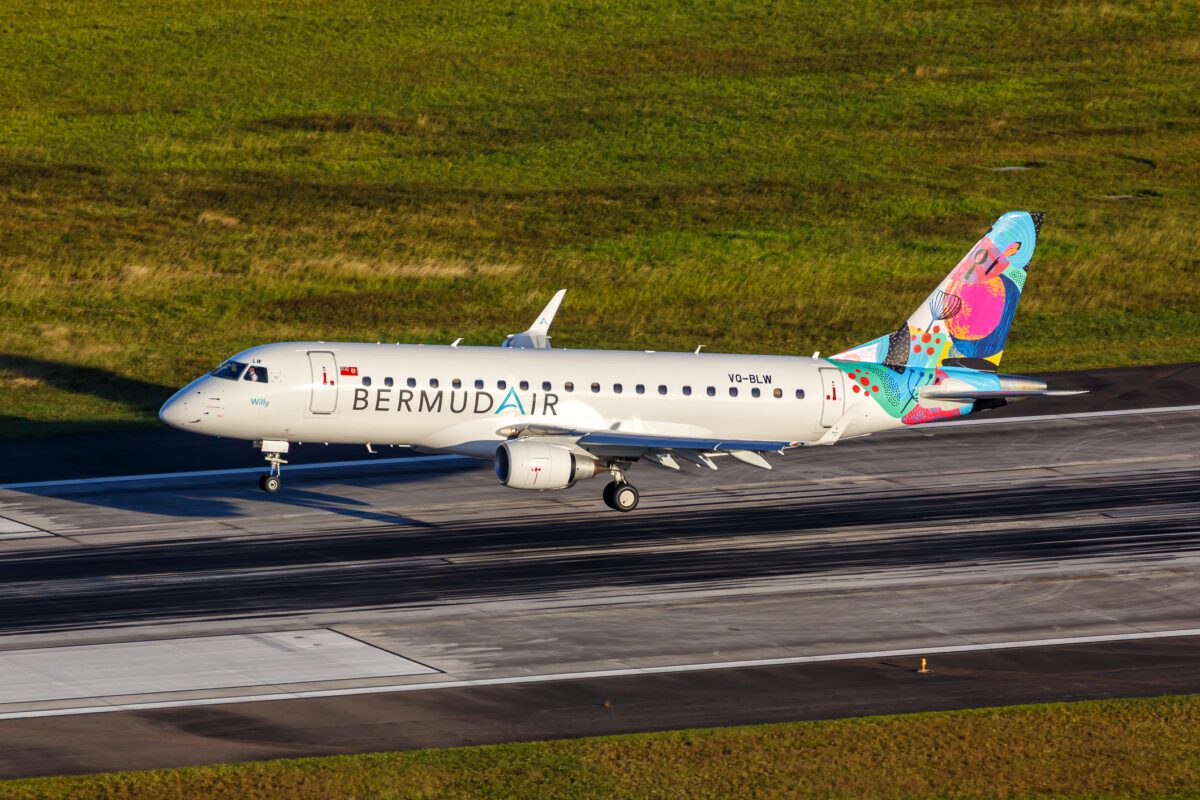
BermudAir has placed a firm order for 10 Airbus A220-300s, giving the young island carrier an aircraft capable of supporting a much larger network across Bermuda, the Caribbean, Central America and North America.
The deal marks BermudAir’s first direct commitment to an Airbus aircraft program and represents a significant change in scale for an airline that currently operates a fleet of four Embraer regional jets.
Airbus officially disclosed the order at the 2026 Farnborough International Airshow on July 22. However, the manufacturer had already included the 10 aircraft in its March 2026 order book under the name of an unidentified customer.
Read our stories in your inbox
Two aviation newsletters. Zero fluff.
According to BermudAir’s announcement, the order was placed through affiliated company Odyssey. Deliveries are scheduled to begin during the fourth quarter of 2027.
The aircraft will be configured with 135 seats across three cabin classes, giving BermudAir substantially more capacity than its existing Embraer E175s and E190s while preserving the premium-oriented product that has become central to the airline’s identity.
A Major Commitment for a Four-Aircraft Airline
BermudAir began scheduled operations from L.F. Wade International Airport (BDA) in September 2023 with two Embraer E175 regional jets.
It subsequently added two larger Embraer E190s, bringing its fleet to four aircraft. The E175s are configured with 70 seats, while the E190s accommodate 96 passengers.
The 135-seat A220-300 will therefore provide approximately 41% more capacity than BermudAir’s E190 and nearly twice as many seats as its E175.
That additional capacity will lower seat costs, but it also raises the commercial risk associated with each departure. BermudAir will need to generate substantially more demand to maintain strong load factors, particularly on routes that are currently supported by aircraft carrying fewer than 100 passengers.
The airline is not treating the 10-aircraft order as the limit of its ambitions. CEO and founder Adam Scott told Reuters that BermudAir intends to operate as many as 20 A220s by 2030.
The carrier also plans to use the type as an eventual replacement for its Embraer E190 fleet. The E-Jets are expected to remain in service for several years as the first A220s arrive and BermudAir gradually builds enough capacity to support the transition.
For an airline of BermudAir’s size, operating both Embraer and Airbus aircraft will create additional pilot training, maintenance, spare-parts and scheduling requirements. A gradual introduction should allow the carrier to manage those expenses while avoiding a sudden reduction in available capacity.
The A220 Will Arrive in Late 2027
BermudAir expects its first Airbus A220-300 to arrive during the fourth quarter of 2027.
That gives the airline more than a year to prepare pilots, cabin crews, maintenance personnel and ground operations for an entirely new aircraft family.
The carrier will also need to establish appropriate technical support at L.F. Wade International Airport (BDA), including tooling, spare parts, ground equipment and arrangements for heavier maintenance that cannot be performed in Bermuda.
The lengthy preparation period will also allow BermudAir to continue developing its network before introducing the larger aircraft. The airline currently serves 11 routes but expects to more than double that figure by the end of 2026.
Its expansion includes additional service involving Bermuda Airport (BDA), as well as flights linking U.S. cities with Anguilla’s Clayton J. Lloyd International Airport (AXA), Providenciales International Airport (PLS) in Turks and Caicos and Philip S. W. Goldson International Airport (BZE) in Belize.
BermudAir is therefore evolving beyond an airline focused exclusively on bringing passengers to and from Bermuda. It is building a broader premium leisure network connecting island destinations with cities along the eastern United States.
The A220-300 gives it the range and capacity to pursue that strategy more aggressively.
BermudAir Plans a 135-Seat, Three-Class Cabin
BermudAir’s A220-300s will seat 135 passengers in a three-class configuration.
The airline has not released a complete seat map or disclosed how many seats will be allocated to each cabin. However, the aircraft will include a dedicated Premium Economy section in addition to Business Class and Economy Class.
A 135-seat layout is relatively spacious for an aircraft that Airbus certifies for significantly more passengers. The A220-300 can accommodate between 100 and 160 seats, depending on an airline’s cabin configuration and service model.
BermudAir’s decision to stop at 135 seats should allow it to provide additional space in its premium cabins while retaining enough Economy Class capacity to reduce unit costs.
The airline is also evaluating the type of reclining premium seat used by Breeze Airways on its A220-300s. A final Business Class seat has not been announced, so BermudAir could still select a different supplier or configuration before deliveries begin.
New XL overhead bins will be installed throughout the aircraft. Airbus says the redesigned bins provide approximately 20% more carry-on capacity than the A220’s original overhead compartments.
BermudAir also plans to introduce onboard Wi-Fi with the new fleet. Its current Embraer aircraft do not offer internet connectivity, making the A220 an opportunity to improve both the physical cabin and the airline’s digital passenger experience.
Why the A220 Fits BermudAir’s Network
The A220-300 was designed specifically for the market between traditional regional jets and larger narrowbody aircraft such as the Airbus A320neo and Boeing 737 MAX 8.
It provides more capacity and range than BermudAir’s Embraer E175s and E190s without forcing the airline to move directly into an aircraft carrying 170 to 190 passengers.
Airbus lists a maximum range of approximately 3,600 nautical miles, or 6,700 kilometers. That is far more than BermudAir requires for its existing flights between Bermuda Airport (BDA) and the eastern United States.
The additional range is important because it expands the number of cities BermudAir can serve nonstop from Bermuda and other island markets.
From L.F. Wade International Airport (BDA), the A220 could comfortably reach destinations throughout the continental United States, eastern Canada, Central America and the Caribbean. Its published range could also make selected longer routes possible, although actual performance would depend on passenger loads, cargo, winds, fuel reserves and airport conditions.
The aircraft is particularly well suited to long, relatively thin routes that may not generate enough traffic for an A320 or 737 but are beyond the ideal operating profile of a smaller regional jet.
That gives BermudAir the ability to open new destinations with more favorable seat economics while avoiding the capacity of a full-size mainline narrowbody.
Performance Matters at Island Airports
BermudAir cited the A220’s performance at operationally constrained airports as one of the reasons for selecting the type.
Island airports can present a combination of short runways, high temperatures, limited diversion options and restricted ground infrastructure. Even where runway length is adequate, an airline must account for the fuel required to reach suitable alternate airports if weather or another disruption prevents landing.
The A220’s modern wing, relatively low operating weight and Pratt & Whitney geared turbofan engines provide strong takeoff and climb performance for its capacity category.
This can allow an airline to carry more passengers, baggage or fuel under conditions where an older aircraft might require payload restrictions.
Not every airport in BermudAir’s network is highly constrained. L.F. Wade International Airport (BDA), for example, has a runway capable of supporting transatlantic widebody operations. The greater advantage may emerge as BermudAir expands into smaller Caribbean and Central American airports.
The A220 can provide useful field performance without sacrificing the range needed to connect those airports directly with distant U.S. markets.
A Noticeably Different Passenger Cabin
The A220’s cabin will represent a major change from BermudAir’s current Embraer aircraft.
Economy Class is normally arranged with five seats per row in a two-three configuration. That means only one passenger in each row receives a middle seat, compared with two middle seats in the six-abreast layout used on an Airbus A320 or Boeing 737.
Airbus lists standard A220 Economy seats at more than 18 inches wide, with the middle seat on the three-seat side measuring approximately 19 inches.
The cabin also has large windows, vertical sidewalls and a wider aisle than many regional aircraft. These features make the interior feel more like a larger mainline jet despite the A220’s relatively modest passenger capacity.
Business Class can be configured with four seats per row in a two-two layout. Unlike European-style Business Class products that simply block an Economy middle seat, BermudAir has the opportunity to install wider, purpose-built premium seats.
The aircraft should also be quieter than BermudAir’s current-generation E-Jets. Airbus designed the A220 around two Pratt & Whitney PW1500G geared turbofan engines, which reduce fuel consumption and external noise compared with many previous-generation aircraft.
Those characteristics fit BermudAir’s attempt to position itself as a premium leisure airline rather than a conventional low-cost carrier.
Lower Fuel Burn Is Only Part of the Economic Case
Airbus says the A220 provides approximately 25% lower fuel consumption and carbon dioxide emissions per seat than previous-generation aircraft in its market segment.
That claim is based on a per-seat comparison. BermudAir will still be operating a larger and heavier aircraft than its current E175s and E190s, meaning the total fuel burned on an individual flight will not necessarily be lower.
The economic advantage comes from spreading the aircraft’s operating costs across 135 passengers rather than 70 or 96.
That works well when demand supports the additional seats. If the aircraft departs with a low load factor, the benefits of its improved per-seat economics become more difficult to realize.
BermudAir will therefore need to match aircraft deployment carefully to seasonal demand. The airline’s busiest routes from Bermuda Airport (BDA), including services to Boston Logan International Airport (BOS), Fort Lauderdale-Hollywood International Airport (FLL) and the New York area, are natural candidates for the A220.
Smaller or less frequent markets may continue to use Embraer aircraft during the transition, particularly where 135 seats would exceed demand.
The A220 also offers additional cargo capacity, which could be valuable for an island economy that depends heavily on imported goods. Belly cargo and mail can provide meaningful supplemental revenue, especially on flights where passenger demand varies seasonally.
The A220 Order Supports a Much Broader Airline
BermudAir initially built its network around nonstop flights connecting Bermuda Airport (BDA) with cities in the United States and Canada.
Its strategy is now expanding through AnguillAir and additional services to Turks and Caicos and Belize.
The planned network includes six U.S. routes to Providenciales International Airport (PLS) and five routes to Philip S. W. Goldson International Airport (BZE), along with expanded seasonal service to Anguilla Airport (AXA).
This creates a different type of airline.
Rather than relying solely on Bermuda residents and visitors, BermudAir can sell premium leisure flights from multiple U.S. cities to several island destinations. Aircraft can potentially rotate between Bermuda, the Caribbean and North America rather than returning to BDA after every trip.
The A220’s range provides the flexibility required for that network, while its 135-seat configuration remains small enough to serve leisure routes that may not support a larger narrowbody every day.
Airbus described the order as introducing the A220 to a distinct new operating environment in the Atlantic and Caribbean. A220s already fly into parts of the Caribbean with North American airlines, but BermudAir will establish the type with a locally based island carrier and use it as the foundation of a regional network.
The A220 Program Continues to Grow
BermudAir joins an increasingly diverse group of A220 customers.
At the end of June 2026, Airbus had delivered 526 A220s to more than 25 operators. The program had accumulated more than 1,100 historical orders from over 35 customers.
The A220 was originally developed by Bombardier as the CSeries before Airbus assumed majority control of the program in 2018. Aircraft are assembled in Mirabel, Quebec, and at Airbus’ production facility in Mobile, Alabama.
The family consists of the smaller A220-100 and the larger A220-300 selected by BermudAir. The -300 has become the more commercially successful version because it combines a relatively low trip cost with capacity closer to that of a small mainline narrowbody.
For BermudAir, joining an established program provides access to a growing international maintenance and supplier network. It also means competing for delivery positions in an order book that now extends several years into the future.
Bottom Line
BermudAir’s order for 10 Airbus A220-300s is far more than a routine fleet expansion.
The 135-seat aircraft will provide approximately 41% more capacity than the airline’s Embraer E190s, significantly longer range and lower operating costs per seat. It will also introduce a three-class cabin, larger overhead bins and planned onboard Wi-Fi.
Deliveries are scheduled to begin in the fourth quarter of 2027, giving BermudAir time to develop its expanding network and prepare for an entirely new aircraft family.
The airline ultimately plans to operate as many as 20 A220s by 2030 and gradually replace its Embraer E190 fleet. That would transform BermudAir from a four-aircraft island carrier into a much larger regional airline connecting Bermuda, the Caribbean, Central America and North America.
The A220 gives BermudAir the technical capability to pursue that plan. The more difficult challenge will be generating enough year-round demand to fill 135 seats across a rapidly expanding network.
Keep reading FlyMag
Get the Daily Brief in the morning or the Route Watch weekly recap on Fridays. Or both.