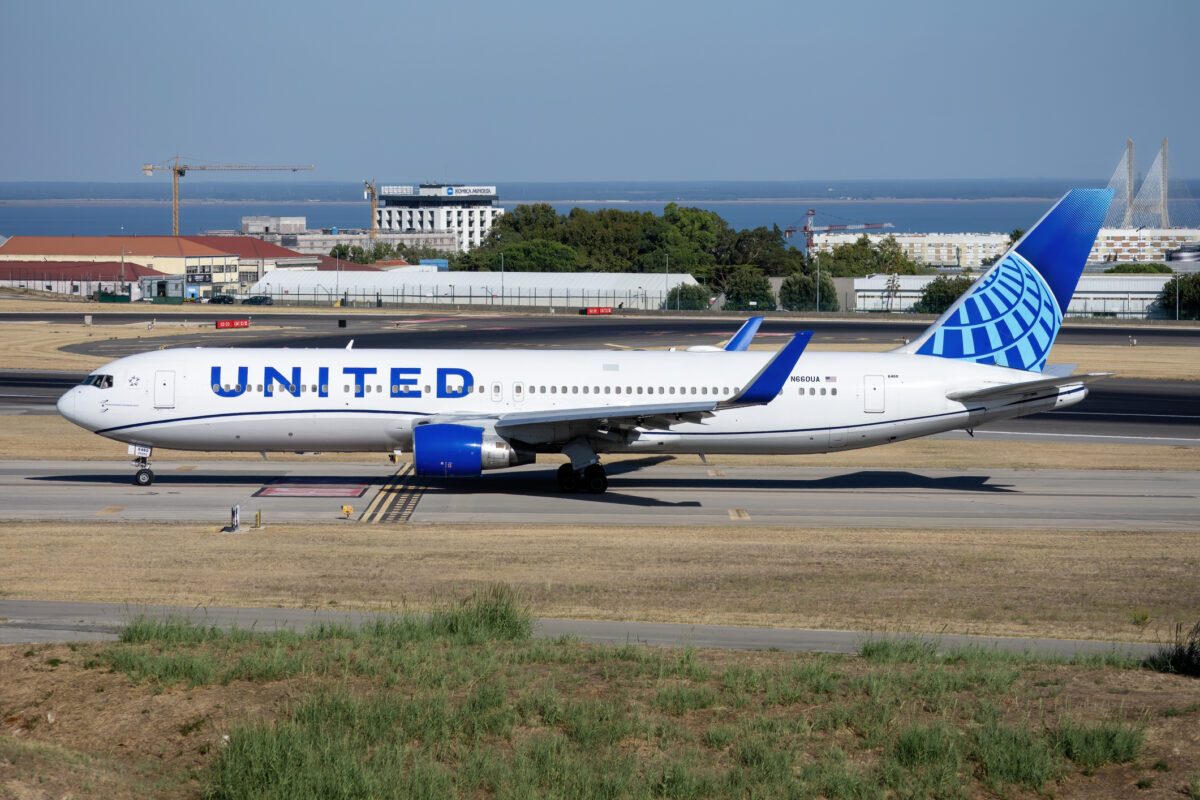
A United Airlines Boeing 767-300ER operating from London Heathrow (LHR) to Newark (EWR) returned to Heathrow on Thursday, October 15, after transmitting the emergency transponder code 7700.

Flight UA941 departed LHR at 4:05 p.m. local time, five minutes behind schedule, before turning back during the initial portion of its westbound transatlantic flight. AirNav Radar’s flight record identifies the aircraft as N686UA and records a flight duration of about two hours, ending back at Heathrow.
The 767 landed safely. No primary-source statement available by publication time identified the reason for the return, and FlyMag is not attributing the incident to any specific aircraft system.
Read our stories in your inbox
Two aviation newsletters. Zero fluff.
Emergency Code Appeared More Than an Hour After Departure
Open ADS-B records show that N686UA began transmitting code 7700 at 4:22 p.m. UTC, or 5:22 p.m. in London. The ADSB IQ emergency log associates the transmission with callsign UAL941, aircraft type B763 and manufacturer serial number 33468.
The tracking record continued to show the emergency code after the aircraft reached Heathrow, with its final recorded position near the airport at low ground speed. The sequence is consistent with the aircraft retaining the emergency setting through landing and the initial ground response.
Flight tracking places the return roughly two hours after the 4:05 p.m. departure. UA941 had been scheduled to arrive at EWR at 7:20 p.m. Eastern time following an eight-hour, 20-minute block time. Its planned track covered approximately 3,004 nautical miles.
Returning to LHR kept the aircraft at a major United outstation with established maintenance, passenger-handling and crew support. It also avoided continuing into the North Atlantic operating environment after the emergency condition had been identified.
What the 7700 Transmission Establishes
Code 7700 identifies an aircraft in an emergency state but does not communicate the nature or severity of the event. UK operating rules published by the Civil Aviation Authority direct pilots to select 7700 to indicate an emergency unless air traffic control has already assigned another code.

The transmission gives controllers an immediate and conspicuous indication of the aircraft’s status. It can accompany a range of situations, from a systems malfunction to smoke, a medical event or another condition requiring priority handling. The code alone cannot support a diagnosis.
In UA941’s case, the independently recorded facts are the 7700 transmission, the reversal of course and the safe return to Heathrow. Reports assigning a specific technical cause should be treated separately from those verified operating details unless United or an investigating authority provides confirmation.
A Premium-Heavy Boeing 767 Operation
N686UA is a Boeing 767-300ER, serial number 33468. A United aircraft financing disclosure identifies the airframe as having entered service in January 2003, making it approximately 23 years old at the time of Thursday’s return. The same disclosure lists a 407,000-pound maximum takeoff weight and Pratt & Whitney PW4060-series powerplants.
The 767-300ER remains well matched to missions such as London-Newark: long enough to cover the route comfortably while offering less capacity than United’s Boeing 777 and 787 fleets. Its twin-aisle cabin and lower gauge also allow the airline to sustain multiple frequencies in business-heavy transatlantic markets.

United has used particularly premium-dense 767-300ERs between Newark and London. When it introduced the configuration across the route, the airline described a cabin with 46 Polaris business-class seats, 22 Premium Plus seats, 47 Economy Plus seats and 52 standard economy seats. That 167-seat layout gave the aircraft an unusually high proportion of premium inventory, with direct aisle access throughout the 1-1-1 Polaris cabin. United detailed the configuration in its Newark-London fleet announcement.
The type’s mission capability was not a limiting factor on UA941. Boeing’s airport-planning material presents the 767-300ER as an intercontinental aircraft with payload-range performance extending well beyond the approximately 3,000-nautical-mile Heathrow-Newark sector. That combination of range and relatively modest capacity has kept the 767 useful on long-haul routes that benefit from frequency and premium seating rather than maximum aircraft size.
Return Ends the Flight Before the Atlantic Crossing
The timing of the emergency meant the crew could return to the departure airport before proceeding into the oceanic portion of the flight. Heathrow offered long runways, emergency services and access to United’s local operation, while returning passengers to their point of origin simplified the immediate recovery compared with a diversion farther along the route.
The incident did not establish a wider problem with the Boeing 767 fleet. Emergency codes identify individual operating events, and separate 7700 transmissions involving the same aircraft family do not demonstrate a common technical cause.
Bottom Line
The consequential decision was not the use of code 7700 itself, but the choice to discontinue the transatlantic crossing and return to Heathrow. For a flight still within practical reach of its departure station, that course preserved access to United’s support operation and avoided carrying an unresolved condition into oceanic airspace, where diversion choices become progressively more constrained.
The event also illustrates why the 767 remains operationally important to United despite the type’s age. Its premium-heavy cabin and smaller gauge give the airline scheduling flexibility on high-value transatlantic routes, but each interruption can remove a comparatively specialized aircraft from the rotation and complicate reaccommodation across several cabin products. The next meaningful information will be the aircraft’s return to service or any formal maintenance or regulatory finding, rather than speculation based on the emergency code alone.
Keep reading FlyMag
Get the Daily Brief in the morning or the Route Watch weekly recap on Fridays. Or both.