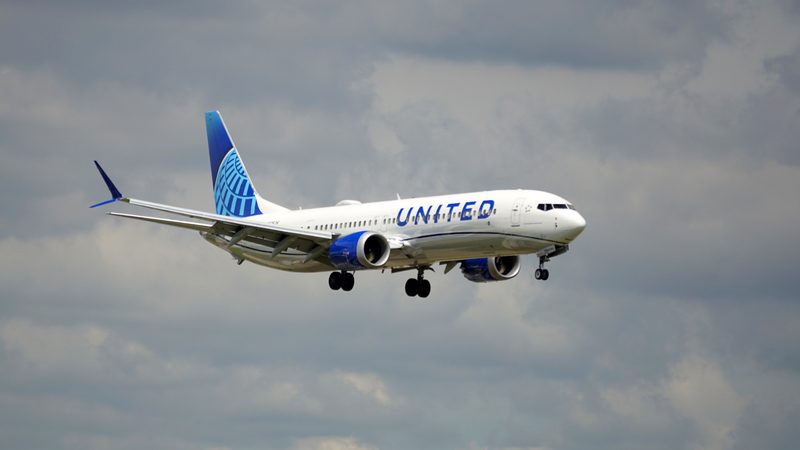
A United Airlines Boeing 737 MAX 9 landed safely at Houston Bush (IAH) on Sunday, October 25, after its crew declared an emergency during the final stages of a flight from Grand Cayman.

United said Flight UA1854 experienced a mechanical indication on arrival. The aircraft landed, taxied normally to its gate and discharged its passengers through the terminal. The flight was carrying 83 passengers and six crew members.
Public flight tracks show the aircraft maneuvering near IAH for considerably longer than a routine straight-in arrival, including two low approaches before its eventual landing on Runway 9 at about 8:12 p.m. local time.
Read our stories in your inbox
Two aviation newsletters. Zero fluff.
Reports based on the radio traffic identified the initial concern as the right main landing gear, which the crew could not confirm was down. They also attributed increasingly urgent fuel-related transmissions to the pilots before the final approach. United has not publicly identified the affected system beyond describing a mechanical indication, and it has not said that the aircraft was close to exhausting its fuel.
Aircraft Made Multiple Passes Before Landing
UA1854 was operating from Grand Cayman’s Owen Roberts (GCM), where the Cayman Islands Airports Authority lists Houston among United’s destinations.
The flight initially approached the parallel east-west runways on the north side of IAH, then climbed away and remained northwest of the airport at low altitude. A second pass also ended without a landing. The aircraft subsequently repositioned for Runway 9, the southernmost of Houston’s three parallel east-west runways.
Low passes can allow controllers, airport operations personnel or another aircraft to inspect the landing gear visually. They also give the flight crew time to complete non-normal checklists and compare cockpit indications with external observations. An indication that a landing gear leg is not locked does not necessarily mean that the gear itself has failed to extend.
The distinction matters in this case. The 737 landed without an apparent gear collapse, remained mobile and taxied to the terminal under its own power. That outcome is consistent with the landing gear being physically extended by the time of touchdown, although it does not establish whether the original indication was false, intermittent or resolved through checklist action.
Runway 9/27 gave controllers a useful option if the aircraft had become disabled after landing. The 10,000-foot runway sits south of the passenger terminal complex and is separated from the other primary arrival runways. Houston Airports had completed a 90-day resurfacing and lighting project on Runway 9/27 earlier in 2026.
IAH has five runways measuring between 9,000 and 12,001 feet, according to Houston Airports’ airfield data. That layout allows controllers to isolate one runway for an emergency arrival while retaining substantial capacity elsewhere on the airfield.
Fuel Claims Require Caution
The most serious descriptions of the incident characterize it as a second emergency involving only 10 to 12 minutes of fuel. That figure has not appeared in a public statement from United or an identified FAA record.
Initial accounts of the radio exchange also cited approximately 4,800 pounds of fuel remaining while the aircraft was maneuvering. A fuel quantity alone cannot be converted reliably into minutes without knowing the aircraft’s configuration, fuel flow, altitude, distance from touchdown and the point at which the quantity was reported.
“Double emergency” is not a formal operational classification. A crew may declare an emergency over one malfunction and subsequently advise controllers that fuel has become limiting. Pilots can also use the standardized “minimum fuel” advisory or declare a fuel emergency when the predicted landing quantity reaches a critical level. Those terms have specific operational meanings and should not be inferred solely from an extended arrival or a reported fuel figure.
What is established is that the flight spent additional time maneuvering after reaching Houston, made more than one pass near the airport and then received priority handling for its landing. The aircraft touched down safely before taxiing normally to the gate.
A Newly Delivered Boeing 737 MAX 9
The aircraft involved was N27474, manufacturer serial number 67665. The FAA aircraft registry identifies it as a 2026-built Boeing 737-9 powered by CFM International LEAP-1B28 engines. Its airworthiness date was August 18, and its current registration certificate was issued on August 27, making it only about two months old at the time of the incident.
The aircraft’s recent delivery is notable but does not, by itself, indicate whether the event originated in a component, sensor, installation or maintenance issue. United has not disclosed the result of its post-flight inspection.
United configures its 737 MAX 9s for 179 passengers in two classes, according to an aircraft financing disclosure. With 83 passengers aboard, UA1854 was carrying fewer than half of its available passenger seats.
Boeing gives the 737-9 a typical two-class capacity of 175 to 195 passengers and a range of up to 3,300 nautical miles. The manufacturer’s published 737 MAX specifications put the aircraft at 138 feet 2 inches long with a maximum takeoff weight of 194,700 pounds.
That combination of capacity and range makes the type suitable for United’s mixture of hub-to-leisure flying and longer domestic sectors. The roughly 1,150-mile Grand Cayman-Houston route uses only a fraction of the 737-9’s range capability, but international fuel planning must still account for the destination, an alternate where required, forecast conditions and regulatory reserves.
UA1854’s safe landing closes the immediate operational event, but it does not settle the technical question. The significant facts for investigators and United’s maintenance team will be the cockpit indication received by the crew, the actual position and lock status of the right main gear during each pass, and whether the low-fuel reports reflected a formal declaration, a projected landing quantity or an informal estimate during a high-workload arrival.
Bottom Line
The outcome demonstrates why a large, multi-runway hub provides valuable operating margin during an abnormal arrival. Runway 9 allowed Houston controllers to move the aircraft away from the two northern arrival runways and prepare for the possibility that it could stop on the pavement. Because the jet remained mobile, IAH avoided the prolonged runway closure and recovery operation that a gear-up or partial-gear landing could have caused.
For United, the maintenance findings matter more than the age of the aircraft or the MAX label attached to it. A warning-system discrepancy, a mechanical extension problem and a lock-sensor fault can present similarly to a crew while requiring very different corrective action. Whether N27474 returns quickly to service will offer the first external indication of how extensive that work proved to be.
The fuel narrative also deserves disciplined treatment. The extended maneuvering clearly reduced the crew’s remaining margin, but the most dramatic figures circulating after the flight have not been supported by a published airline or regulatory account. A subsequent FAA or NTSB record, if one is opened, would provide the clearest basis for determining whether UA1854 faced a separate fuel emergency or whether the crew was simply making clear that further troubleshooting was no longer an option.