A Trans Air Cargo Service Douglas DC-8-73CF was damaged in a runway excursion at Kinshasa N’djili (FIH) on September 8, potentially leaving the Congolese cargo airline without an operational aircraft.
The Democratic Republic of Congo’s Permanent Bureau of Aviation Accident and Incident Investigations, known as the BPEA, identified the aircraft as 9S-AJO and instructed that it be preserved in its post-accident condition until investigators arrived.
Images released by the bureau show the four-engine freighter off the paved surface with its forward fuselage pitched down and its nose resting close to the ground. The visible position is consistent with serious damage around the nose landing gear, although the full structural condition of the aircraft will depend on a detailed inspection.
Read our stories in your inbox
Two aviation newsletters. Zero fluff.
The BPEA has not attributed the excursion to a particular mechanical, operational or environmental factor. Its evidence-preservation instruction is intended to protect ground marks, component positions and other physical evidence before the aircraft is recovered.
TACS Loses Its Active Lift
The operational consequences extend beyond the damaged airframe. Trans Air Cargo Service’s own fleet page presents the DC-8 as the aircraft supporting its cargo business and markets service across a domestic network in the Democratic Republic of Congo.

Public flight-tracking data also indicates that 9S-AJO remained active immediately before the accident. Flightradar24 recorded movements by the aircraft on September 3 and September 5, three days before the excursion.
Taken together, the airline’s fleet presentation and the aircraft’s recent activity indicate that 9S-AJO was TACS’s operational lift at the time of the accident. Its removal from service therefore affects the carrier’s ability to operate flights with its own equipment, rather than simply reducing spare capacity in a larger fleet.
That distinction matters in the Democratic Republic of Congo, where air cargo links serve cities separated by long distances and limited surface infrastructure. A freighter with a large main deck can move consolidated shipments, machinery and other dense or outsized cargo that cannot be accommodated as belly freight on domestic passenger services.
Recovery will require more than replacing a nose gear assembly if loads from the excursion transferred into the forward fuselage, keel structure or attachment points. Investigators and engineers will also need to assess the lower fuselage and any damage caused as the aircraft traveled over soft or uneven ground.
For a small cargo operator, the engineering decision is inseparable from the commercial one. Even a technically repairable aircraft may not be economical to return if structural work, parts sourcing and specialist labor produce an extended grounding. Damage to a scarce freighter can consequently become a fleet event, as FlyMag also noted when a rare Kalitta Air Boeing 777-300ERSF required attention following a tail strike.
Why the DC-8-73CF Remained Useful
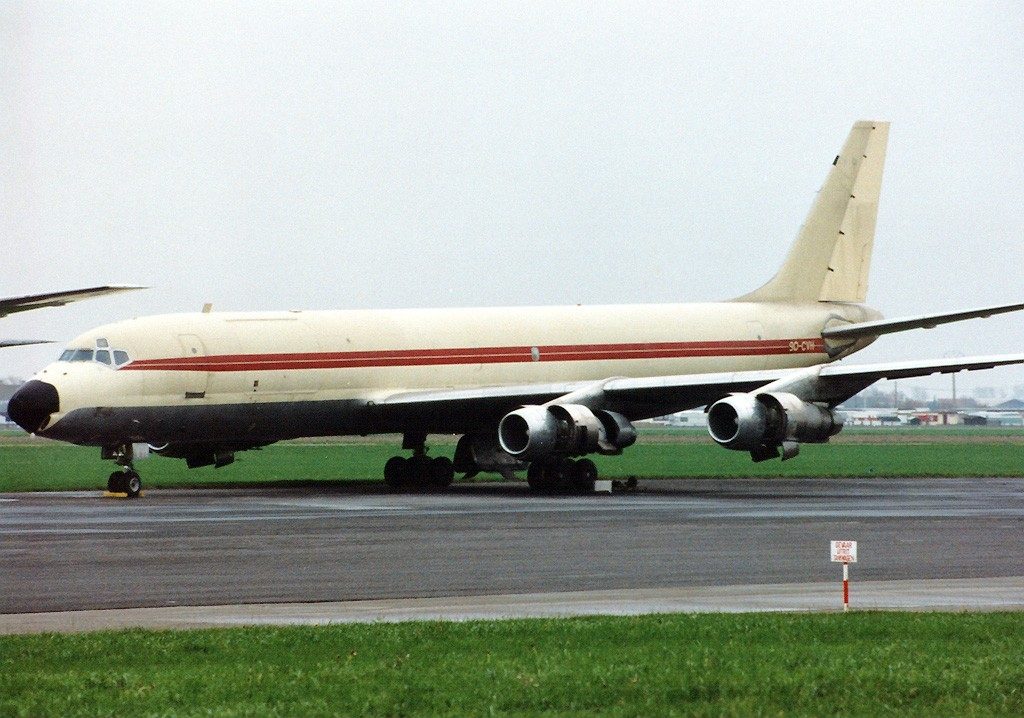
The DC-8-73CF combines the stretched fuselage of the Super 60 series with CFM56-2 turbofans installed under the Super 70 re-engining program. The conversion gave the DC-8 a second commercial life by retaining its established cargo volume while improving range, fuel consumption and noise performance compared with the original Pratt & Whitney-powered aircraft.
According to Boeing’s DC-8 freighter planning data, the DC-8-73CF can accommodate 18 standard 88-by-125-inch pallets or containers on its main deck. Boeing lists 224.3 cubic meters of main-deck volume and 70.8 cubic meters below deck, producing total cargo volume of 295.1 cubic meters.
The manufacturer’s reference figures give the -73CF a maximum takeoff weight of 161,025 kilograms, a structural payload of 47,535 kilograms and a design range of 2,800 nautical miles at maximum zero-fuel-weight payload. Actual capability varies with airframe configuration, operating conditions and sector requirements, but those figures explain why the type remained practical for substantial cargo loads despite its age.
The aircraft’s CFM56 engines are also central to that longevity. CFM International records that Delta Air Lines, United Airlines and Flying Tigers selected the engine for the DC-8 Super 70 program in 1979. The first CFM56-powered DC-8 entered revenue service with Delta in April 1982.
Boeing says the wider DC-8 family accumulated 556 deliveries during a 14-year production run. The Series 70 conversion substituted CFM56 engines for the Super 60’s earlier powerplants, providing longer range and compliance with stricter noise standards while retaining the underlying aircraft’s operating weights.
One Clearly Active Commercial DC-8 Remains
The Kinshasa accident also narrows an already tiny active DC-8 population. Before September 8, 9S-AJO and Skybus Jet Cargo’s Peruvian-registered OB-2231P were the two aircraft most clearly documented in recent commercial operation.
Tracking records for OB-2231P show the Skybus DC-8-73F continuing to operate revenue cargo sectors in early September. With 9S-AJO now damaged at FIH, the Skybus aircraft is the only DC-8 with clearly documented recent commercial flight activity.
The BPEA investigation will determine the accident sequence and the factors that caused the aircraft to leave the runway. Separately, TACS and its engineering advisers must establish whether 9S-AJO can be recovered and returned to service without repairs exceeding the practical value of the airframe.
Bottom Line
The immediate issue for Trans Air Cargo Service is access to lift. A carrier built around one active freighter cannot absorb an extended grounding through routine fleet substitution. If 9S-AJO requires major structural work, TACS will need outside charter capacity, a leased replacement or a fundamental change to its operating model to continue serving its cargo network.
The accident also illustrates why the final years of a legacy aircraft type rarely end according to a planned retirement schedule. The DC-8-73CF still offers credible volume and payload, but every serious repair now depends on a shrinking pool of parts, tooling and type-experienced personnel. Those constraints can turn otherwise manageable damage into the event that closes an airframe’s career.
What matters next is not only the BPEA’s finding on the excursion but the condition of the forward fuselage and landing-gear structure once 9S-AJO is recovered. That assessment will decide whether the DC-8 population returns to two active commercial aircraft or whether the type’s operational presence has effectively contracted to a single freighter.