Thai Airways has canceled two consecutive Bangkok-Brussels departures as the carrier reduces flying to stabilize operations following severe flooding around the Thai capital.

Flight TG934 from Bangkok Suvarnabhumi (BKK) to Brussels (BRU) is canceled on Wednesday, September 30, and Thursday, October 1, according to an official list of additional cancellations published by the Thai government from information supplied by the airline.
An earlier Thai Airways notice also canceled the corresponding TG935 departure from Brussels to Bangkok on September 30. The later list names TG934, but not TG935, for October 1.
Read our stories in your inbox
Two aviation newsletters. Zero fluff.
The cancellations are part of a broader reduction involving domestic, regional and long-haul flights between September 29 and October 1. Thai Airways listed 37 additional canceled departures in its expanded notice, including 28 scheduled for September 30.
Brussels Loses Two Bangkok Departures
Thai Airways normally operates the Brussels route daily. Its published Brussels schedule shows TG934 leaving BKK at 12:30 a.m. and arriving at BRU at 7:05 a.m. local time. TG935 is scheduled to depart Brussels at 1:10 p.m. and reach Bangkok at 6:10 a.m. the following day.
The timing makes the canceled westbound services especially sensitive to overnight disruption at BKK. TG934 is among the first wave of long-haul departures after midnight, when aircraft, crews, baggage and connecting passengers must all be positioned after the previous day’s operation.
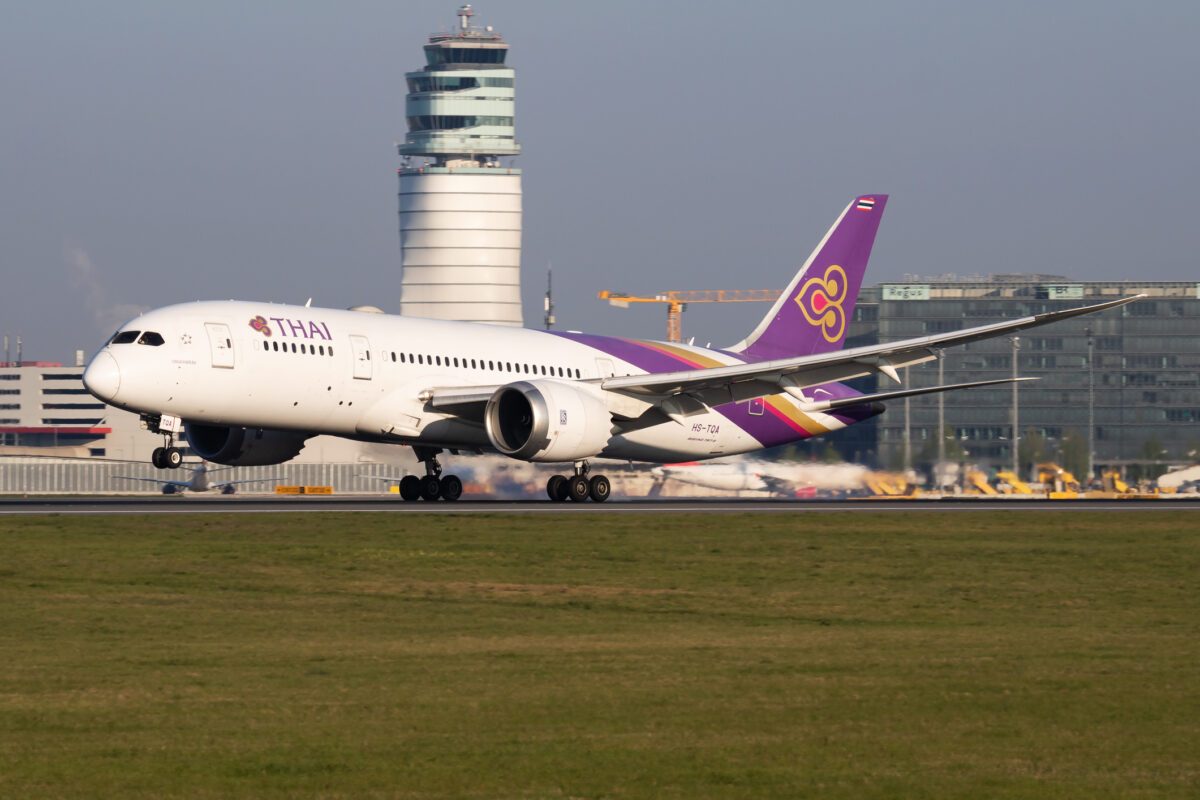
Thai Airways markets the route with the Boeing 787-8. The airline’s current fleet information gives the aircraft 256 seats: 22 in Royal Silk business class and 234 in economy. Each canceled TG934 therefore removes up to 256 scheduled seats from the nonstop market, as well as belly capacity between Thailand and Belgium.
The 787-8 is well matched to the roughly 5,760-mile sector. Its capacity is below that of Thai Airways’ Boeing 777-300ER and Airbus A350-900 fleets, allowing the airline to maintain daily frequency in a long-haul market that also carries passengers connecting through Bangkok to points elsewhere in Southeast Asia and Australasia.
That daily pattern leaves limited recovery capacity when consecutive departures are removed. Passengers can be rebooked over other Thai Airways European gateways or moved to later Brussels flights, but either option places additional demand on an operation already absorbing cancellations across the network.
Flooding Disrupts Ground Staffing and Baggage Handling
Suvarnabhumi has remained open throughout the disruption. An airport travel advisory said flights were continuing and the principal access roads remained usable, although passengers were told to avoid flooded roads in the Lat Krabang area and allow additional time for their journeys.
The operational problem has instead centered on staffing and ground handling. Flooding around Bangkok prevented some employees from reaching the airport, reducing the personnel available to service aircraft and process baggage. Delays then accumulated across successive rotations, while bags that missed their intended flights added to the workload facing the next shift.
A September 29 government recovery update said reduced Thai Airways staffing and customs processing had contributed to continued baggage delays at BKK. Authorities deployed 69 military personnel to assist, with the remaining baggage problems expected to take about a week to clear.

Cutting selected departures gives Thai Airways more time and labor to work through delayed bags, restore aircraft rotations and reduce the number of passengers entering an already constrained transfer operation. It also limits the risk that heavily delayed outbound flights will carry disruption into overseas stations and return late to Bangkok.
The airline has published updated ticket-handling guidance for agents dealing with flood-affected bookings. Passengers booked on TG934 or TG935 should confirm their revised itinerary with Thai Airways or the issuing travel agency before traveling to the airport.
Recovery Depends on Restoring the Bangkok Operation
Rainfall had eased by September 29, but several areas of Bangkok remained flooded. The immediate aviation issue is therefore no longer simply the weather at the runway. Thai Airways must restore reliable staff access, clear delayed baggage and rebuild aircraft and crew sequences after several days of disruption.
The Brussels cancellations illustrate how a ground-handling constraint at a hub can quickly reach long-haul routes even while the airport itself remains operational. A departure may have an available aircraft and favorable flying conditions, but it cannot leave on time without the required crew, loading teams, passenger processing and baggage reconciliation.
Thai Airways’ next scheduled Brussels rotations will be an early indication of how quickly the long-haul operation is recovering. The carrier’s priority will be to resume the daily pattern without sending another delayed aircraft into BRU or adding fresh baggage to the backlog at BKK.
Bottom Line
The Brussels cuts are a capacity-management decision rather than a withdrawal from the route. Canceling complete rotations is costly, but it can be more effective than operating a long-haul departure many hours late while the hub’s baggage and staffing systems remain under pressure. Brussels passengers bear a disproportionate impact because Thai Airways has only one daily nonstop frequency and limited scope to add recovery sections at short notice.
The broader signal is that Suvarnabhumi’s airfield capacity is not the principal constraint. The recovery now depends on the resilience of the labor-intensive functions behind each departure. Restoring ground-staff attendance and clearing mishandled baggage will determine whether Thai Airways can rebuild its schedule without another cycle of delays.
Attention will turn to the next Brussels departures after October 1 and to the speed at which delayed bags are returned. A stable resumption would contain the disruption to a short operational reset. Further cancellations would indicate that the effects of the flooding are continuing to interfere with aircraft rotations and connecting traffic well after the heaviest rain has passed.
Keep reading FlyMag
Get the Daily Brief in the morning or the Route Watch weekly recap on Fridays. Or both.