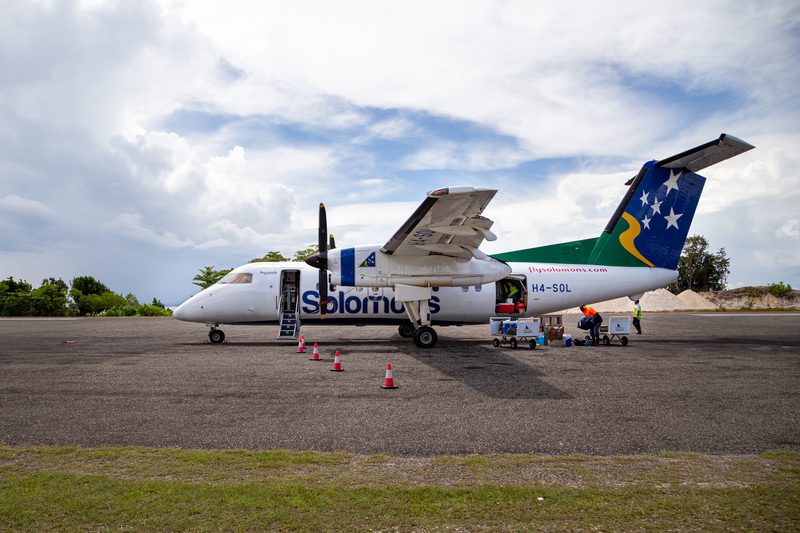
Solomon Airlines is set to pause operations of its sole De Havilland Canada DHC-8-100 as the aircraft enters scheduled C-check maintenance from April 11, prompting a temporary reshaping of the carrier’s domestic network from Honiara International Airport (HIR).

To cover part of the gap, the airline will deploy its Airbus A320-200 on domestic services between Honiara (HIR) and Munda International Airport (MUA) from April 13. That is a notable move for a market where the Dash 8 has typically handled the heavier end of domestic flying. The shift gives Solomon Airlines a way to preserve lift on one of its most strategically important domestic links while its only Dash 8 is out of action.
Why Munda Is the Route Getting the A320
The HIR–MUA sector is the logical place to use the A320. Munda International Airport (MUA) is one of the most operationally significant points in the Solomon Islands domestic network, and it also carries international relevance as the country’s second international airport after Honiara (HIR).
Read our stories in your inbox
Two aviation newsletters. Zero fluff.
That makes it the one domestic route where a larger narrowbody can do more than simply plug a capacity gap. It can help preserve schedule integrity, support passenger flows that connect beyond the domestic network, and keep a key corridor functioning while the smaller turboprop fleet absorbs pressure elsewhere.
Aircraft choice also matters. Solomon Airlines’ A320-200 is configured with 12 Business Class seats and 138 Economy Class seats, giving the airline far more capacity than the Dash 8 it is temporarily replacing. It also allows the carrier to offer international-style baggage allowances on the Munda service during the maintenance period, which is an unusual but commercially useful enhancement on a domestic route.
The Rest of the Domestic Network Will Be Thinner
The trade-off is that the wider domestic schedule will tighten.
Solomon Airlines says it will maintain its core domestic operation using its two De Havilland Canada DHC-6-300 Twin Otters while the Dash 8 is away for maintenance, but services to Arona Airport (RNA) and Lomlom Airport (LLM) will be suspended temporarily. That underlines the scale of the strain. When one aircraft removal forces selective route suspension, it is a reminder of how thinly stretched small-island fleets can become when maintenance windows arrive.
For a carrier like Solomon Airlines, this is not just a scheduling issue. It is a network-balance issue. The Twin Otter is well suited to smaller and shorter-field operations across the archipelago, but it cannot fully replace the role of the larger Dash 8 across the network. That means the airline has had to prioritize which routes keep higher-capacity support and which markets temporarily lose service.
A Maintenance Story, Not a Crisis Story
It is important to frame this correctly. This is a planned C-check, not an emergency grounding.
That distinction matters because heavy maintenance on a small fleet can look disruptive even when it is entirely routine. For Solomon Airlines, the challenge is less about the maintenance itself and more about how to keep a geographically fragmented domestic network functioning while a key aircraft is unavailable.
Even so, the Dash 8’s recent history adds context. In September 2025, mechanical issues had already restricted the aircraft largely to Munda operations while the airline awaited a replacement part. That earlier episode does not change the fact that the current withdrawal is scheduled maintenance, but it does reinforce how dependent the network has become on a single aging turboprop to provide a layer of domestic capacity above Twin Otter level.
The Fleet Mix Explains the Pressure
The fleet structure is at the center of this story.
The Dash 8-100 has been Solomon Airlines’ only aircraft of its kind, sitting between the short-field flexibility of the Twin Otters and the much larger capacity of the Airbus A320. That makes it a particularly important asset in a network where runway constraints, route demand, and aircraft economics vary sharply from island to island.

When that middle-sized aircraft disappears, even temporarily, the airline has limited options. It can upgauge one strategically important market with the A320 and rely on the Twin Otters elsewhere, but it cannot perfectly replicate the Dash 8’s role. That is why the current plan looks the way it does: protect HIR–MUA, preserve as much of the core domestic system as possible, and accept short-term suspensions at the edges.
Bottom Line
Solomon Airlines’ decision to place its DHC-8-100 into scheduled maintenance from April 11 is forcing a temporary but meaningful rework of the domestic network.
The Airbus A320-200 will step in on Honiara (HIR)–Munda (MUA) from April 13, giving the airline a high-capacity bridge on one of its most important domestic routes. But the cost of that coverage is a thinner operation elsewhere, with Arona (RNA) and Lomlom (LLM) temporarily losing service while the carrier leans on its two Twin Otters to keep the rest of the network moving.
For airline readers, the bigger takeaway is straightforward. This is a clear example of how one heavy-maintenance event can ripple through an island carrier’s entire operation when fleet depth is limited and every aircraft type plays a distinct role.
Keep reading FlyMag
Get the Daily Brief in the morning or the Route Watch weekly recap on Fridays. Or both.