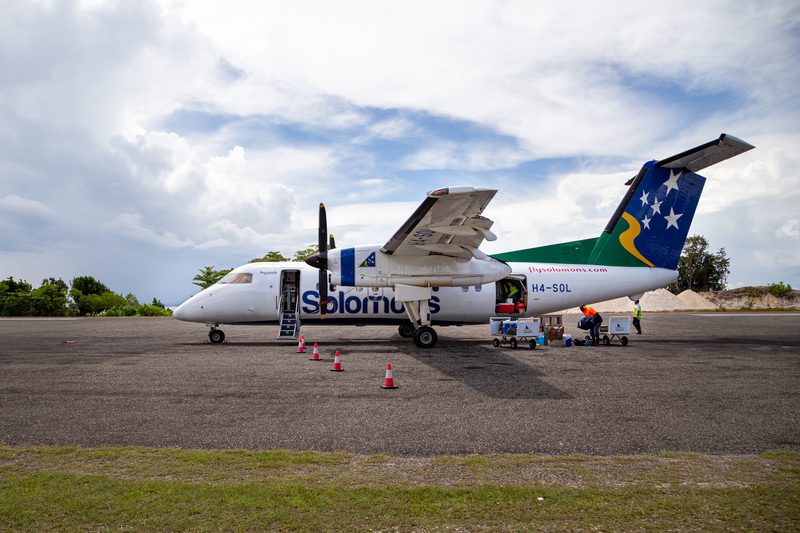
Solomon Airlines (IE) is formally opposing Qantas’ (QF) bid to add more capacity between Brisbane (BNE) and Honiara (HIR), arguing the Australian flag carrier’s planned frequency hike amounts to capacity dumping on a market that hasn’t meaningfully recovered since before the pandemic.


In a submission to Australia’s International Air Services Commission (IASC), Solomon Airlines CEO Paul Abbot labeled Qantas’ proposal a “cynical attempt to dump capacity” on what he described as a stagnant route, with the aim of squeezing out the Solomons’ national carrier. The dispute has quickly become one of the more closely watched Pacific aviation flashpoints this season, because the BNE–HIR corridor isn’t just a leisure route—it underpins the economics of domestic connectivity inside the Solomon Islands.
What Qantas Is Asking For, and When It Would Start
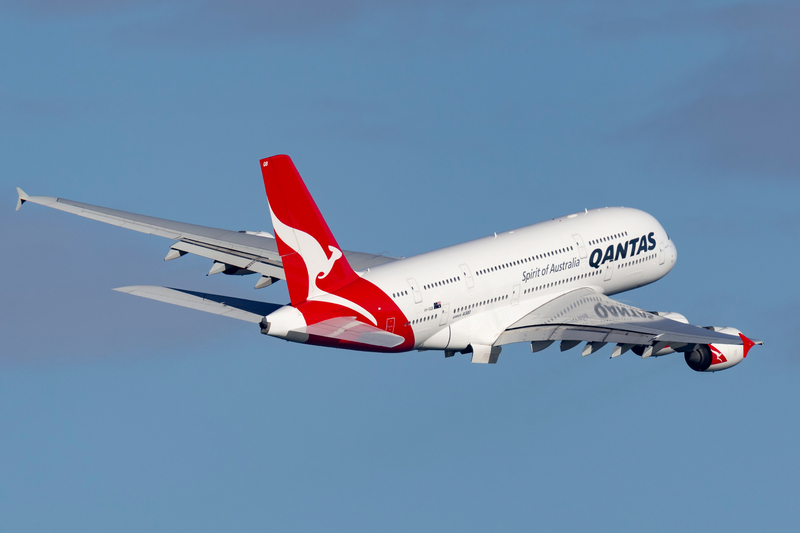
Qantas has applied to lift its Brisbane (BNE)–Honiara (HIR) schedule from four to five weekly flights, with the additional service planned to begin March 29, 2026.
Read our stories in your inbox
Two aviation newsletters. Zero fluff.
Rather than deploying a mainline Boeing 737, the extra frequency is slated to be operated using wet-leased Alliance Airlines capacity—specifically an Embraer E190 configured with 97 seats. That 97-seat figure is important because it signals the capacity step-up is being made with a right-sized regional jet rather than a larger narrowbody, allowing Qantas to add frequency without dramatically overshooting demand in a single departure.
Why the E190 fits this mission
The Embraer E190 is a common tool for “thin international” flying in the 2–4 hour range—exactly the kind of stage length you see between BNE and HIR. It typically delivers:
-
strong economics at smaller seat counts versus an A320/737,
-
quick turns that help preserve utilization,
-
and enough range margin for Pacific routings without the payload penalties you’d face on older regional jets.
In wet-lease form, the aircraft, crew, maintenance, and insurance are provided by the lessor (Alliance), while Qantas controls the commercial side—schedules, fares, distribution, and customer handling. To passengers, it generally still “feels” like Qantas, but the operational platform underneath is Alliance’s.
Solomon Airlines’ Core Argument: This Route Funds the Domestic Network
Solomon Airlines’ objection is less about pride and more about structural vulnerability.
Abbot’s warning is that Solomon Airlines’ international flying helps cross-subsidize its domestic network—a common reality in small island states where many domestic sectors are socially and economically essential but cannot always stand alone financially. In that model, international routes like HIR–BNE aren’t just profit centers; they’re the financial stabilizers that help keep inter-island connectivity alive.
If yields on BNE–HIR are pushed down by excess capacity and fare pressure, the impact can show up far away from the international check-in counters—on domestic schedules, fleet availability, staffing, and even the ability to maintain frequency to smaller islands where air service is critical infrastructure.
The Demand Reality: Recovery Still Lags Pre-2019 Levels
Solomon Airlines’ submission points to the market’s relatively limited size. The airline cited 2025 passenger numbers of 39,722 on the route—still well below 2019 levels—supporting the claim that demand has not returned to a level that easily absorbs added capacity.
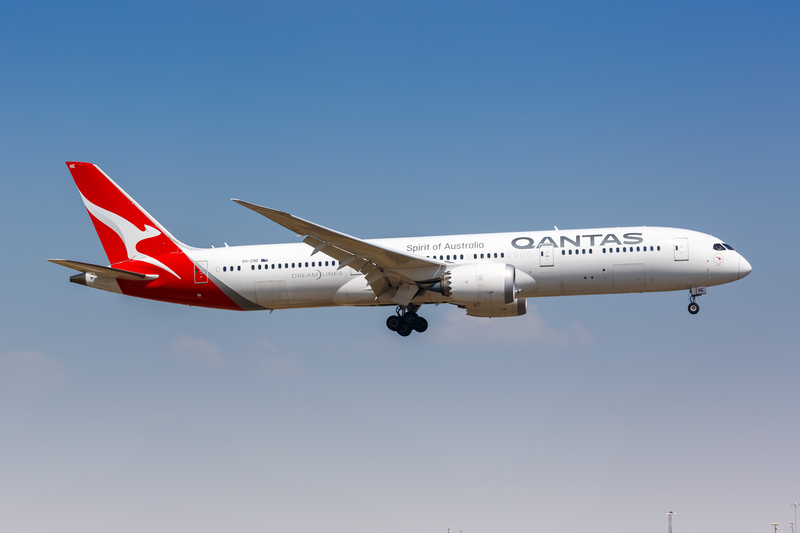
This is a crucial nuance for Pacific flying: the route may look strategically important on a map, but it can remain numerically small. That makes it unusually sensitive to competitive behavior. On a high-volume trunk route, an added frequency is often absorbed through stimulation and schedule utility. On a smaller market like BNE–HIR, an extra weekly flight can quickly translate into:
-
lower average fares,
-
weaker load factors on marginal days,
-
and a sharper fight over the same base of VFR, government, NGO, and limited leisure traffic.
Why Qantas Might Want More Frequency Anyway
From Qantas’ perspective, a fifth weekly frequency can be defended on several operational and commercial grounds—especially if the airline believes it can grow the market rather than simply split it:
-
Schedule utility: Additional frequency improves options for short-notice travel, reduces “dead days,” and strengthens connecting opportunities through Brisbane (BNE).
-
Network consistency: More regular service can stabilize demand in markets where travelers dislike planning around limited operating days.
-
Cargo and logistics: Even on passenger routes, belly cargo and mail flows can matter in the Pacific—especially where shipping options are limited.
And there’s a strategic layer too. The Pacific is a region where connectivity can carry geopolitical and governmental significance beyond pure commercial logic. Airlines sometimes maintain or expand service in these markets because the network role outweighs route-by-route margin in the short term.
The Regulatory Lens: What the IASC Will Be Weighing
Australia’s IASC process is essentially a capacity-allocation mechanism on certain international routes. In disputes like this, the Commission is typically weighing:
-
whether the market can support additional seats without destabilizing competition,
-
whether the proposed capacity is consistent with bilateral entitlements,
-
and whether the overall public interest is better served by more choice and frequency, or by preserving a competitive balance that sustains a smaller operator.
This is where Solomon Airlines’ “predatory behavior” framing matters. If the Commission views the added capacity as commercially rational and proportionate—especially with a 97-seat E190 rather than a larger aircraft—approval becomes easier. If it sees the move as likely to damage competition in a fragile market, the dynamics change.
Bottom Line
Solomon Airlines is drawing a hard line against Qantas’ plan to add a fifth weekly Brisbane (BNE)–Honiara (HIR) flight from March 29, 2026, operated via a wet-leased Alliance Airlines Embraer E190 (97 seats). The carrier argues the route remains below 2019 demand levels—citing 39,722 passengers in 2025—and warns that extra capacity risks undermining the international revenues that help sustain its domestic lifeline network. For Qantas, the additional frequency offers schedule strength and a more consistent Pacific presence. For the Solomon Islands’ flag carrier, it’s a test of whether a small-market airline can remain viable when a much larger competitor decides to lean in.
Keep reading FlyMag
Get the Daily Brief in the morning or the Route Watch weekly recap on Fridays. Or both.