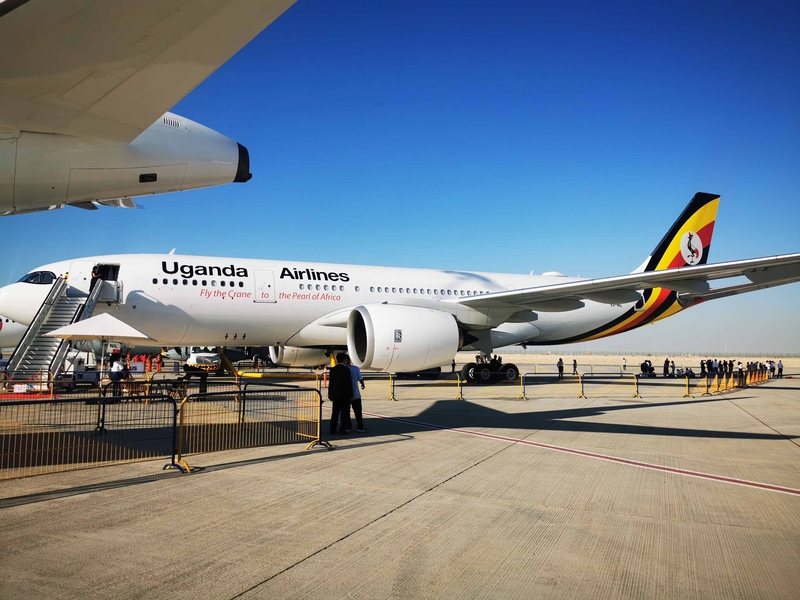
Uganda Airlines (UR) is living the operational risk that every small widebody operator fears: both long-haul aircraft out of service at the same time.
The carrier’s two Airbus A330-800neo widebodies—5X-CRN (msn 1979) and 5X-NIL (msn 1977)—have been grounded in separate events that together pulled the rug out from under UR’s long-haul schedule. With no spare widebody in the pool, Uganda Airlines has had to scramble for short-term ACMI (wet-lease) capacity to keep core international flying alive from Entebbe International (EBB).
It’s the kind of disruption that doesn’t just delay flights; it tests the airline’s ability to protect its brand promise on the routes that matter most.
Read our stories in your inbox
Two aviation newsletters. Zero fluff.
The aircraft and the timeline: 5X-CRN grounded first, 5X-NIL then goes AOG at LGW
Uganda Airlines’ long-haul fleet is as tight as it gets—two aircraft of the same type, both critical to the schedule:
-
5X-CRN (A330-800neo) has been out of action since January 11.
-
5X-NIL (A330-800neo) became grounded at London Gatwick (LGW) on February 20, effectively sidelining the airline’s remaining long-haul lift.
Once both A330-800neos were unavailable, UR’s intercontinental operation had no internal fallback. That’s a major structural vulnerability for any carrier, but especially for one whose flagship international routes are long stage-length, high-profile services that can’t be substituted with narrowbodies.
Why the A330-800neo is both a smart choice and a high-stakes one for UR
Uganda Airlines operates one of the rarest modern widebodies in commercial service: the Airbus A330-800neo. The type is designed for long-range flying with lower trip costs than larger widebodies, powered by Rolls-Royce Trent 7000 engines and offering an advertised range around 8,100 nautical miles.
Uganda’s cabin configuration is optimized for long-haul comfort and yield segmentation, with 258 seats across three cabins:
-
20 Business Class lie-flat seats
-
28 Premium Economy seats
-
210 Economy seats
The upside is obvious: the A330-800neo is efficient for “long and thin” missions—exactly the kind of routes UR has targeted from EBB. The downside is equally obvious: when your long-haul fleet is only two aircraft, any unscheduled maintenance event immediately becomes a network event.
Which routes were disrupted: LGW and BOM first, then DXB and ABV feel the knock-on
The most visible impacts were on Uganda Airlines’ two flagship long-haul routes:
-
EBB–LGW (Entebbe–London Gatwick)
-
EBB–BOM (Entebbe–Mumbai)
But the ripple didn’t stop there. With aircraft and crew rotations broken, the airline also faced pressure across other longer missions, with disruption reported on services touching:
-
DXB (Dubai International)
-
ABV (Abuja)
For a carrier operating a small fleet, this is the cascading effect: one grounded aircraft forces schedule reshuffles; two grounded aircraft forces triage.
The operational solution: why ACMI is the fastest way to keep long-haul flying alive
When a carrier loses its only widebodies, it has three choices—none cheap:
-
Cancel long-haul flying until the fleet returns.
-
Reaccommodate passengers entirely on other airlines.
-
Secure an ACMI (wet-lease) aircraft to operate the schedule temporarily.
Uganda Airlines moved toward the third option, pursuing short-term ACMI capacity so it could keep operating its core routes while engineering teams work through the maintenance backlog.
An ACMI arrangement typically includes:
-
Aircraft
-
Crew
-
Maintenance
-
Insurance
This is why it’s the “emergency tool” in disruption periods. It allows a carrier like UR to keep selling and operating flights from EBB without first building a new training and maintenance pipeline for an unfamiliar aircraft type.
In March 2026, UR’s recovery planning has centered on restoring stability to EBB–LGW and EBB–BOM first—because these routes carry the airline’s highest reputational and commercial visibility.
The hard part isn’t finding a plane—it’s protecting the schedule once you do
Even when an ACMI aircraft is secured, the operational challenges don’t disappear:
-
Crew legality and continuity: wet-lease crews operate under different rostering and duty frameworks, and irregular ops recovery can be slower.
-
Ground handling compatibility: catering, cabin provisioning, and service routines at EBB, LGW, and BOM can require quick adaptation.
-
Product consistency: passengers booked on UR expect a specific onboard product. A wet-lease aircraft may differ in cabin layout, IFE, and seating—particularly in premium cabins.
-
Regulatory and approval layers: operating aircraft under wet lease can involve additional approvals and operational oversight, especially on international routes.
For passengers, this often shows up as last-minute aircraft substitutions, modified seating assignments, and changes in onboard service flow—while the airline tries to keep departure times stable.
Leadership change during disruption: why governance matters when the fleet is fragile
The long-haul disruption has also landed during a leadership reset.
Ugandan President Yoweri Museveni has appointed veteran aviation executive Girma Wake as adviser and acting CEO following the dismissal of Jenifer Bamuturaki. Wake’s background—former CEO and chairman of Ethiopian Airlines and former chairman of RwandAir—signals a focus on operational discipline and fleet reliability.
That’s not abstract. In a two-widebody airline, governance decisions directly affect:
-
maintenance contracting and spares strategy,
-
technical escalation processes,
-
and how quickly the airline can execute short-term solutions like ACMI while protecting safety and compliance.
What passengers should expect if they’re booked on UR long-haul routes
Uganda Airlines has said affected passengers will be re-accommodated via:
-
alternative airlines where available, or
-
rebooking onto future UR flights once capacity stabilizes.
If you’re traveling on UR long-haul services in the near term, the practical reality is to expect variability—especially for EBB–LGW and EBB–BOM—as the airline transitions between aircraft availability, wet-lease support, and the return-to-service timeline for both A330-800neos.
Bottom Line
Uganda Airlines’ twin grounding of its A330-800neo fleet—5X-CRN out since January 11 and 5X-NIL grounded at London Gatwick (LGW) since February 20—has exposed the most unforgiving truth in long-haul operations: without fleet depth, “unscheduled maintenance” becomes a network crisis overnight.
By pursuing short-term ACMI capacity to protect Entebbe (EBB) long-haul flying—especially to LGW and Mumbai (BOM)—UR is using the industry’s standard emergency lever to restore schedule integrity while engineering teams work to return both widebodies to service. The coming weeks will be a test of execution: how quickly the airline can stabilize operations, maintain customer confidence, and rebuild resilience around one of the world’s rarest modern widebody fleets.
Keep reading FlyMag
Get the Daily Brief in the morning or the Route Watch weekly recap on Fridays. Or both.