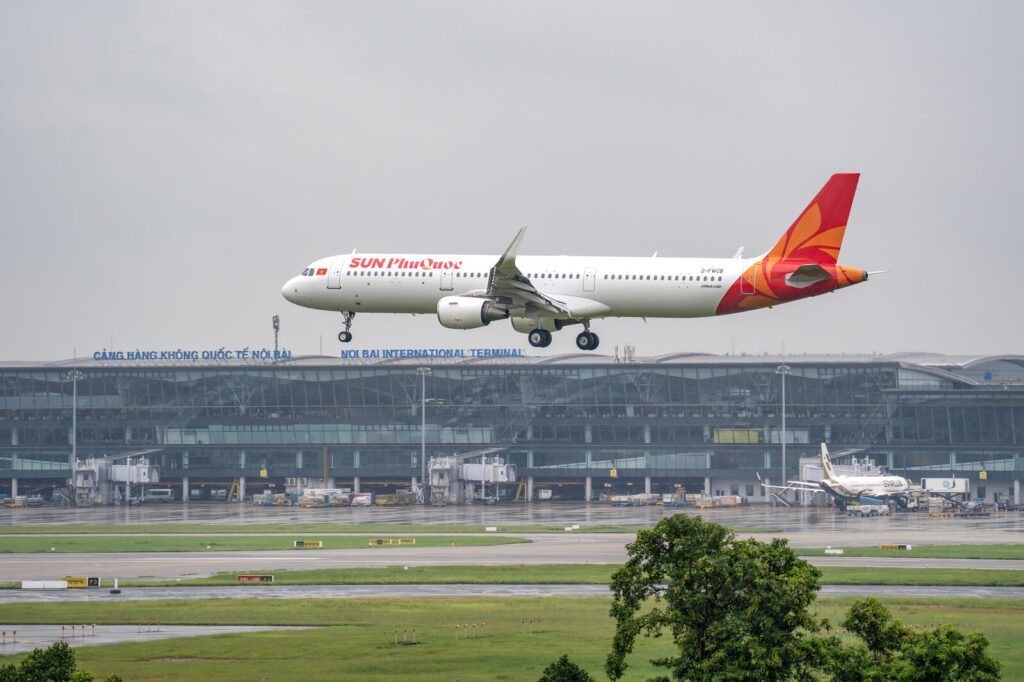
Vietnam’s newest airline is making a statement order before it even becomes a household name.
Sun PhuQuoc Airways has committed to up to 40 Boeing 787-9 Dreamliners, a deal being described as the largest widebody aircraft order in Vietnamese history. The 787-9 will form the backbone of the carrier’s long-haul fleet, with operations centered on Phu Quoc International Airport (PQC)—an unusually bold choice of hub for a widebody airline, and a clear signal that this is a tourism-first network built around Vietnam’s resort economy rather than traditional capital-city demand.
The agreement was unveiled in Washington, D.C., and it represents Sun PhuQuoc Airways’ first direct aircraft purchase—an early foundation for what the airline and its backers want to position as a premium international gateway.
Read our stories in your inbox
Two aviation newsletters. Zero fluff.
Why the 787-9 is the right tool for PQC
The Boeing 787-9 is built for exactly the kind of long, thin routes a resort-centric airline wants to open: intercontinental stage lengths that are too long for narrowbodies and too risky for older, less efficient widebodies.
Key performance and product details that matter to airline professionals:
-
Range: roughly 7,565 nautical miles (14,010 km), enough to make nonstop flying from PQC to large parts of Europe and Northeast Asia, and—depending on routing, winds, payload, and alternates—reach deep into long-haul markets that would normally be served via Hanoi (HAN) or Ho Chi Minh City (SGN).
-
Economics: the 787 family’s composite structure and modern systems are designed for lower fuel burn per seat compared with prior-generation widebodies—critical when you’re building long-haul demand around leisure travelers who shop heavily on total trip price.
-
Passenger experience: higher humidity, a lower cabin altitude than older widebodies, and the Dreamliner’s signature larger windows—comfort features that are especially relevant on 10–14 hour leisure itineraries.
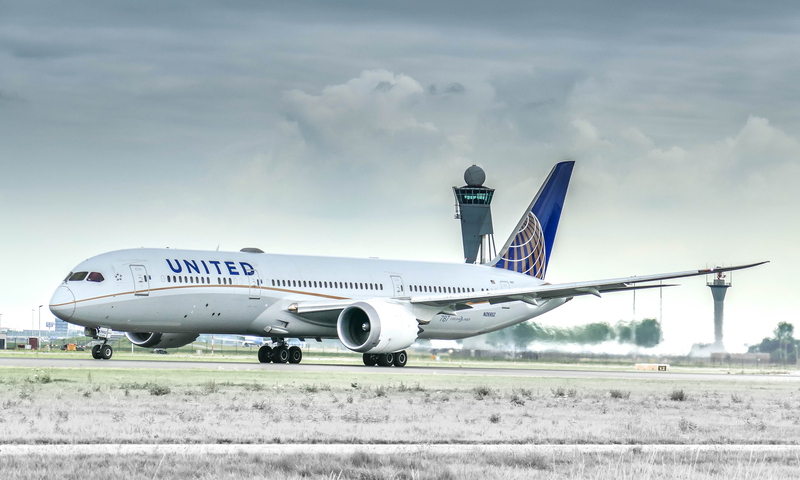
In other words, this isn’t just a prestige widebody. The 787-9 is a practical aircraft for turning a secondary hub like PQC into a long-haul origin point without needing the dense, corporate-heavy demand base that traditional hubs rely on.
A “resort aviation” model built around Sun Group’s tourism engine
Sun PhuQuoc Airways is backed by Sun Group, one of Vietnam’s most prominent tourism and infrastructure developers. That matters because the airline’s model is not simply “fly where demand exists.” It’s closer to an integrated system:
-
develop resorts, attractions, and experiences,
-
then build air access to feed that ecosystem,
-
using a hub-and-spoke structure designed around premium leisure flows.
This kind of “resort hub” strategy can work—if the airline can maintain reliability and seasonality discipline. Leisure traffic peaks hard and swings fast. A widebody-heavy plan needs a network that can flex between summer and winter demand curves while keeping aircraft utilization high enough to protect unit costs.
What “up to 40” likely means in fleet planning terms
Airlines and OEMs often phrase these deals as “up to” because they’re structured with firm orders plus options. The practical takeaway is that Sun PhuQuoc Airways has secured a widebody pipeline big enough to support meaningful scale—especially if the carrier’s stated ambition to grow to 100 aircraft by 2030 holds.
If even a portion of those Dreamliners arrive on schedule, it would move PQC into a rare category: a leisure-driven airport with the potential for consistent long-haul widebody service not dependent on a capital city hub.
Where the network could realistically go from PQC
With the 787-9, the obvious early candidates are high-volume leisure and VFR markets that already move strong traffic to Vietnam:
-
Northeast Asia (Japan, South Korea, parts of China),
-
Australia’s major gateways (subject to bilateral rights and schedule economics),
-
and select European points where tour demand is proven.
North America is the big headline-grabber, but it’s also the hardest to execute sustainably. Ultra-long sectors require deep operational buffers, careful alternates planning, and strong premium yields (or exceptionally efficient leisure packaging) to remain stable year-round. A 787-9 can make long missions possible, but the commercial model must be airtight.
Why Boeing cares: Vietnam is a widebody growth battleground
For Boeing, the order reinforces Vietnam as one of the most dynamic aviation markets in Southeast Asia—and a key long-term widebody battleground. Vietnamese carriers have historically expanded widebody capacity cautiously. An up-to-40 787-9 commitment from a new entrant is a major shift in scale, and it effectively plants the Dreamliner at the center of Vietnam’s next wave of long-haul growth.
It also underscores how quickly Vietnam’s market is diversifying. Instead of a single flag carrier defining long-haul strategy out of HAN and SGN, Vietnam is now seeing new players attempt specialized models—premium leisure, resort hubbing, and integrated tourism networks.
Bottom Line
Sun PhuQuoc Airways’ commitment to up to 40 Boeing 787-9 Dreamliners is a defining move for both the airline and Vietnam’s long-haul landscape. By choosing the 787-9—a widebody with the range and economics to support true intercontinental flying—the Sun Group-backed carrier is betting it can turn Phu Quoc (PQC) into a premium tourism gateway rather than a seasonal side market. The strategy is ambitious, but the aircraft choice is coherent: if you’re going to build a resort-focused long-haul hub, the 787-9 is one of the few platforms that gives you the payload-range flexibility and unit-cost profile to make it believable.
Keep reading FlyMag
Get the Daily Brief in the morning or the Route Watch weekly recap on Fridays. Or both.