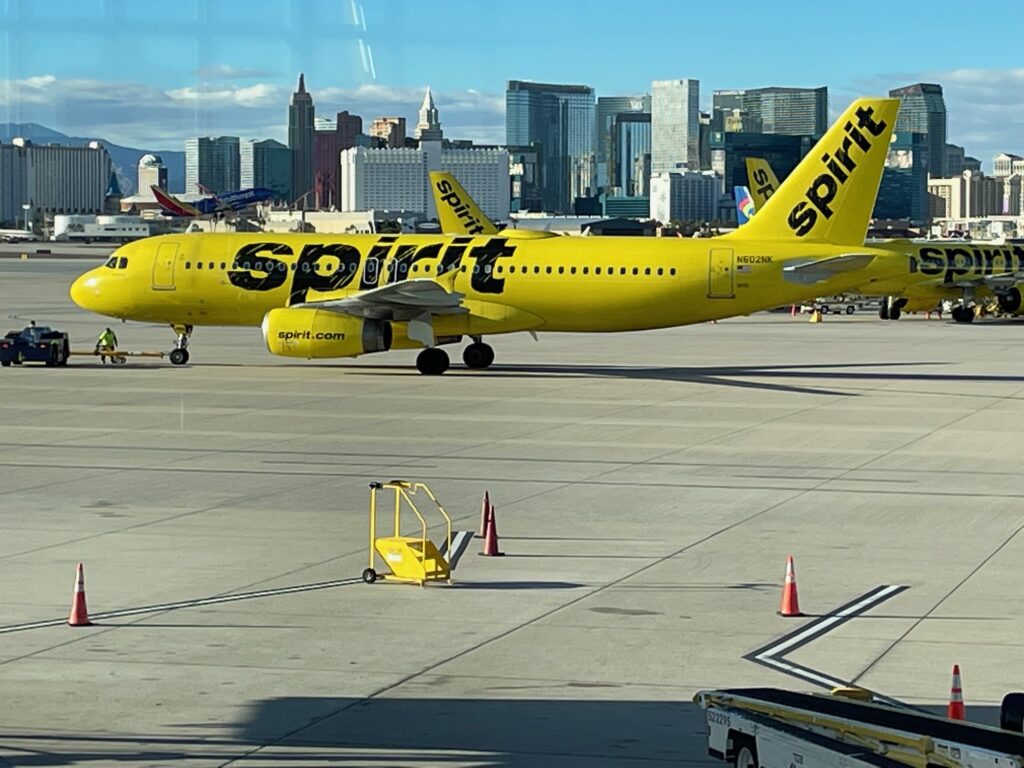
Spirit Airlines (NK) is taking another hard turn toward “survive first, grow later,” and the latest schedule filings show where the knife is falling: international flying—especially anything that doesn’t produce repeatable demand across the week.
From mid-April 2026, Spirit is canceling 11 international routes (some already operating, others planned for summer start-up) and reducing frequencies across a long list of remaining Caribbean, Central America, and South America markets. The center of gravity is exactly where you’d expect: Fort Lauderdale (FLL) and Orlando (MCO), with meaningful knock-on changes at Houston (IAH), New Orleans (MSY), and a handful of other gateways.
This isn’t a “tactical tweak.” It’s Spirit reshaping how it uses aircraft hours—prioritizing fewer, stronger lanes and cutting the kind of thin or overly competitive midweek flying that turns an ultra-low-cost schedule into a cash bleed.
Read our stories in your inbox
Two aviation newsletters. Zero fluff.
The headline cancellations: 11 routes removed, including three FLL international exits
Spirit’s largest immediate international cuts hit Fort Lauderdale–Hollywood (FLL), where three routes are being eliminated in a three-day sequence:
-
FLL–Grand Cayman (GCM) ends April 13, 2026
-
FLL–Managua, Nicaragua (MGA) ends April 14, 2026
-
FLL–San Salvador, El Salvador (SAL) ends April 15, 2026
Orlando (MCO) also takes a visible hit, losing three daily international links effective April 15:
And Houston (IAH) loses four planned Central America starts before they even get going in June:
-
IAH–Guatemala City (GUA) (planned June) canceled
-
IAH–San Pedro Sula (SAP) (planned June) canceled
-
IAH–San Salvador (SAL) (planned June) canceled
-
IAH–Tegucigalpa Palmerola (XPL) (planned June) canceled
Finally, New Orleans (MSY)–San Pedro Sula (SAP) ends April 15.
Here’s the full cancellation set in one place:
| Gateway | Route | Status | Effective |
|---|---|---|---|
| Fort Lauderdale (FLL) | Grand Cayman (GCM) | Cancelled | Apr 13, 2026 |
| Fort Lauderdale (FLL) | Managua (MGA) | Cancelled | Apr 14, 2026 |
| Fort Lauderdale (FLL) | San Salvador (SAL) | Cancelled | Apr 15, 2026 |
| Orlando (MCO) | Bogotá (BOG) | Cancelled | Apr 15, 2026 |
| Orlando (MCO) | Cancún (CUN) | Cancelled | Apr 15, 2026 |
| Orlando (MCO) | San José (SJO) | Cancelled | Apr 15, 2026 |
| New Orleans (MSY) | San Pedro Sula (SAP) | Cancelled | Apr 15, 2026 |
| Houston (IAH) | Guatemala City (GUA) | Planned start cancelled | June 2026 window |
| Houston (IAH) | San Pedro Sula (SAP) | Planned start cancelled | June 2026 window |
| Houston (IAH) | San Salvador (SAL) | Planned start cancelled | June 2026 window |
| Houston (IAH) | Tegucigalpa Palmerola (XPL) | Planned start cancelled | June 2026 window |
Fort Lauderdale (FLL) isn’t just losing routes—many remaining routes are being thinned out
FLL is Spirit’s most important international engine room, so the bigger signal isn’t only the three cancellations. It’s the aggressive frequency trimming across markets that stay on the map.
A few examples that show the scale of the pullback:
-
FLL–Guatemala City (GUA) drops from twice-daily to 4x weekly from April 15
-
FLL–Medellín (MDE) drops from 14x weekly to 6x weekly from April 14
-
FLL–San Juan (SJU) drops from 14x weekly to 7x weekly from April 15
-
FLL–Santo Domingo (SDQ) drops from 14x weekly to 7x weekly from April 14, then reduces further in late April
-
FLL–Guayaquil (GYE) drops from daily to 2x weekly from May 5
-
Multiple Caribbean and Colombia markets step down to 3–5 weekly patterns, which is a classic “weekend-leaning” survival schedule
For airline planners, this is a recognizable strategy: keep the route alive, but reduce exposure on the days that often underperform (Tuesday/Wednesday are the usual suspects) and concentrate flying around weekend peaks when leisure-heavy markets tend to clear at better yields.
Orlando (MCO) gets simpler: fewer international bets, more focus
Orlando’s cuts are a meaningful pivot because MCO is a core Spirit leisure base. Pulling BOG, CUN, and SJO suggests the airline is prioritizing “repeatable Florida domestic + select core international” rather than trying to hold a broader footprint with daily frequency it may not be able to sustain.
For customers, this typically means:
-
fewer nonstop options,
-
more reliance on South Florida (FLL/MIA area) for international access,
-
and tighter seat availability on the international routes that remain.
It’s not all reductions: Spirit actually increases MSY–CUN to daily for part of the spring
One of the more interesting tells in the filings is that Spirit will increase New Orleans (MSY)–Cancún (CUN) from 3x weekly to daily between April 15 and June 17, before stepping down to 4x weekly during the peak summer window.
That’s important because it shows Spirit isn’t abandoning international flying altogether—it’s reallocating it. If a route performs and can sustain higher utilization (especially in leisure peaks), Spirit will still upgauge frequency where the math works.
Aircraft and fleet reality: why these cuts matter even more for Spirit than for a network carrier
Spirit’s international operation is almost entirely built on the Airbus A320-family (A320/A321 and neo variants). That fleet commonality helps, but it also means Spirit’s primary lever is where and when it flies—because it doesn’t have regional jets to “right-size” thin markets.
When demand softens, the airline has two choices:
-
reduce frequency (what you’re seeing here), or
-
exit the route (also happening here)
On the routes that remain, the filings show Spirit continuing to swap gauge between A320 and A321-family aircraft. That’s a classic ULCC move: deploy higher-capacity A321s when demand peaks, then revert to A320s when the shoulder season arrives.
The strategic backdrop: this is consistent with a Chapter 11 exit plan built on a smaller footprint
Spirit’s network contraction is unfolding alongside a creditor-backed plan to emerge from Chapter 11 in late spring to early summer 2026, with management targeting a major reset of debt and lease obligations. A smaller network with fewer weak midweek routes is the operational expression of that strategy: fewer stations, fewer thin routes, fewer complex recovery scenarios, and more predictable utilization where Spirit still has pricing power.
Bottom Line
Spirit’s latest schedule filings aren’t “optimization.” They’re a structural narrowing of the airline’s international footprint—starting in mid-April—with 11 route cancellations and extensive frequency reductions, especially out of Fort Lauderdale (FLL) and Orlando (MCO). The pattern is clear: protect core lanes, cut fragile daily flying, and concentrate aircraft where demand is more repeatable.
For passengers, it means fewer nonstop international options from Florida’s secondary gateways and more seasonal-looking schedules in markets that remain. For the industry, it’s another confirmation that Spirit is still operating in reset mode—shrinking first so it can try to compete later.
Keep reading FlyMag
Get the Daily Brief in the morning or the Route Watch weekly recap on Fridays. Or both.