Spirit Airlines’ financial distress has taken a more dramatic turn, with reports that the carrier has asked the Trump administration for emergency funding as soaring jet fuel prices threaten to derail its Chapter 11 exit.
If confirmed, the request would mark an extraordinary step for a U.S. airline already operating under bankruptcy protection. Spirit is not simply looking for breathing room in a weak quarter. It is trying to protect a restructuring plan that was built for a very different fuel environment. That is what makes this story important. The airline’s problem is no longer just that costs are rising. It is that the math behind its recovery may have shifted too far, too fast.
This is a rescue request, not just another bankruptcy rumor
For days, the discussion around Spirit has centered on whether liquidation was moving from abstract risk to real possibility. The reported funding request sharpens that conversation.
Read our stories in your inbox
Two aviation newsletters. Zero fluff.
According to the reporting, Spirit is seeking hundreds of millions of dollars to offset surging fuel costs and avoid a collapse of its reorganization plan. That matters because the airline had previously been aiming to emerge from Chapter 11 by late spring or early summer. A bailout request suggests management and creditors may no longer be confident that the existing restructuring can get there on its own.
That does not mean liquidation is inevitable. Spirit is still flying, still selling tickets, and still in active discussions about its future. But a request for federal help would be a clear sign that this is no longer just a court-supervised restructuring story. It is now a liquidity story again.
Fuel is hitting Spirit harder than it hits most carriers
Spirit’s vulnerability is not difficult to understand.
The airline’s model was built around keeping costs low enough to stimulate traffic with very cheap fares. That formula works best when fuel is manageable, demand is price-sensitive but stable, and the airline can fill a dense narrowbody cabin without relying on premium revenue to make the route work. It works much less cleanly when fuel spikes and the carrier has limited ability to pass those costs through.
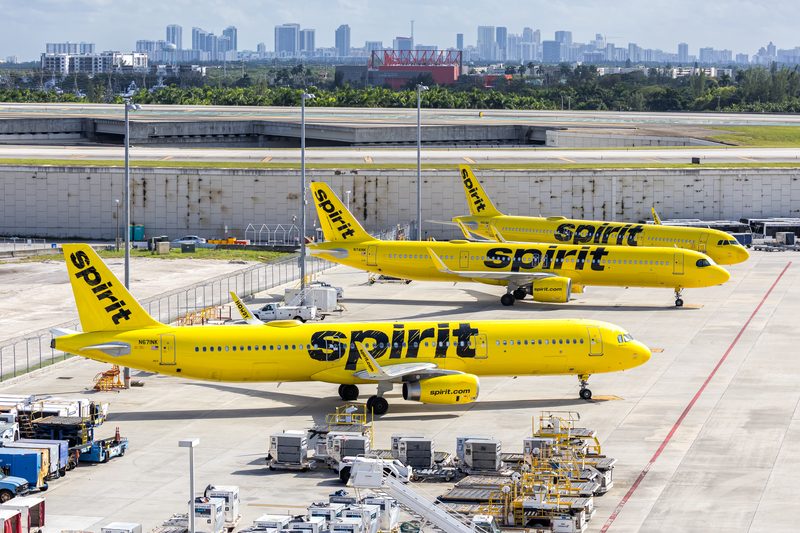
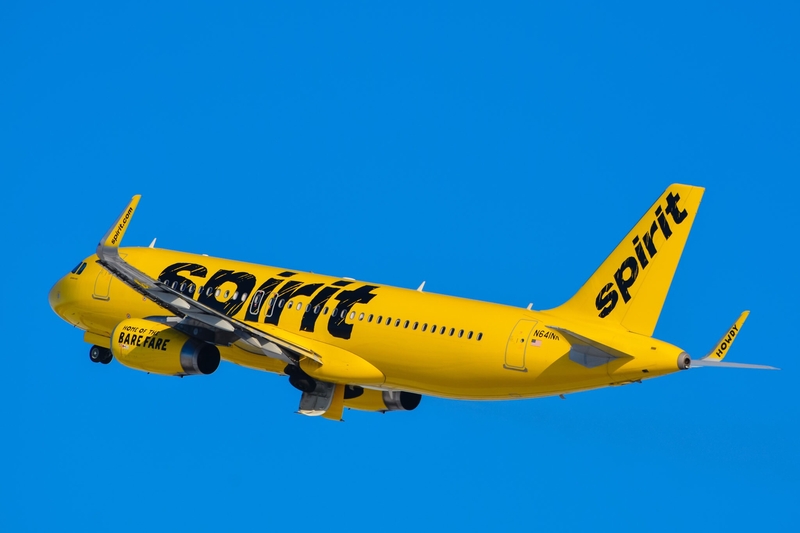
Spirit’s future post-bankruptcy fleet is supposed to center on Airbus A320 and Airbus A321ceo aircraft, high-density single-aisle workhorses that fit the airline’s ultra-low-cost DNA. But even an efficient narrowbody strategy becomes fragile when one of the airline’s largest cost lines suddenly jumps. Spirit has been trying to soften that exposure by pushing further into upsell products such as Spirit First and premium-style seating, yet the core business still depends far more on low fares than on high-yield premium demand.
That is the problem. Carriers with deeper corporate accounts, stronger loyalty economics, and larger premium cabins can absorb a fuel shock differently. Spirit has much less margin for error.
The airline was already restructuring from a position of weakness
That makes the timing especially difficult.
Spirit is not facing this cost shock from a position of balance-sheet strength. It filed for bankruptcy protection again in August 2025 after emerging from an earlier Chapter 11 in March of the same year. Since then, the airline has been shrinking aggressively, cutting aircraft, marketing surplus assets, and redesigning the business around a much smaller operating platform.
At the time of the second filing, Spirit had 214 aircraft. Its latest restructuring plan calls for a fleet of just 76 to 80 aircraft by the third quarter of 2026, primarily Airbus A320 and A321ceo jets. That is not a modest adjustment. It is a wholesale resizing of the airline.
Operationally, the carrier has said the smaller Spirit would focus more tightly on its strongest markets, including Fort Lauderdale-Hollywood International Airport (FLL), Orlando International Airport (MCO), Detroit Metropolitan Wayne County Airport (DTW), and the New York area. In other words, the airline is already trying to emerge as a leaner, more disciplined company. The fuel spike is hitting in the middle of that transition, when the business is already under strain and the room to improvise is limited.
This is not Spirit’s first emergency cash scare
That is another reason the latest report lands so heavily. Spirit has already had to reach for emergency liquidity during this bankruptcy cycle.
In December 2025, the airline secured an additional $100 million in debtor-in-possession funding to keep operations moving and stabilize the restructuring. That was supposed to buy time. Instead, the latest fuel shock has reopened the same broader question: whether time alone is enough.
For airline professionals, that is the key issue. Bankruptcy restructurings can survive negative headlines. What they struggle to survive is a repeated need for emergency cash while the core assumptions behind the plan are being challenged. Once that happens, the conversation shifts from “when will the airline emerge?” to “can the airline still emerge at all?”
The Washington angle says this may be bigger than Spirit
The reported meeting next week between Transportation Secretary Sean Duffy and executives from several low-cost carriers adds another layer to the story.
If the Department of Transportation is indeed trying to gauge the health of smaller airlines, that suggests Washington sees more than a single-company problem. It suggests the fuel shock may be putting broader pressure on the low-cost end of the U.S. airline market, where fare sensitivity is highest and balance sheets are generally thinner than at the large legacy carriers.
Still, Spirit remains the clearest stress case. It is already in bankruptcy. It is already shrinking its fleet. It is already rebuilding its network around a smaller footprint. And now it is reportedly seeking outside help while fuel prices remain deeply unstable. That combination makes Spirit the airline everyone else in the segment is now watching.
Bottom Line
Spirit’s reported appeal to the Trump administration matters because it turns a fuel story into a survival story.
The airline was already trying to emerge from Chapter 11 as a much smaller all-Airbus operator centered on Fort Lauderdale (FLL), Orlando (MCO), Detroit (DTW), and the New York market. That plan may still be possible. But if fuel remains high enough to blow apart the restructuring math, even a smaller Spirit may not be small enough.
For now, the most accurate reading is not that Spirit is finished. It is that the carrier’s recovery has become far more fragile than it looked only a few weeks ago. A bailout request, if confirmed, would be the clearest sign yet that the airline’s bankruptcy exit is no longer just under pressure. It is under genuine threat.
Keep reading FlyMag
Get the Daily Brief in the morning or the Route Watch weekly recap on Fridays. Or both.