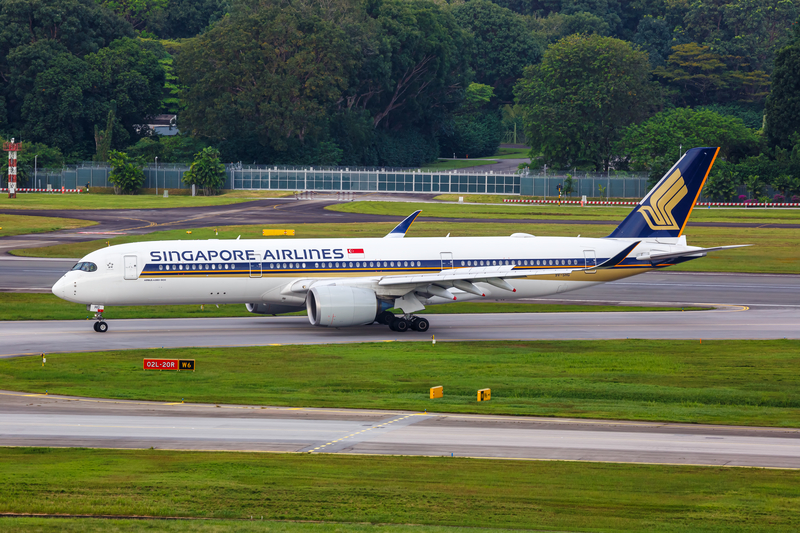
Singapore Airlines is heading back to Saudi Arabia’s capital with a four-times-weekly nonstop link between Singapore Changi Airport (SIN) and King Khalid International Airport (RUH), launching June 2, 2026. For network planners, this is a notable “return-to-market” move: Riyadh is re-emerging as a premium-leaning business gateway, and Singapore is one of the world’s most efficient east–west transfer hubs for Southeast Asia and Oceania flows.
Just as important is the equipment choice. Singapore Airlines will operate the route with its Airbus A350-900 “medium-haul” variant—high-capacity, two-cabin widebody lift that’s optimized for dense regional and mid-length international missions, rather than ultra-long-haul.
Route Snapshot: SIN–RUH Comes Back Online
The service is scheduled to operate four days per week, with Singapore Airlines planning the following timings:
Read our stories in your inbox
Two aviation newsletters. Zero fluff.
-
SQ498 departs Singapore (SIN) at 18:20 and arrives Riyadh (RUH) at 23:00 (local times)
-
SQ499 returns Riyadh (RUH) at 23:00 and arrives Singapore (SIN) the next day (local time varies by seasonal schedule)
At roughly 3,600 nautical miles between SIN and RUH, this sits in a sweet spot for the A350-900 from both performance and product perspectives—long enough to justify a true widebody experience, but short enough to benefit from a high-utilization aircraft type.
Why Riyadh, Why Now
Riyadh (RUH) has shifted from being primarily a government-and-energy city to a broader corporate, events, and investment market—one that increasingly supports consistent long-haul demand rather than purely peak-season spikes. That matters because the economics of a four-weekly widebody route depend on repeatable business traffic, steady visiting-friends-and-relatives (VFR) flows, and onward connections that don’t rely on a single seasonal surge.
For Singapore Airlines, RUH also strengthens its Gulf footprint without needing to rely on intermediate European stops—an older operating model the industry steadily moved away from as ETOPS-capable twins and strong hub banks made nonstops more efficient.
The Aircraft Choice: A350-900 Medium-Haul, Configured for Volume
Singapore Airlines is assigning its Airbus A350-900 medium-haul configuration to the SIN–RUH route. This is a very specific subfleet with a capacity and cabin mix that signals how the airline views the market:
-
303 seats total in a two-class layout
-
40 Business Class seats
-
263 Economy Class seats
-
No Premium Economy cabin on this variant
From an operational lens, the A350-900 brings the usual advantages airline professionals track closely: strong fuel efficiency for its size class, excellent dispatch reliability maturity across global fleets, and a wide performance envelope in hot-and-high environments—relevant in the Gulf during peak summer conditions.
Powering the type are Rolls-Royce Trent XWB engines, a key contributor to the A350’s long-haul economics and a major reason the platform has become a go-to solution for carriers balancing range, payload, and trip cost.
Product Implications: Widebody Comfort on a Mid-Length Sector
Because SIN–RUH is a true widebody route, Singapore Airlines can offer the cabin experience its brand is built around—particularly in Business Class, where the airline’s regional A350 product uses a modern 1-2-1 layout designed for direct aisle access. For corporate travelers, that matters: you’re not just selling a seat, you’re selling a usable work-and-rest environment across an evening departure bank out of SIN.
Economy on the A350 is also a strategic fit for Riyadh: it provides the seat volume needed for price-sensitive VFR demand and regional leisure traffic while keeping unit costs competitive.
Network Connectivity: What This Unlocks at Both Ends
At Singapore (SIN), this route plugs into one of the most connection-rich banks in Asia. The most obvious upside is Southeast Asia–Gulf and Australia–Gulf connectivity with a single stop, but the bigger commercial play is the ability to flow traffic from multiple origin points into a single RUH departure—helping support frequency even before a route reaches daily scale.
At Riyadh (RUH), the benefit is simpler: nonstop access to Singapore’s global connectivity, especially for travelers who value schedule reliability and smooth transfers over circuitous routings.
It also complements existing Saudi Arabia access from Singapore Airlines Group, with the group already present in the Kingdom via service to Jeddah (JED).
Bottom Line
Singapore Airlines’ return to Riyadh (RUH) is more than a headline route launch—it’s a capacity-and-product statement. Using the 303-seat A350-900 medium-haul aircraft suggests the airline is targeting a balanced mix of premium business demand and high-volume economy traffic, while relying on Singapore (SIN) as the connective engine that can sustain the route beyond initial launch enthusiasm. For industry watchers, SIN–RUH will be a useful bellwether for how quickly Riyadh can support sustained, premium-credible long-haul growth.
Keep reading FlyMag
Get the Daily Brief in the morning or the Route Watch weekly recap on Fridays. Or both.