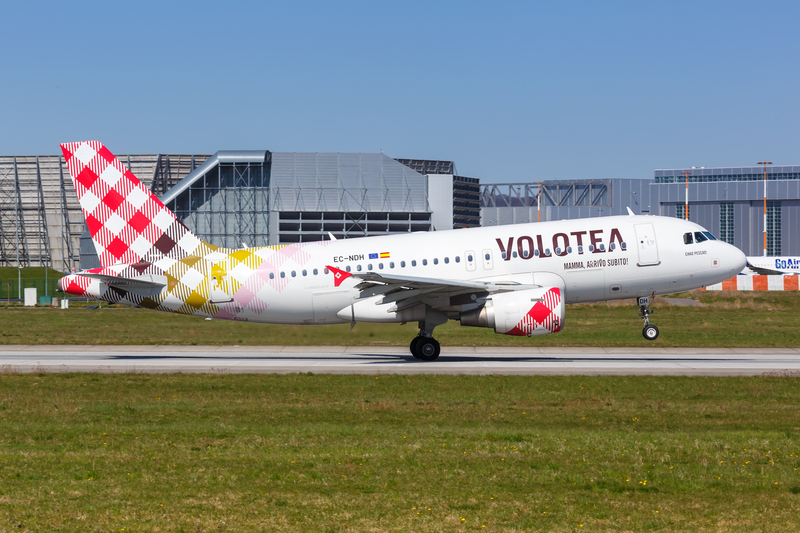
Volotea has secured the public service obligation contract for a new route between Strasbourg Airport (SXB) and Copenhagen Airport (CPH), adding another state-backed link that says a great deal about both the airline’s regional strategy and Strasbourg’s place in the French network.

The new service begins on April 9, 2026 and will operate twice weekly, on Mondays and Thursdays, under a two-year public service agreement awarded by French authorities. More than 33,000 seats are expected to be offered over the life of the contract.
On the surface, this is a modest route launch. In reality, it is another sign that Volotea is becoming structurally important to Strasbourg in a way few low-cost carriers ever do at a regional airport.
Read our stories in your inbox
Two aviation newsletters. Zero fluff.
This Is Not Just Another Leisure Route
The most important point here is that Strasbourg–Copenhagen is not being launched purely as a discretionary commercial experiment. It is a PSO route.
That matters because PSO contracts are awarded when authorities believe a route serves a broader public interest that the market might not sustain on purely commercial terms. In this case, the goal is not just tourism. It is connectivity, regional access, and support for economic and institutional links between eastern France and Northern Europe.
That is especially relevant in Strasbourg.
Strasbourg is not a typical regional city in the French aviation system. It is a political, institutional, and diplomatic center, home to major European institutions and a city whose air links carry importance beyond simple local leisure demand. When a PSO route is awarded from Strasbourg Airport (SXB), it often reflects a wider connectivity rationale than a standard airport expansion story would suggest.
Copenhagen Is A Smart PSO Choice
The Copenhagen Airport (CPH) route may surprise some readers at first glance, but it is more logical than it looks.
Copenhagen is one of Northern Europe’s most important business and institutional gateways, with strong Scandinavian connectivity and a broad catchment that extends beyond Denmark alone. For Strasbourg, that makes CPH a useful northern anchor point. It provides access not just to Denmark, but to a wider regional economy and a travel market that has relevance for both business and public-sector mobility.
The twice-weekly structure also fits the PSO logic. This is not being built as a mass-market daily operation. It is being designed as a dependable, scheduled link that supports specific travel flows while keeping capacity aligned with realistic demand.
That is often how successful PSO flying works: disciplined frequency, clear public purpose, and a route that fills a strategic gap rather than simply chasing volume.
Volotea Is Becoming Strasbourg’s Defining Airline
The broader significance lies in what this says about Volotea’s position at Strasbourg.

With Copenhagen added, Volotea says it will serve 28 routes from SXB across eight countries, making it the leading airline at the airport by number of destinations. That is a remarkable position for a carrier that has built much of its European identity around linking secondary and mid-sized cities rather than dominating major national hubs.
At Strasbourg, though, that model appears to have matured into something more substantial. Volotea is no longer just another operator adding seasonal city pairs. It is becoming one of the airport’s central network architects.
That matters because airlines that win PSO contracts often gain more than revenue support. They gain institutional credibility, stronger local visibility, and a deeper role in shaping the airport’s strategic relevance.
The Copenhagen Route Follows A Pattern, Not A One-Off
This award is also notable because it follows another recent PSO win for Volotea from Strasbourg to Munich Airport (MUC), likewise due to begin in April.
Taken together, the Copenhagen (CPH) and Munich (MUC) awards suggest that French authorities and regional stakeholders increasingly see Volotea as a dependable provider of strategically useful connectivity from SXB. That is not a small shift.
Low-cost carriers are often viewed primarily through the lens of leisure stimulation and seasonal flexibility. Volotea’s Strasbourg portfolio shows a more layered role. It is operating like a hybrid regional connector: still very much a low-cost airline, but one increasingly entrusted with routes that have public-interest value as well as commercial relevance.
That is a different kind of maturity.
Strasbourg’s Role In The Network Is Quietly Strengthening
For Strasbourg Airport (SXB), this matters far beyond one Scandinavian route.
Airports like Strasbourg compete not only on raw passenger numbers, but on relevance. They need routes that support business, institutions, tourism, and cross-border mobility without depending entirely on Paris or larger foreign hubs. Winning and maintaining that kind of relevance often comes down to targeted connectivity rather than sheer scale.
That is where PSO-supported routes can be especially useful.
A service to Copenhagen (CPH) helps diversify Strasbourg’s northern European access and complements links that are more conventionally focused on southern leisure markets or domestic French flows. It also reinforces the idea that Strasbourg is an airport with a specific role to play in European institutional and regional connectivity, rather than simply a secondary airport in France’s east.
Why Volotea Fits This Role
Volotea’s business model helps explain why it keeps winning this kind of work.
The airline has long specialized in connecting cities that larger network carriers often overlook and that ultra-low-cost rivals may not want to serve at the required frequency or reliability. That makes it well suited to PSO flying, particularly from airports where the route’s public value may be greater than its pure yield profile.
For Strasbourg–Copenhagen, that fit is obvious. The route is important enough to justify protection and support, but not necessarily large enough to attract aggressive competition from a major network airline on standard commercial terms. Volotea sits neatly in that space.
It can offer the route at the right scale, with a relatively efficient short-haul cost base, while still operating in a way that matches the public-service expectations attached to the contract.
Bottom Line
Volotea’s PSO award for Strasbourg Airport (SXB) to Copenhagen Airport (CPH) is a small route announcement with larger strategic meaning.
The twice-weekly service from April 9, 2026 strengthens Strasbourg’s northern European connectivity, supports the airport’s wider regional and institutional role, and confirms Volotea’s growing importance in eastern France. Coming on the heels of another PSO-backed Strasbourg route to Munich (MUC), the Copenhagen win also shows that Volotea is no longer simply expanding at SXB. It is becoming one of the airport’s defining carriers.
For aviation readers, that is the real takeaway. This is not just a new city on the departures board. It is another step in Volotea’s evolution from secondary-city specialist into a more deeply embedded regional connectivity partner.