Lufthansa Cargo has moved its Mumbai freighter operation from Mumbai (BOM) to Navi Mumbai (NMI), making the newly opened airport a station in its dedicated cargo network ahead of the 2026-2027 winter season.
The transfer took effect October 12, two weeks before the winter schedule begins on October 25. In its winter network announcement, Lufthansa Cargo said the schedule will provide 88 freighter connections to 40 destinations worldwide, with the largest concentration of changes in Asia-Pacific.
Navi Mumbai Becomes Lufthansa Cargo’s New Mumbai Gateway
Lufthansa Cargo attributed the transfer from BOM to infrastructure modernization intended to increase capacity and operating efficiency. Navi Mumbai lies about 19 miles east of the established Mumbai airport and gives the airline another way to serve one of India’s principal industrial and commercial regions.
Read our stories in your inbox
Two aviation newsletters. Zero fluff.
The change is more consequential than a simple airport-code substitution. Freight forwarders, trucking companies and shippers must redirect cargo flows to a different side of the Mumbai metropolitan area, while ground handlers establish new import, export and transfer processes. Lufthansa Cargo is betting that the adjustment will be offset by greater room for growth at NMI.
Navi Mumbai’s cargo facilities operate around the clock and include provisions for pharmaceuticals, perishables, cold-chain shipments, hazardous materials, live animals, valuables and oversized freight. The airport says cargo capacity is planned to grow in phases from 500,000 to 2.6 million metric tons annually, ultimately using separate facilities for international, domestic and express traffic.

That scale is important in a market where airport capacity and landside access can be as limiting as aircraft availability. Lufthansa Cargo Chief Executive Ashwin Bhat described India as a strategically important growth market and said the NMI station would preserve access to the carrier’s global network and main-deck capacity.
Southern India will also gain another Lufthansa Group routing. SWISS WorldCargo is adding Bengaluru (BLR) to its network from Zurich (ZRH), providing an additional European gateway for shipments originating in and around India’s technology and manufacturing center.
Singapore Added to an Existing Asian Rotation
Lufthansa Cargo plans as many as 46 weekly freighter rotations serving 17 Asia-Pacific destinations during the winter season. Singapore (SIN) will be inserted into an existing Frankfurt (FRA)-Taipei (TPE) rotation, creating another intra-Asian freight leg and adding main-deck capacity in a market where passenger belly space cannot accommodate every shipment type.
The carrier will retain several additions made for summer 2026. Its Frankfurt-Ho Chi Minh City (SGN)-Shanghai (PVG)-Los Angeles (LAX) transpacific rotation will continue twice weekly. Additional Frankfurt flights to Taipei and Chengdu (CTU) will each remain at three weekly frequencies, while Almaty (ALA) will return to the freighter network with a connection to Frankfurt.
The combination of fifth-freedom-style regional sectors and flights continuing across the Pacific lets Lufthansa Cargo use each rotation for several traffic flows rather than relying only on freight moving to or from Germany. Adding Singapore to the Taipei pattern follows the same principle, creating saleable capacity within Asia while feeding the Frankfurt hub.
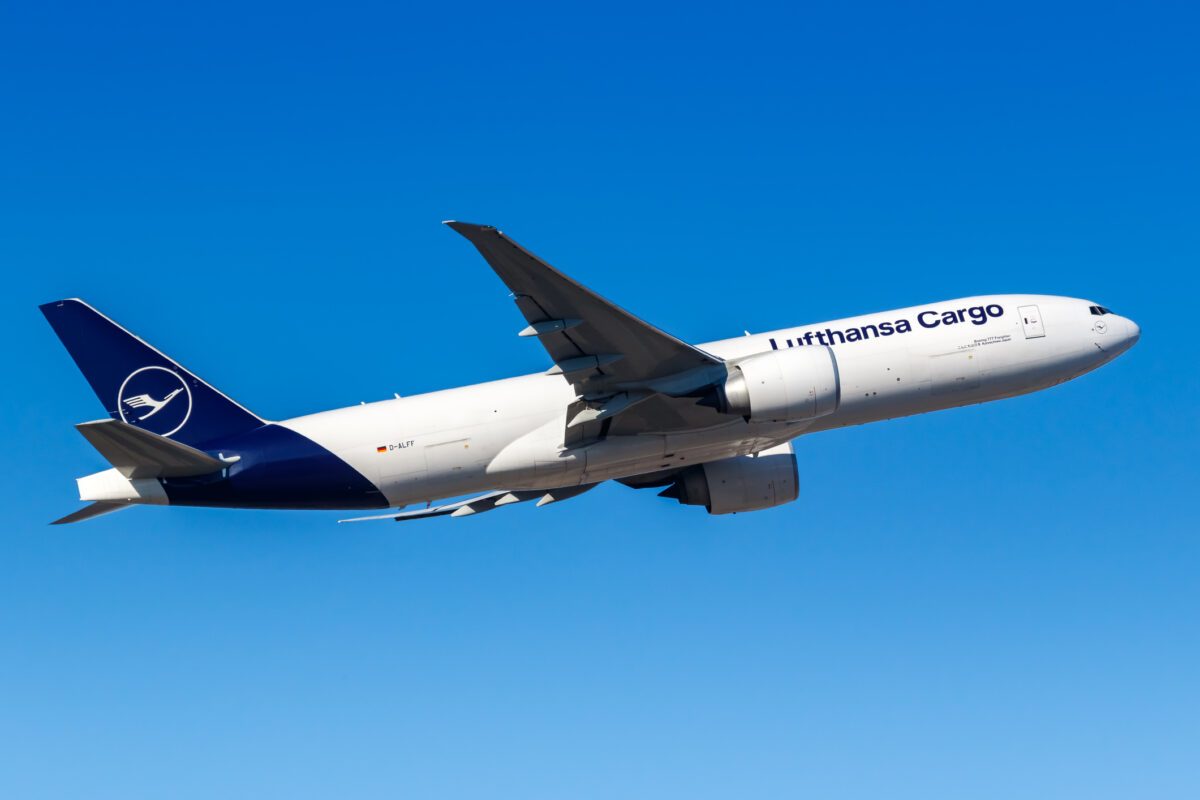
The widebody backbone of the operation is the Boeing 777F. Lufthansa Cargo’s published fleet comprises 18 777 freighters alongside four Airbus A321 freighters. According to Boeing’s specifications, the 777F can carry 27 main-deck pallets, has a maximum structural payload of 107 metric tons and offers about 5,000 nautical miles of range. That combination suits the multi-sector Asian and transpacific rotations in Lufthansa Cargo’s schedule, particularly where dense freight or shipments requiring full-height main-deck positions are involved.
More Frequencies for Three US Cargo Markets
The carrier’s Americas map remains at 11 North American and four South American destinations, but three US stations receive additional winter frequency. Dallas/Fort Worth (DFW) increases to four weekly connections, Houston (IAH) rises to three and New York Kennedy (JFK) reaches five.
The South American operation remains at four destinations and four weekly connections. Rather than opening more stations, Lufthansa Cargo is concentrating added aircraft time in established US gateways with significant industrial, energy, technology and general freight demand.
777 Freighters Take a Larger Role Within Europe
Lufthansa Cargo will schedule up to three weekly Boeing 777F rotations serving as many as three European destinations. Frankfurt services to Larnaca (LCA), Istanbul (IST) and Stavanger (SVG), which had been offered on a short-term basis, will become regular parts of the schedule.
The change comes as Lufthansa Cargo searches for a new operator for its four Airbus A321F aircraft. Routes previously served by those narrowbody freighters will meanwhile receive capacity from long-haul freighters or the Lufthansa Group passenger network. The converted A321 freighters had provided a 28-ton payload and roughly 1,890 nautical miles of range, making them suitable for European and nearby medium-haul sectors without committing a 777F.
Passenger flying will continue to broaden the cargo schedule beyond the dedicated freighter map. Lufthansa Airlines is adding Kuala Lumpur (KUL) five times weekly, while ITA Airways will begin two weekly flights to Santo Domingo (SDQ) in November. Lufthansa Cargo markets the available belly capacity across the group, giving customers access to roughly 7,500 weekly flights and 350 destinations through Frankfurt, Munich, Vienna, Brussels, Rome and Zurich.
Bottom Line
The move to Navi Mumbai gives NMI an important early endorsement from a major global cargo operator. For Lufthansa Cargo, it offers room to protect and eventually expand its position in western India without waiting for further capacity to become available at BOM. The immediate test will be whether forwarders can shift trucking and handling patterns without undermining transit times or adding excessive landside cost.
The broader schedule shows Lufthansa Cargo prioritizing aircraft productivity over rapid destination growth. Singapore is being added to an existing rotation, transpacific sectors are being retained, and extra US capacity is going to established gateways. That approach allows the carrier to sell the same 777F capacity across several regional and intercontinental markets while limiting the risk attached to entirely new freighter routes.
The unresolved element is the A321F fleet. Until Lufthansa Cargo secures another operator, 777 freighters and passenger-aircraft belly capacity must cover parts of the former short- and medium-haul network. That will preserve connectivity, but it cannot fully reproduce the schedule flexibility and main-deck economics of a dedicated narrowbody freighter. How quickly the four A321Fs return under a new operating arrangement will shape the carrier’s European network beyond this winter.
Keep reading FlyMag
Get the Daily Brief in the morning or the Route Watch weekly recap on Fridays. Or both.