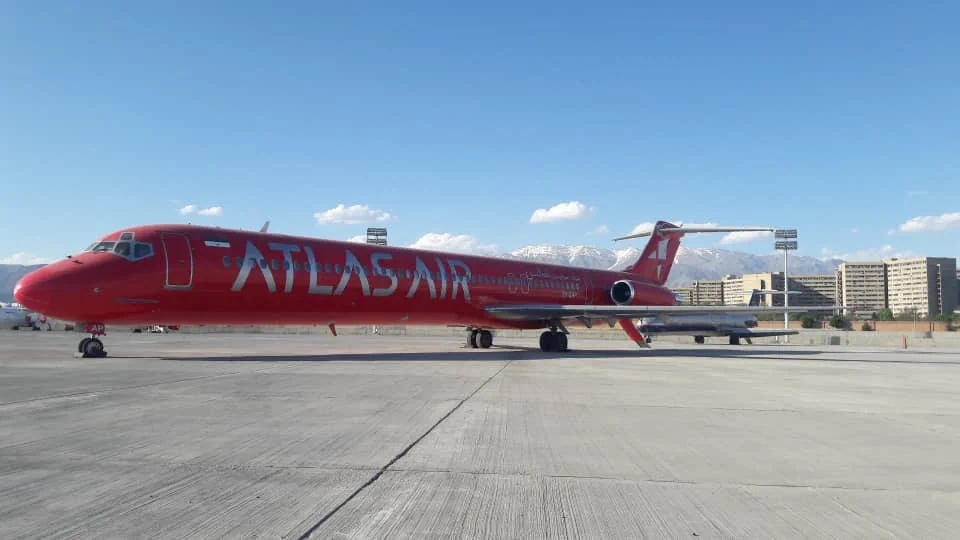
Iranian carrier Atlas Air has opened sales for scheduled flights linking Tehran Mehrabad (THR) with Minsk (MSQ), extending its premium, low-density passenger operation into Belarus.
The airline announced the Tehran-Minsk-Tehran route through its official channel, identifying the McDonnell Douglas MD-87 as the operating aircraft. Atlas said passengers departing Tehran would be processed through Mehrabad’s CIP facilities, consistent with the executive-style product it has built around the aircraft.
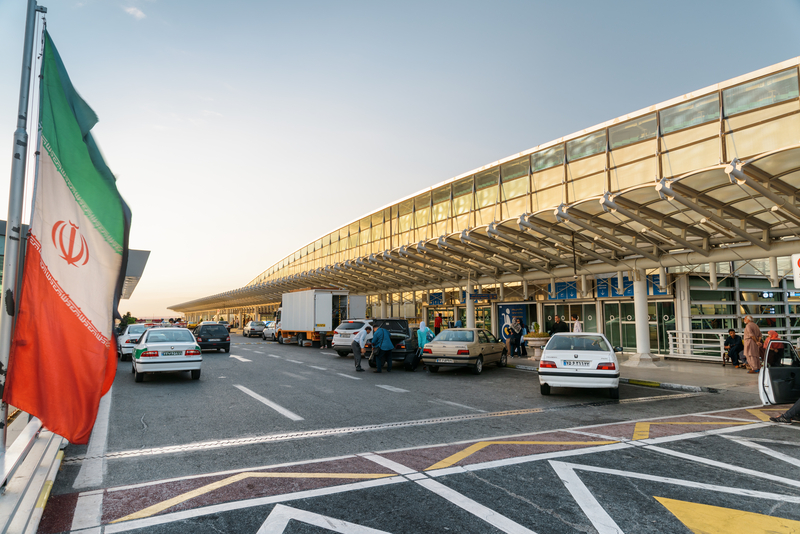
The service is notable for both its departure airport and its unusually small gauge. International flights serving Tehran are generally concentrated at Imam Khomeini (IKA), while Atlas is placing the Belarus operation at the centrally located Mehrabad, its existing operational base and the principal airport for Iranian domestic services.
Read our stories in your inbox
Two aviation newsletters. Zero fluff.
Atlas is selling the Minsk flights through its website and authorized ticketing channels rather than marketing the operation solely as an ad hoc charter. The airline has not presented the route as a conventional, high-capacity scheduled service: its proposition centers on a private cabin, lie-flat seating and space suitable for meetings during the flight.

A scheduled route with business-aviation capacity
The Minsk operation reflects Atlas Air’s unusual position between scheduled airline service and business aviation. Its aircraft are being placed on published routes, but the onboard capacity is closer to a large corporate shuttle than a normal narrowbody flight.
Atlas has promoted its MD-87 with configurations of roughly two dozen passengers. Its official company profile describes a 25-seat executive layout, while more recent airline material markets a 22-seat configuration. The cabin includes seats that convert into beds, dedicated private space and an area intended for meetings.
That layout represents a substantial departure from the MD-87’s original airline role. Boeing’s MD-80 airport-planning data gives the MD-87 a maximum certified capacity of 139 passengers. Atlas is therefore using less than one-fifth of the type’s standard maximum seating capacity on the Belarus service.
The low seat count changes the economics of the route. Atlas does not need to generate the passenger volume required to fill an Airbus A320 or Boeing 737, but each departure must support a considerably higher yield. That makes the product more relevant to government, corporate, delegation and premium leisure traffic than to price-sensitive connecting passengers.

The MD-87 fits the sector without a fuel stop
The MD-87 is the shortest member of the MD-80 family, retaining the series’ rear-mounted Pratt & Whitney JT8D engines and five-abreast fuselage while reducing the cabin length. The type was designed to combine the MD-80 platform with improved range and performance for thinner routes.
Tehran-Minsk is approximately 2,740 kilometers, or about 1,480 nautical miles, on a direct track. Boeing’s payload-range information shows that the MD-87 can comfortably cover that distance, particularly with the light payload associated with Atlas’ executive interior. The aircraft is therefore well matched to the sector from a range perspective even after accounting for reserves and route deviations.
Atlas’ low-density cabin also leaves a large margin below the structural payload associated with a conventional MD-87 operation. The trade-off is operating cost: the JT8D-powered type cannot match the fuel efficiency or maintenance economics of a modern narrowbody. With only about two dozen passengers, Atlas is selling privacy, schedule convenience and cabin space rather than unit-cost efficiency.
The Minsk route gives the aircraft a mission that plays to those strengths. At around four hours in the air, it is long enough for lie-flat seating and private working areas to distinguish the product, but short enough to remain comfortably within the MD-87’s performance envelope.
Atlas Air expands beyond charter flying
The Iranian company should not be confused with the U.S. cargo and charter operator of the same name. The Iranian carrier’s registered company identity is Atlas Khomein Kish. The international company designator listing assigns it the three-letter code ATS and the radio callsign “Air Atlas.”
Atlas has developed a mixed operation spanning passenger flights, air taxi work, cargo missions and special-purpose aviation. Its fleet marketing includes MD-80-family aircraft, the British Aerospace RJ85, Boeing 737 equipment and smaller business aircraft.
The carrier has already used the executive MD-87 on Iranian scheduled routes, including Tehran-Kish and Bandar Abbas-Abu Musa. Minsk takes the same premium scheduled concept into a longer international market rather than introducing a separate long-haul product.
The decision to retain Mehrabad as the Tehran endpoint reinforces that positioning. For travelers starting or ending their journeys in central Tehran, THR offers a different proposition from the longer surface journey to IKA. Combining that location with CIP processing and an executive cabin allows Atlas to differentiate the service before passengers board the aircraft.
Minsk also gives Atlas a destination where a very small aircraft can sustain a nonstop link without requiring broad transfer feed. The route’s commercial case can rest on a narrow pool of higher-value passengers, organized groups and official travel rather than a large local leisure market.
Bottom Line
Atlas Air’s entry creates a nonstop option whose main advantage is not frequency or scale, but a combination of central-airport access in Tehran and a cabin closer to a corporate jet than a scheduled narrowbody. That gives delegations and premium travelers an alternative to connecting itineraries while allowing Atlas to enter the market with fewer than 30 seats at risk on each departure.
The route also shows how older aircraft can retain a viable role outside conventional high-density airline service. The MD-87 is expensive to operate on a per-seat basis, but Atlas is not competing on per-seat cost. It is using the aircraft’s range, large cabin and executive conversion to sell a product that smaller business jets cannot easily match for group capacity.
The measure of the Minsk service will be whether Atlas can maintain the yield required by such a specialized operation. If it does, the carrier will have a template for additional international routes from Mehrabad: limited capacity, premium pricing and destinations where nonstop access matters more than network breadth.
Keep reading FlyMag
Get the Daily Brief in the morning or the Route Watch weekly recap on Fridays. Or both.