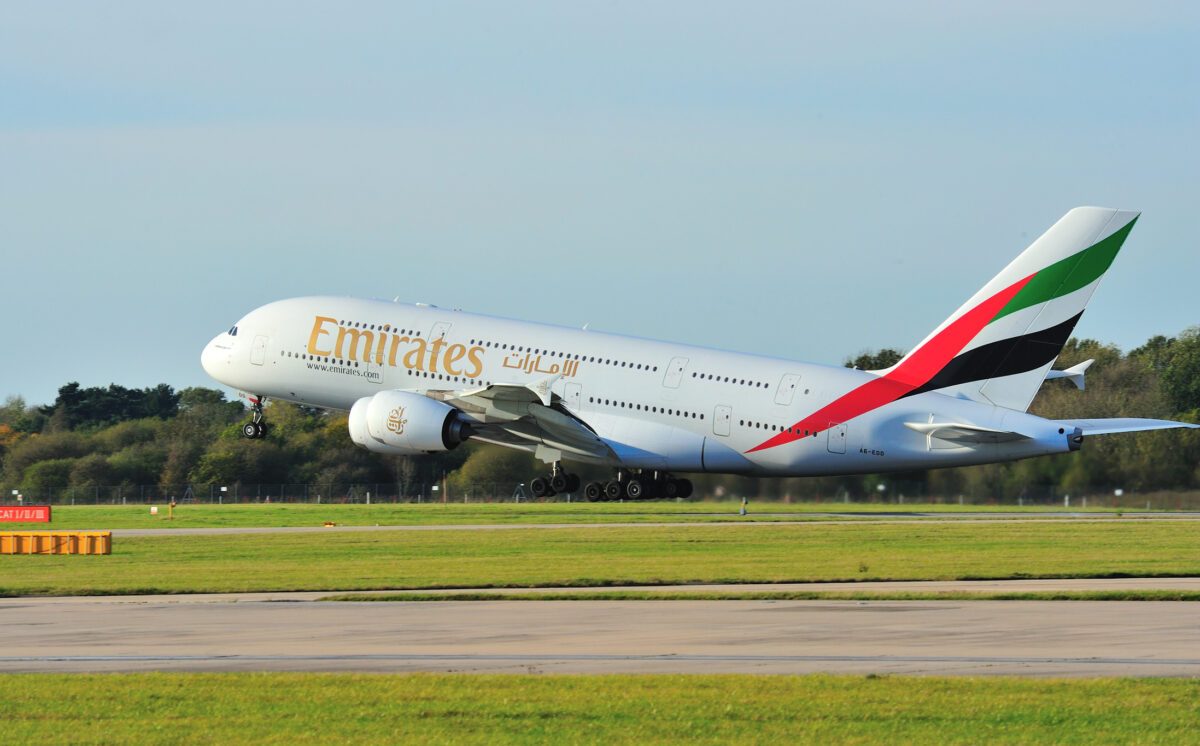
Emirates will introduce Premium Economy on two of its three daily round trips between Dubai International (DXB) and Mauritius (MRU) on September 1, 2026, extending the cabin to one of the airline’s highest-frequency Indian Ocean markets.

The cabin will be sold on EK703/704, operated by an Airbus A380, and EK709/710, operated by a Boeing 777-200LR. Emirates’ Mauritius deployment gives the route 80 Premium Economy seats in each direction per day: 56 on the A380 and 24 on the 777.
That equates to 560 seats in the cabin each way per week. Premium Economy will be available on 14 of Emirates’ 21 weekly frequencies, rather than across the full schedule. The remaining EK701/702 rotation is not included in the September rollout.
Read our stories in your inbox
Two aviation newsletters. Zero fluff.
Two Distinct Three-Class Configurations
The A380 assigned to EK703/704 will carry 569 passengers, with 76 Business Class seats, 56 Premium Economy seats and 437 Economy Class seats. It will not offer First Class.
That layout matches the high-density A380 configuration created through Emirates’ conversion of aircraft that previously had only Business and Economy cabins. In the new three-class A380 layout, Premium Economy is installed on the upper deck in a 2-3-2 arrangement. Emirates removed 120 upper-deck Economy seats to make room for the 56-seat cabin and 18 additional Business Class seats.
The arrangement is a notable departure from Emirates’ four-class A380s, where the same number of Premium Economy seats is positioned at the front of the main deck in a 2-4-2 layout. For Mauritius, the upper-deck installation preserves the aircraft’s high overall capacity while creating a substantial intermediate cabin without retaining First Class.
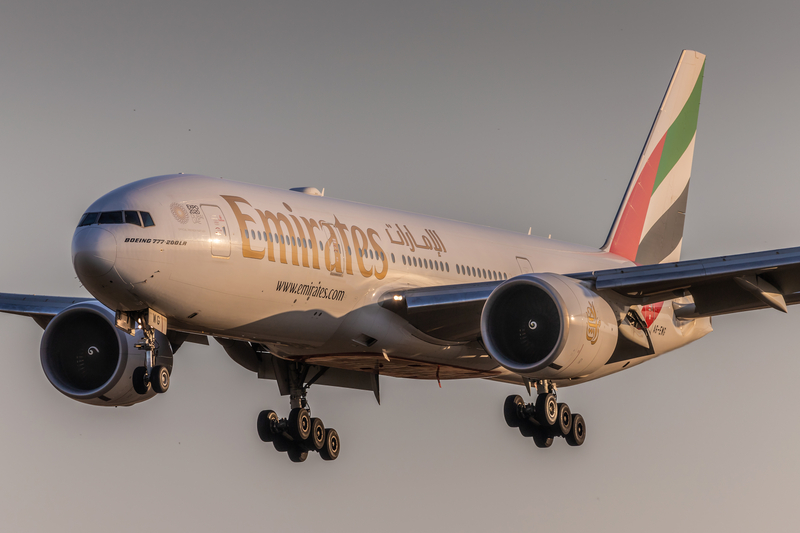
The Boeing 777-200LR operating EK709/710 will have 276 seats: 38 in Business Class, 24 in Premium Economy and 214 in Economy. Its smaller gauge gives Emirates a second daily Premium Economy departure without duplicating the A380’s capacity, while the 777-200LR has more than sufficient range for the approximately six-and-a-half-hour sector.
Both aircraft are therefore tailored to a market combining large leisure volumes with demand for a product above Economy. The A380 provides the bulk of the seats, while the 777 adds frequency and a smaller premium cabin at a different point in the daily schedule.
Premium Economy Spans Two Dubai Connection Banks
Emirates’ published Mauritius timetable lists EK709 leaving DXB at 7:55 a.m. and reaching MRU at 2:30 p.m. The return EK710 departs at 6:30 p.m. and arrives in Dubai at 1:05 a.m. the following day.
EK703 follows from Dubai at 10:35 a.m., arriving in Mauritius at 5:10 p.m. EK704 leaves MRU at 9:50 p.m. and lands at DXB at 4:25 a.m. the next morning. Emirates lists a scheduled flight time of six hours and 35 minutes in each direction.
The timings place Premium Economy in two separate connection flows at DXB. The early-morning arrivals from Mauritius are particularly useful for onward departures to Europe, Asia and the Americas, while the two Dubai departures give inbound travelers a choice of afternoon or early-evening arrival in Mauritius.
Emirates says passengers originating in Mauritius will be able to book through Premium Economy itineraries to 70 destinations. Examples include selected Bangkok services and all six daily flights between Dubai and London Heathrow (LHR). The value of the deployment therefore extends beyond local Dubai traffic: it reduces the likelihood of passengers having to change cabin during a connecting itinerary.
A Product Upgrade Rather Than Added Frequency
The September change leaves the route at three daily services but adds a new fare and service tier. Emirates’ Premium Economy seat is 19.5 inches wide, with a pitch of up to 40 inches and eight inches of recline. It includes an adjustable headrest, calf and foot supports, charging points, a side table and a 13.3-inch entertainment screen.
The airline’s full Premium Economy service also includes upgraded catering and tableware, a broader beverage selection, amenity kits and dedicated bedding. At DXB, passengers have access to a separate Premium Economy check-in area and receive priority boarding.
Those elements position the cabin as more than an extra-legroom Economy product. On a sector of this length, the increased recline and leg support create a clear distinction from the 437-seat Economy cabin on the high-density A380, while keeping the price point below Business Class.
Mauritius Joins the Wider Retrofit Rollout
Emirates began serving Mauritius in September 2002 with three flights per week. Its A380 became a daily fixture in 2013, followed by double-daily service in 2014. The carrier later introduced a third daily frequency, establishing the 21-flight weekly schedule now in place.
The Premium Economy launch is tied to Emirates’ wider cabin retrofit program rather than a route-specific aircraft acquisition. By May 2026, Emirates Engineering had completed work on 95 aircraft, comprising 42 A380s and 53 Boeing 777s. The program has expanded from an initial 120 aircraft to 219, with the airline turning out an average of two refurbished jets per month.
Emirates expects its Premium Economy network to reach 99 destinations by the end of 2026. Mauritius adds a high-volume leisure market to that footprint and demonstrates how the airline is using both the A380 and Boeing 777-200LR to distribute the cabin across multiple frequencies, rather than limiting it to a single flagship departure.
Bottom Line
For Emirates, the Mauritius deployment is primarily a yield move. The airline is not adding another frequency or materially changing the route structure; it is creating 560 weekly opportunities in each direction to sell passengers out of Economy and into a higher-value cabin. On a route already supporting three daily widebody services, that is a more targeted use of capital than adding further capacity.
The aircraft mix also shows the flexibility Emirates is gaining from its retrofit program. A high-density, three-class A380 can continue carrying more than 400 Economy passengers while placing Premium Economy on the upper deck, and the Boeing 777-200LR can offer the same cabin on a lower-capacity rotation. The absence of First Class on both aircraft reflects the route’s volume-led profile without leaving Business Class as the only step above Economy.
The next measure of the strategy will be whether Emirates extends Premium Economy to EK701/702. Covering all three daily services would simplify through-booking and product consistency, but the initial two-frequency deployment allows the airline to concentrate the new cabin around the connection banks most likely to support a fare premium.
Keep reading FlyMag
Get the Daily Brief in the morning or the Route Watch weekly recap on Fridays. Or both.