The U.S. Department of Transportation has opened bidding for the next Essential Air Service contracts linking four Southeast Alaska communities with Juneau.
The department’s request for proposals covers Angoon (AGN), Elfin Cove (ELV), Pelican (PEC) and Tenakee Springs (TKE). The new service term is due to begin February 1, 2027, immediately after the incumbent contracts expire. Carrier proposals are due October 1, 2026.
Alaska Seaplanes, the operating name of Kalinin Aviation, currently holds all four contracts. Its flights connect each community with Juneau (JNU), the carrier’s principal base and the regional gateway for onward air travel.
Read our stories in your inbox
Two aviation newsletters. Zero fluff.
Tender Retains Strong Seasonal Variation
The baseline service pattern reflects the pronounced difference between summer and winter demand in coastal Southeast Alaska. DOT is seeking 10 weekly roundtrips at Angoon during an 18-week peak period, falling to five per week during the remaining 34 weeks.
Tenakee Springs is allocated seven weekly roundtrips in peak season and three off-peak. Elfin Cove receives five per week during the peak and two in the off-season. Pelican’s requirement is six weekly roundtrips throughout the year.

Across the four communities, that schedule represents 1,048 roundtrips over a full 52-week cycle: 350 at Angoon, 228 at Tenakee Springs, 158 at Elfin Cove and 312 at Pelican. The structure concentrates additional flying where summer visitors, seasonal residents and fishing activity produce the greatest increase in traffic.
Alaska Seaplanes’ own destination information describes Elfin Cove as a sportfishing center and notes that Tenakee Springs’ population rises during summer with second-home owners, visitors and yacht traffic. Pelican and Elfin Cove are both on Chichagof Island, while Angoon is on Admiralty Island.
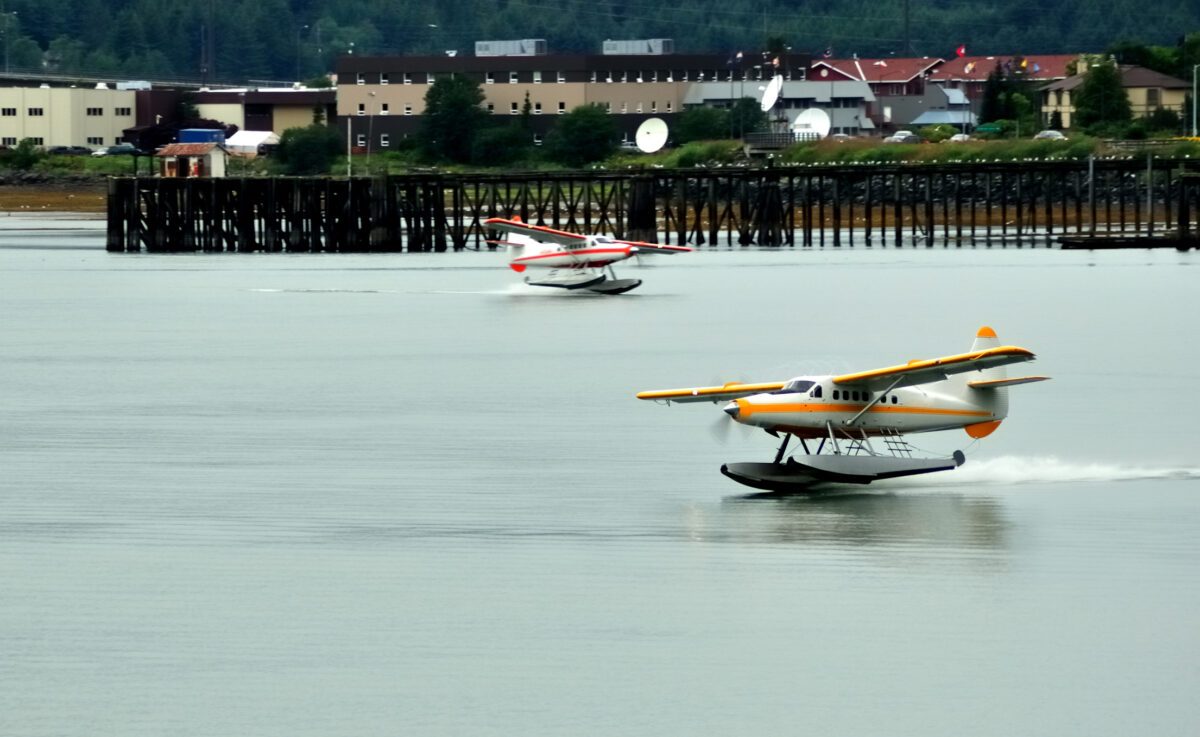
These are not conventional runway markets. Alaska Seaplanes tells passengers that travel to all four communities is always by floatplane. That operating requirement narrows the potential field to carriers with suitable aircraft, crews and Southeast Alaska infrastructure.
Small Floatplanes Match the Service Pattern
DOT’s December 2022 carrier-selection order authorized Alaska Seaplanes to use four-passenger Cessna 206s, six-passenger DHC-2 Beavers and nine-passenger Cessna Caravans across the four markets.

The mix lets the carrier match capacity and payload to individual departures rather than committing every flight to one aircraft size. The piston-powered Cessna 206 covers the lightest loads, while the larger DHC-2 Beaver adds useful passenger and freight capacity. The turboprop Cessna 208A Caravan provides the highest capacity of the three and is better suited to departures carrying heavier combined passenger, baggage and cargo loads.
That flexibility matters on routes where freight is part of the scheduled-air-service function rather than an ancillary business. Alaska Seaplanes publishes cargo rates between Juneau and all four communities, with standard freight generally moving within one to three days depending on volume, weather and season.
The carrier’s fleet page lists Cessna 208A Caravans, DHC-2 Beavers and Cessna 206s among its floatplanes. Its broader wheeled fleet includes Cessna 208B Grand Caravans, Grand Caravan EXs and Pilatus PC-12s, but the four markets in this proceeding depend on water operations.
Current Subsidy Reaches $2.35 Million
The existing four-year award runs from February 1, 2023, through January 31, 2027. DOT approved annual subsidy increases in each market over the term, taking the combined amount from $1.21 million in the first year to $2.35 million in the fourth.
For the final year, the authorized figures are $440,619 for Angoon, $548,306 for Elfin Cove, $1.04 million for Pelican and $316,645 for Tenakee Springs. Pelican accounts for more than 44% of the combined subsidy despite having fewer annual roundtrips than Angoon, illustrating how geography, stage length, operating cost and expected local revenue can outweigh frequency alone.
Alaska Seaplanes was the only carrier to bid in the previous competition. Its 2022 proposal used a market-specific subsidy per departure, payable regardless of which approved aircraft operated the flight. DOT converted those departure rates into annual contract amounts when making the award.
The new proceeding gives Alaska Seaplanes an opportunity to defend a group of routes it already operates as one network. A challenger could bid for one or more communities, although separating markets may reduce the scheduling, staffing and fleet efficiencies available from operating all four through the same Juneau floatplane base.
Alaska selections also carry an experience consideration tailored to the state. Federal law directs DOT to consider a bidder’s record in scheduled Alaska service or significant nonscheduled operations under adverse Alaska weather conditions. That provision favors operators able to demonstrate more than aircraft availability and a low subsidy request.
Bottom Line
The competition will show whether another carrier sees a viable opening in Southeast Alaska floatplane EAS or whether the four communities remain, in practice, a single-source package. Alaska Seaplanes enters with the advantages of local stations, an established Juneau operation, the required floatplane fleet and experience carrying both passengers and freight on the routes.
Cost will nevertheless be central to the next award. The combined subsidy authorized under the present contract nearly doubled between its first and fourth years. DOT will have to balance that trajectory against operational reliability and the risk of fragmenting a small network among multiple providers. A lower bid has limited value if it requires new infrastructure or lacks enough aircraft depth to recover from maintenance and weather disruptions.
The proposals due October 1 will therefore be worth watching for more than the headline subsidy figures. Aircraft assignments, per-departure economics, seasonal schedules and whether bidders pursue the four communities together will indicate how much genuine competition exists for some of Alaska’s most specialized scheduled flying.
Keep reading FlyMag
Get the Daily Brief in the morning or the Route Watch weekly recap on Fridays. Or both.