Delta Air Lines will end nonstop service between New York John F. Kennedy (JFK) and Washington Dulles (IAD) after February 10, 2027, removing the only scheduled nonstop operator from the airport pair.

The airline’s published schedule shows the route continuing through the winter before disappearing on February 11. Delta currently offers as many as two daily round trips, but the operation is set to contract to one daily frequency from December 19 for its final weeks.
The cancellation concerns JFK-IAD specifically rather than Delta’s broader presence in Washington. The airline will continue serving Washington Reagan (DCA) from JFK and retains flights from IAD to its other hubs.
Read our stories in your inbox
Two aviation newsletters. Zero fluff.
A 198-Nautical-Mile Regional Route
JFK and IAD are approximately 198 nautical miles apart, equivalent to about 228 statute miles. Scheduled block times are nevertheless around 90 minutes because of taxi time, air traffic congestion and the relatively small proportion of the journey spent at cruise altitude.

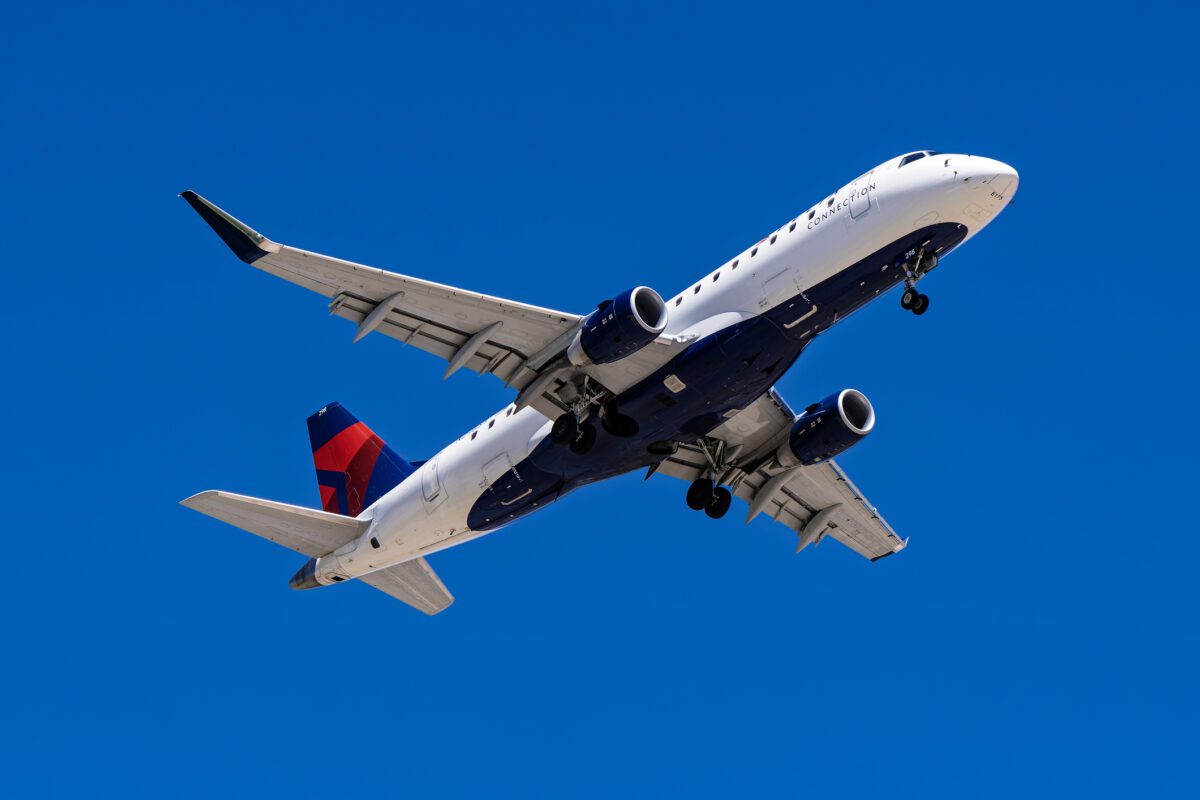
The route is operated under the Delta Connection brand. The November schedule primarily uses the Embraer E175, flown for Delta by Republic Airways, while the final phase is scheduled around Endeavor Air regional-jet operations.
Delta’s E175 fleet has 70- and 76-seat configurations, including 12 First Class seats and 20 Delta Comfort seats. The aircraft’s two-by-two cabin, useful baggage capacity and premium seating make it a better fit for a short connecting market than the 50-seat regional jets that previously dominated similar sectors.
The Bombardier CRJ-900 also appears in the wider schedule pattern. Delta’s versions seat either 70 or 76 passengers, again with 12 First Class seats. Both types have far more range than the route requires; their value is matching capacity to demand while maintaining a three-cabin product consistent with Delta’s larger domestic network.
The Flight’s Main Value Was at JFK
For local New York-Washington passengers, JFK-IAD competes with rail, road travel and a much larger air market involving other airports in both metropolitan areas. Its network role is more distinctive: it links the Dulles catchment with Delta’s international and domestic banks at JFK without requiring a connection through Atlanta, Detroit or another hub.
That proposition is useful for some itineraries, particularly where Delta or one of its partners offers a stronger option from JFK than from IAD. It is also operationally expensive. A short sector consumes two airport movements, a regional aircraft rotation and crew resources while producing little flying time over which to spread those costs.
The opportunity cost is particularly important at JFK. The FAA classifies the airport as Level 3 and requires airlines to submit detailed schedules for coordinated operating seasons. Its Summer 2027 scheduling notice identifies March 28 through October 30 as the next summer season and requires carriers to provide flight numbers, operating times, frequencies, equipment and effective dates.
At a constrained airport, a regional route is measured not only against its own revenue but against other possible uses of the same operating window. Removing JFK-IAD gives Delta additional flexibility to deploy regional aircraft, gates and schedule space toward markets with stronger local demand or more valuable connecting flows.
Delta has continued to build JFK as its principal New York international gateway. The carrier describes JFK and LaGuardia as a dual-hub system with hundreds of peak-day departures, while emphasizing JFK’s role in its transatlantic network on its New York network page. In that context, preserving a very short regional spoke requires the service to generate enough connecting value to justify scarce resources.
A Route With More Than Three Decades of History
The airport pair has a long association with Delta, although the service has not operated continuously. Delta’s own historical schedules, preserved through the Delta Flight Museum and the Digital Library of Georgia, place the market in the carrier’s network more than three decades ago.
A Delta timetable effective February 1, 1994 shows the airline serving both Kennedy and Dulles as part of a substantially different domestic system. The operation has since passed through several Delta Connection carriers and generations of regional equipment as Delta reshaped its New York network.
The historical comparison also shows how the economics of short-haul flying have changed. Earlier iterations of the route existed in an era of lower airport costs, more extensive turboprop and small-jet networks, and different competitive conditions in the Northeast. Today, 70- and 76-seat regional jets carry higher trip costs, while JFK slots and regional-aircraft resources have alternative uses across Delta’s network.
Washington Dulles Loses Its JFK Nonstop
Dulles currently lists New York-Kennedy among its nonstop destinations. Once Delta leaves, travelers between IAD and JFK will no longer have a nonstop option in the published schedule.
Passengers remaining with Delta can use DCA for nonstop JFK service or connect from IAD through another Delta hub. Neither is a direct replacement for every traveler. DCA and IAD serve different parts of the Washington region, and changing airports can materially alter ground transportation time.
The schedule remains subject to normal airline revisions before February, but Delta has removed JFK-IAD beyond February 10 while continuing to sell the route before that date through its booking system. The final withdrawal will close another chapter in a short route whose strategic purpose was always larger than its mileage suggested.
Bottom Line
The immediate winners are the Delta markets that receive the aircraft time and JFK schedule space released by the Dulles flight. Even one daily regional-jet rotation can be more productive when attached to a market with stronger local demand, better fare performance or more connections across Delta’s international banks.
For Dulles passengers, the change reduces access to Delta’s JFK network rather than eliminating Delta service to New York or Washington altogether. Travelers willing to use DCA retain a nonstop option, but those tied to IAD will face a connection or a change of airline and New York airport. That distinction matters most to passengers in Northern Virginia and to international customers building an itinerary around JFK.
The route’s disappearance is another sign that long-lived regional links are no longer protected by history alone. At a constrained hub, short sectors must compete directly with larger domestic and international opportunities. The next point to watch is how Delta uses the freed capacity in its 2027 JFK schedule and whether another carrier sees enough value to restore the IAD-JFK airport pair.