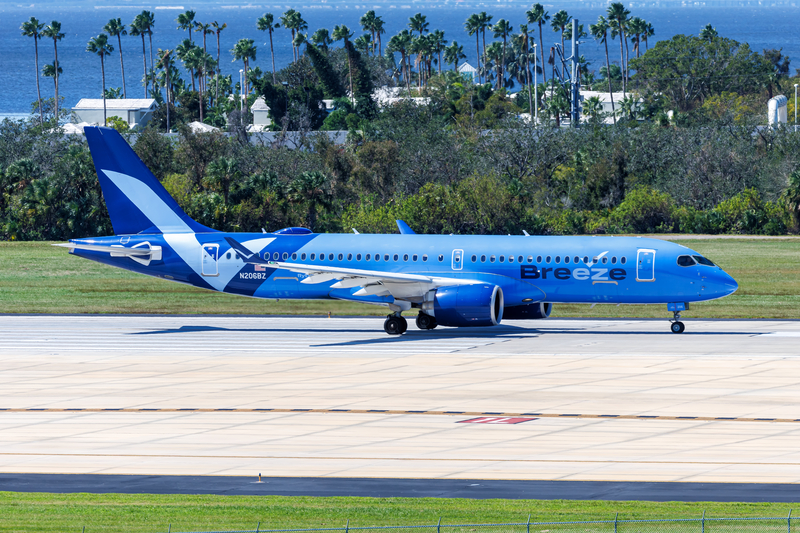
Breeze Airways (MX) has made a habit of moving faster than the industry’s ability to keep up. The airline’s brightly branded Airbus A220-300s have steadily multiplied across the U.S., showing up in markets that often haven’t seen a meaningful nonstop “new entrant” in years. After a busy start to 2026 that included another announced network buildout—and the carrier’s early steps into international flying—industry watchers are now circling what looks like the next burst of domestic growth.

A route list circulating in the route-tracking community points to 12 additional city pairs likely being prepared for launch later in 2026, with a clear emphasis on the U.S. Southeast and Florida. What makes this one particularly interesting is that several of the proposed pairs have started to appear as live origin-and-destination pages inside Breeze’s own booking ecosystem—often the kind of breadcrumb that shows up when an airline is close to filing schedules and pushing routes into distribution.
A route list built around three anchor airports
The reported 12-route package concentrates on three airports, each playing a different strategic role in Breeze’s network design:
Read our stories in your inbox
Two aviation newsletters. Zero fluff.
-
Raleigh-Durham International Airport (RDU), a fast-growing market where Breeze is scaling up and staffing for larger operations.
-
Fort Lauderdale–Hollywood International Airport (FLL), one of the most competitive leisure airports in the country, but also a demand engine for Florida and the broader Caribbean basin.
-
Cincinnati/Northern Kentucky International Airport (CVG), an airport with a strong catchment area and a history of supporting point-to-point growth.
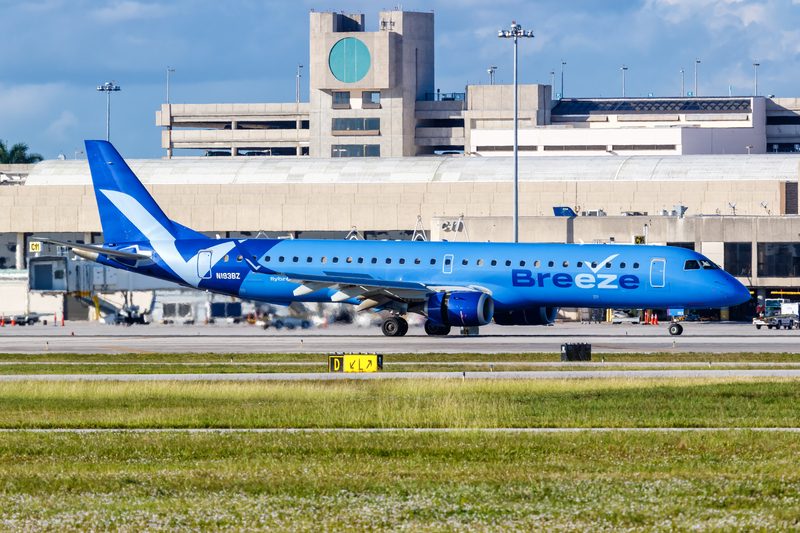
The proposed city pairs are expected to include:
From Raleigh-Durham International Airport (RDU)
RDU–Birmingham-Shuttlesworth International Airport (BHM)
RDU–Tallahassee International Airport (TLH)
From Fort Lauderdale–Hollywood International Airport (FLL)
FLL–Birmingham-Shuttlesworth International Airport (BHM)
FLL–Tallahassee International Airport (TLH)
FLL–Jacksonville International Airport (JAX)
FLL–Tampa International Airport (TPA)
FLL–Wicomico Regional Airport / Salisbury–Ocean City (SBY)
FLL–Scranton/Wilkes-Barre International Airport (AVP)
FLL–Charleston International Airport (CHS)
FLL–Greenville-Spartanburg International Airport (GSP)

From Cincinnati/Northern Kentucky International Airport (CVG)
CVG–Greenville-Spartanburg International Airport (GSP)
CVG–Portland International Jetport (PWM)
While Breeze has not packaged these in a single formal announcement, several of the pairings have already begun surfacing in its online route framework—suggesting the airline is at least building the plumbing needed to support a public launch.
Tallahassee (TLH) is the most consequential “new city” in the mix
If this route set comes together, Tallahassee International Airport (TLH) would be the headline addition—not because of raw volume, but because of how constrained the market is today and how clearly it aligns with Breeze’s “long-thin and underserved” playbook.

TLH’s current nonstop network is unusually limited for a state capital: service is concentrated almost entirely around major legacy hubs—Hartsfield-Jackson Atlanta International Airport (ATL), Charlotte Douglas International Airport (CLT), Ronald Reagan Washington National Airport (DCA), Dallas/Fort Worth International Airport (DFW), and Miami International Airport (MIA). That makes TLH a classic “hub-and-spoke dependency” market, where most itineraries require a connection and fares can remain resilient simply because travelers have few alternatives.
The proposed Breeze service—TLH–RDU and TLH–FLL—would do two important things:
-
Introduce new nonstop options that don’t rely on ATL/CLT/DFW/MIA/DCA banks.
-
Add low-fare stimulation in a market that’s been trying to broaden airline participation.
From a competitive-history perspective, the intra-Florida angle matters. JetBlue’s experiment on FLL–TLH (launched in January 2024) was short-lived, with the airline later exiting the market in October 2024. Before that, Silver Airways had been a familiar player in Florida intrastate flying, but its abrupt shutdown in mid-2025 reshaped a number of smaller Florida markets and removed a layer of nonstop connectivity that didn’t involve legacy hubs. The net effect: TLH became even more “hub-only” than it already was.
For TLH, a Breeze entry would also land amid a broader push by local stakeholders to make the airport more attractive to new carriers, including multi-year incentive frameworks designed to reduce start-up risk (often through minimum revenue guarantees and marketing/fee support). Those programs don’t guarantee route success, but they can materially change the early economics for a carrier that operates on thin margins and thrives on low fixed-cost market entry.
Birmingham (BHM): large enough to matter, small enough to be “Breeze-sized”
The other notable “new city” in the rumored list is Birmingham-Shuttlesworth International Airport (BHM). Birmingham is not an ultra-small airport; it’s a steady, mid-sized facility that has been clearing 3 million+ annual passengers, supported by a catchment area that blends VFR, business travel, and a meaningful university footprint.
From a route-planning perspective, BHM is exactly the kind of market where a right-sized narrowbody can unlock nonstops that don’t justify mainline frequency wars. If Breeze adds BHM–RDU and BHM–FLL, it creates:
-
A short-to-medium-haul spoke from RDU, where Breeze’s footprint keeps expanding.
-
A South Florida link into FLL, a market that can feed leisure demand year-round (beaches, cruises, second homes), while also capturing inbound traffic headed to Alabama.
It’s also worth noting that Breeze already has an Alabama presence via Huntsville International Airport (HSV), so moving into BHM would broaden the airline’s regional relevance without forcing the carrier into a totally unfamiliar operating environment.
Fort Lauderdale (FLL): doubling down in the low-cost arena
The FLL portion of the list is the most aggressive: eight new routes, including three intrastate Florida links (FLL–TLH, FLL–JAX, FLL–TPA). That’s a meaningful statement because FLL is not short on capacity—it’s a hyper-competitive market shaped by low-cost and hybrid carriers, and it sits close enough to Miami International Airport (MIA) to create overlapping demand in certain segments.
So why push harder into FLL?
FLL is one of the few airports where demand can absorb new entrants quickly—especially on routes that connect Florida with secondary Northeastern and Mid-Atlantic airports. That’s why the inclusion of FLL–SBY and FLL–AVP is so telling. Both Wicomico Regional (SBY) and Scranton/Wilkes-Barre (AVP) are the kind of “small-but-sticky” markets where nonstop leisure traffic can support limited weekly frequency—particularly when the alternative is a connection over a major hub with long travel times and limited schedule control.
The other proposed FLL additions—FLL–CHS and FLL–GSP—fit a similar mold: connect fast-growing Southeastern metros with a major South Florida demand base, without needing hub connectivity to make the route relevant.
Aircraft assignment: why Breeze’s A220-300 is the backbone—and where the E190 fits
For fleet-minded readers, this expansion is as much an aircraft story as it is a network one.
Breeze’s signature platform is the Airbus A220-300, a modern, geared-turbofan-powered narrowbody optimized for routes that fall into the airline’s sweet spot: thin, medium-length markets that can’t support 180-seat economics but can thrive with 130–140 seats at lower trip cost and strong fuel efficiency. The type’s range (roughly 3,400 nautical miles in typical configurations) is more than enough for everything on this rumored list, and it also supports Breeze’s growing transcontinental and near-international ambitions.
In Breeze’s configuration, the A220-300 is typically marketed as a 137-seat aircraft, with a premium-forward layout that includes the airline’s “Nicest” cabin (Breeze Ascent) up front. That premium cabin is not just a product feature—it’s a revenue lever. On routes where business travelers, government travel, university traffic, and higher-yield leisure overlap (think RDU, FLL, and certain seasonal peaks), a small premium cabin can materially improve unit revenue without changing the aircraft’s cost base.
The other tool in Breeze’s kit is the Embraer 190, generally used where demand is thinner, runways are more restrictive, or the airline wants to control capacity while it proves a market. In a 2–2 cabin, the E190 also delivers a passenger experience that’s often better than regional-jet alternatives—an important factor when you’re trying to pull travelers away from one-stop itineraries on legacy carriers.
If these 12 routes roll out, expect lower-frequency launches first—often a few flights per week—before any market graduates into higher utilization. That’s the standard “test and scale” method for carriers building networks outside hub-and-spoke connectivity.
What happens next
The immediate tell will be whether the remaining city pairs beyond the currently visible ones begin to surface more clearly in Breeze’s distribution channels—especially the rest of the FLL set (FLL–JAX, FLL–TPA, FLL–CHS, plus the unconfirmed pairs) and the CVG additions (CVG–GSP and CVG–PWM).
For network planners and airport teams, the sequencing will matter just as much as the headlines:
-
How quickly are schedules filed and loaded?
-
Do these routes launch as seasonal or year-round?
-
What frequencies are used to start (2x weekly vs. 4x weekly)?
-
Which aircraft is assigned (A220-300 vs. E190), and does the premium cabin appear on the market?
Those details will determine whether this is a short-term opportunistic push—or the next step in Breeze’s longer-term strategy of building meaningful “mini-bases” in growth markets like RDU and pushing deeper into Florida through FLL.
Bottom Line
Breeze Airways appears to be lining up another significant route wave—12 city pairs with a heavy Southeast tilt—anchored by growth at Raleigh-Durham (RDU), a bigger bet at Fort Lauderdale (FLL), and selective additions from Cincinnati (CVG). The standout is Tallahassee (TLH), a market currently dominated by legacy-hub flying where new nonstops to RDU and FLL could meaningfully reshape traveler options. If the airline follows through, expect the Airbus A220-300 to do most of the heavy lifting, with the Embraer 190 available as the “right-size” tool for thinner markets as Breeze tests demand and scales what works.