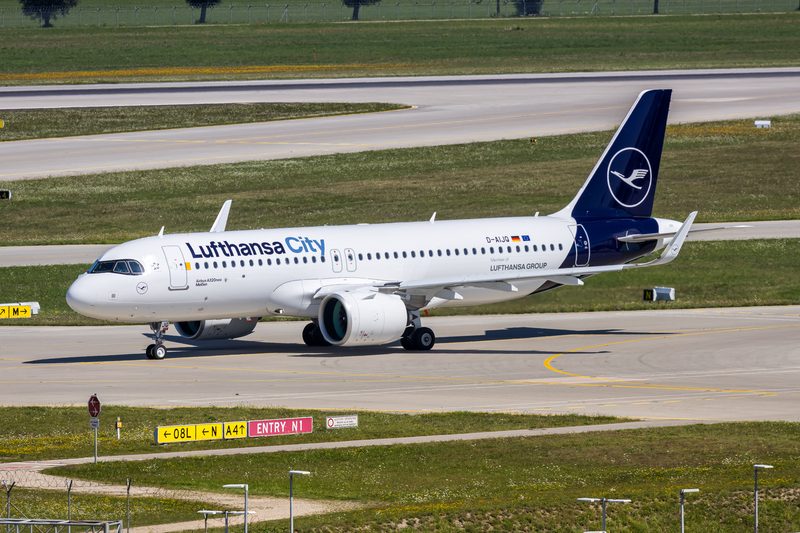
Lufthansa City Airlines has officially opened its second operating base—this time at Lufthansa Group’s primary hub, Frankfurt Airport (FRA)—with first flights operating on February 9, 2026. The launch is a meaningful operational marker for the Group’s short-haul reshaping: Frankfurt is where the network’s connection banks, aircraft rotations, and recovery playbook are at their most complex, and where additional narrowbody capacity has the biggest downstream effect across Europe and long-haul feed.
The inaugural FRA departure was operated by an Airbus A320neo, underlining City Airlines’ role as a modern, efficiency-driven feeder and point-to-point operator within the Group.
Read our stories in your inbox
Two aviation newsletters. Zero fluff.
The first flight: FRA–MAN kicks off Frankfurt operations on the A320neo
Lufthansa City Airlines’ first Frankfurt-operated service departed Frankfurt (FRA) at 16:11 local time (UTC+1) and arrived in Manchester (MAN) at 16:55 local time (UTC+0). The aircraft type was an Airbus A320neo, which has become the go-to narrowbody for airlines prioritizing fuel burn, noise footprint, and range flexibility on European stage lengths.
For network planners, MAN is a sensible “first destination” choice: it’s a high-demand business and leisure market with year-round strength, and it provides immediate feed value into Lufthansa’s FRA hub structure without overcomplicating turn performance.
Why the A320neo matters here
The A320neo family’s core advantage is its new-generation engine and aerodynamic package—typically delivering materially lower fuel consumption versus earlier A320ceo aircraft, along with reduced noise. Lufthansa City Airlines’ A320neo fleet is also configured around a high-efficiency short-haul cabin, and Lufthansa Group has been equipping newer A320neos with Airbus’ Airspace interior features (larger overhead bins and updated lighting), which improves boarding flow and cabin experience—two areas that matter on banked hub operations where minutes add up fast.
What changes at FRA: more short-haul lift where hub banks live and die
Adding City Airlines flying at FRA isn’t just “more flights.” Frankfurt is an orchestration problem: hundreds of daily movements, complex runway and taxiway flows, and tight connection windows that depend on predictable feeder reliability. The impact of extra short-haul capacity typically shows up in three places:
-
Hub feed resilience: More frequency to major European points increases connection options for long-haul passengers and gives operations more recovery paths during disruption.
-
Fleet utilization: A standardized narrowbody subfleet operating short cycles helps protect aircraft productivity without mixing too many types into the FRA operation.
-
Cost and structure: Lufthansa Group has been reworking how it produces European short-haul flying. A City Airlines ramp at FRA supports that strategy by allocating flying to a platform built for high-cycle operations.
The near-term network: Berlin and Valencia next, then Düsseldorf and Málaga in March
The first wave of routes from Frankfurt (FRA) builds quickly:
-
Later in February 2026, City Airlines adds Berlin (BER) and Valencia (VLC) from FRA.
-
In March 2026, Düsseldorf (DUS) and Málaga (AGP) follow, timed with the assignment of a second aircraft to the Frankfurt base.
This sequencing makes operational sense. BER and DUS are high-volume German markets where frequency is a product; VLC and AGP add leisure-weighted demand and seasonal balance—useful for keeping aircraft utilization stable while matching passenger flows.
Summer 2026 expansion: a blend of business trunk and high-demand leisure points
From summer 2026, Lufthansa City Airlines plans to broaden its FRA map with additional destinations that mix premium demand, strong point-to-point volume, and connection utility:
-
London Heathrow (LHR)
-
Stockholm (ARN)
-
Bilbao (BIO)
-
Hamburg (HAM)
-
Helsinki (HEL)
-
Ibiza (IBZ)
-
Marseille (MRS)
-
Bucharest (OTP)
This list is telling: LHR, ARN, HAM, and HEL are classic schedule-and-connectivity plays; BIO, IBZ, and AGP lean into leisure seasonality; OTP is a high-demand Eastern Europe market that supports both local traffic and network feed.
Fleet build at Frankfurt: seven A320neos by September 2026
Lufthansa City Airlines plans to grow its Frankfurt-based fleet to seven Airbus A320neo aircraft by September 2026. That’s a meaningful presence at FRA, and it signals intent: this isn’t a token base, it’s a scaled operation designed to carry real schedule weight inside Lufthansa Group’s largest hub.
The airline’s primary base remains Munich (MUC), where it already operates a larger local fleet. In 2025, Lufthansa City Airlines flew nearly 16,000 flights, carried around 2 million passengers, and served 27 destinations—metrics that show it has moved beyond “startup airline” dynamics and into repeatable production.
Staffing and platform growth: building a Frankfurt team from the ground up
A new base needs more than aircraft and slots. Lufthansa City Airlines says around 60 employees have already been hired in Frankfurt, with plans to recruit an additional 80 cockpit crew and 200 cabin crew in the coming months. Total headcount is currently around 450.
That hiring curve matters operationally: staffing depth is what sustains reliability during peak seasons and prevents the schedule from becoming brittle when disruption hits.
Star Alliance integration: already in the global system
Lufthansa City Airlines has been a Star Alliance member since September 2025, which is important for commercial coherence. At a hub like FRA, alliance integration is not just branding—it affects connecting flows, loyalty earning/redemption, and the predictability of passenger handling across interline and alliance journeys.
Bottom Line
Lufthansa City Airlines’ new base at Frankfurt (FRA) is a strategic addition to Lufthansa Group’s short-haul machine, launched on February 9, 2026 with an Airbus A320neo inaugural service to Manchester (MAN). With BER and VLC coming online from FRA in February, DUS and AGP following in March, and a summer expansion that includes LHR, ARN, BIO, HAM, HEL, IBZ, MRS, and OTP, the airline is ramping quickly. The plan to station seven A320neos at FRA by September 2026—backed by aggressive recruitment—signals that this isn’t a symbolic move: it’s Lufthansa Group building a scaled, modern narrowbody platform at its largest hub to reinforce connectivity, improve resilience, and support a broader European network reset.
Keep reading FlyMag
Get the Daily Brief in the morning or the Route Watch weekly recap on Fridays. Or both.