Breeze Airways is adding five more international routes to its network, deepening its expansion into Cancún and Punta Cana and showing that its move beyond the U.S. domestic market is becoming much more deliberate.

That matters because Breeze had no scheduled international service in 2025. Now, by early 2027, it expects to have a meaningful, if still modest, international footprint built around leisure-heavy destinations in Mexico and the Caribbean.
For aviation readers, the most interesting part is not just the number of routes. It is the kind of routes Breeze is choosing: thinner, underserved, highly seasonal city pairs from mid-sized U.S. markets where nonstop service can still stand out.
Read our stories in your inbox
Two aviation newsletters. Zero fluff.
The Three New Cancún Routes
Breeze is adding three more services to Cancún International Airport (CUN):
- Tampa (TPA) – Cancún (CUN) from December 19, 2026, twice weekly
- Pittsburgh (PIT) – Cancún (CUN) from January 7, 2027, three times weekly
- Richmond (RIC) – Cancún (CUN) from January 8, 2027, twice weekly
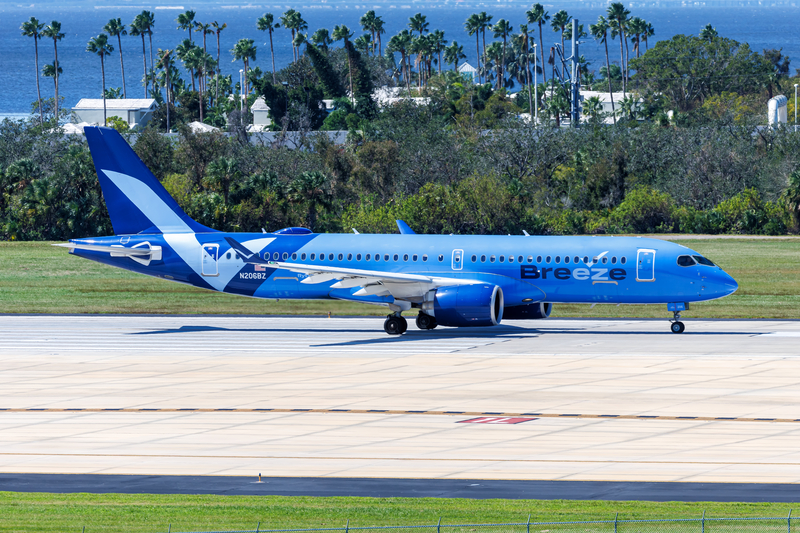
All three are scheduled on the Airbus A220-300, which is exactly the sort of aircraft Breeze needs for these markets. It offers enough range and efficiency to serve medium-length international leisure routes without forcing the airline to overcommit on seat count.

Tampa is the most obvious market of the three, with stronger local volume and an established leisure profile. Richmond is more distinctive, because it gives the airport a restored international link in a market that has had very little nonstop service outside the United States in recent years. Pittsburgh sits somewhere in between: large enough to support a route like this, but still the kind of airport where additional nonstop winter-sun flying is meaningful.
The Two New Punta Cana Routes
Breeze is also adding two more routes to Punta Cana International Airport (PUJ):
- Pittsburgh (PIT) – Punta Cana (PUJ) from January 7, 2027, three times weekly
- Columbus (CMH) – Punta Cana (PUJ) from January 8, 2027, twice weekly
These are important for different reasons.
Pittsburgh becomes a stronger international leisure point for Breeze, with the airline clearly seeing room to build multiple warm-weather Caribbean and Mexico options from the airport. Columbus is notable because it will mark Breeze’s first international service from Ohio, which gives the route more strategic importance than its frequency alone might suggest.
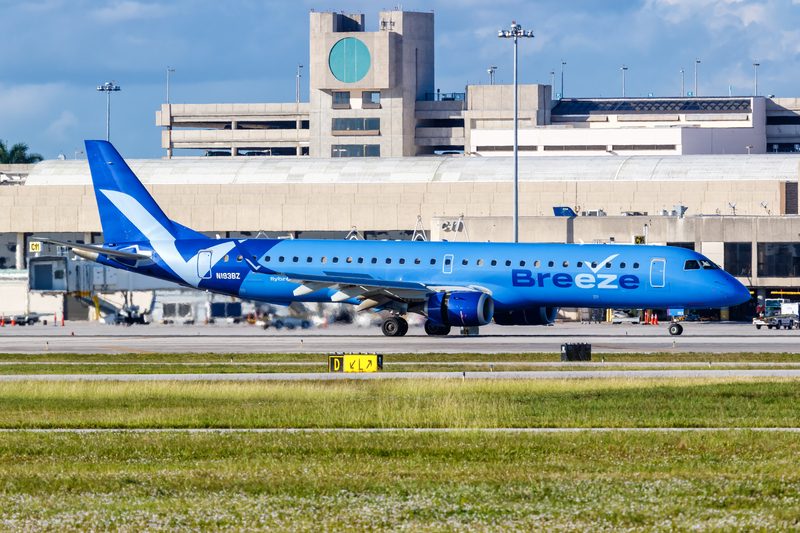
In both cases, Breeze is not trying to create demand from nothing. It is targeting markets where indirect traffic already exists, but where nonstop service is limited enough that a new entrant still has room to matter.
Breeze Is Building A Very Specific Kind Of International Network
What ties all five routes together is discipline.
Breeze is not trying to become a broad international airline overnight. It is building a narrow, highly focused international network based on:

- secondary and mid-sized U.S. airports
- strong winter leisure demand
- limited or inconsistent existing nonstop competition
- right-sized Airbus A220 flying
That is a very coherent strategy. It matches the airline’s domestic model, where it has often targeted underserved city pairs rather than fighting head-on in the biggest trunk markets.
The A220 Makes This Possible
The Airbus A220-300 is central to the whole plan.
Without that aircraft, a lot of these routes would be much harder to justify. Larger narrowbodies would increase seat risk and require stronger demand to break even. The A220 allows Breeze to operate long, thin leisure routes with a more manageable cost profile and enough passenger comfort to make the product attractive.
That is why Breeze’s international expansion is worth watching. It is not just a story about route launches. It is a story about what the A220 lets a newer airline do.
This Is Still Small In The Bigger U.S. Market
Even with the five new routes, Breeze will remain a very small player in the broader U.S.–Caribbean/Mexico market.
That is important context. This expansion is meaningful for Breeze, but it does not make the airline a major international force overnight. Instead, it makes the carrier more credible as a niche operator that can profitably connect U.S. secondary markets with high-demand leisure destinations.
That may actually be the stronger long-term position anyway.
Bottom Line
Breeze Airways’ five new international routes to Cancún and Punta Cana show an airline expanding carefully, not recklessly. The additions from Tampa, Pittsburgh, Richmond, and Columbus deepen a very specific network formula: mid-sized U.S. cities, warm-weather destinations, and Airbus A220 economics.
By early 2027, Breeze will have built a much larger international network than it had only a year earlier. The bigger takeaway is not that the airline is going global. It is that it has found a very particular kind of cross-border route that fits its model surprisingly well.