Royal Air Maroc has opened a new nonstop link between Brussels Airport (BRU) and Tetouan-Sania Ramel Airport (TTU), adding a twice-weekly service that gives northern Morocco a more direct connection to one of Europe’s most important Moroccan diaspora markets.
On the surface, this is a modest route launch. In practice, it is a well-targeted network addition. Brussels is one of the most established Morocco markets in Western Europe, and Tetouan is a city that has long had strong local relevance but far less direct international lift than larger Moroccan gateways such as Casablanca Mohammed V Airport (CMN) or Tangier Ibn Battouta Airport (TNG). By linking BRU and TTU nonstop, Royal Air Maroc is not just adding another city pair. It is tightening access to a region that has historically relied on more circuitous routings.
The schedule is straightforward and commercially sensible. Flights operate twice weekly, on Mondays and Fridays, which gives the route a rhythm that fits both visiting-friends-and-relatives traffic and shorter leisure demand. For an airline like Royal Air Maroc, that kind of frequency pattern is often the right way to develop a market without oversupplying it too early.
Read our stories in your inbox
Two aviation newsletters. Zero fluff.
The Embraer 190 Is the Right Aircraft for This Market
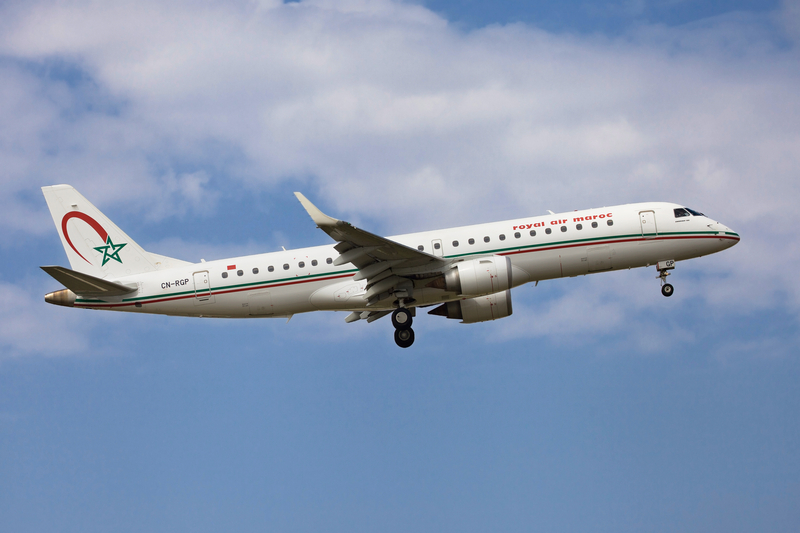
The inaugural BRU-TTU service, flight AT1630/AT1631, was operated by Embraer E190 CN-RGP, and that aircraft choice says a lot about how Royal Air Maroc sees the route.
The Embraer 190 is a useful fit for markets like Brussels-Tetouan because it allows an airline to open thinner international routes without forcing narrowbody mainline economics onto a city pair that may still be in its development phase. In Royal Air Maroc’s fleet, the E190 is configured with 96 seats, including 12 in Business Class and 84 in Economy. That gives the airline enough scale to serve diaspora and leisure demand efficiently, while preserving a premium cabin for higher-yield traffic and official travel.

Operationally, the E190 is also better suited than a larger Boeing 737 for selective regional growth. It lowers trip cost, reduces the risk of oversizing the market, and gives the airline more freedom to build frequency and visibility gradually. For TTU in particular, that matters. Regional airports often benefit most from aircraft that can right-size demand rather than chase headline capacity.
More Than a Standalone Route
The new BRU-TTU service should also be viewed in the context of Royal Air Maroc’s wider push in northern Morocco. Tetouan is not simply receiving a single new route. The airline has been developing TTU as a more meaningful outstation, with new European flying designed to improve the region’s direct connectivity rather than forcing all traffic through CMN.
That wider context makes the Brussels route more significant. A direct link to BRU adds a high-value market to Tetouan’s map and gives Royal Air Maroc a stronger foothold in northern Morocco beyond its more established positions elsewhere in the country. It also complements the carrier’s broader role as both Morocco’s flag carrier and a network airline that increasingly has to balance hub feed with point-to-point opportunity.
For TTU, this is especially useful. Northern Morocco has strong cultural and economic ties with Europe, but its aviation profile has often been overshadowed by larger airports. Direct access to BRU helps correct that imbalance.
Brussels Becomes an Even Stronger Morocco Gateway
From the Belgium side, the route further deepens Royal Air Maroc’s Morocco portfolio from Brussels Airport (BRU). The airline already serves key Moroccan markets including Casablanca (CMN), Rabat-Salé Airport (RBA), Marrakech Menara Airport (RAK), Nador International Airport (NDR), and Tangier (TNG). Adding TTU gives the carrier a broader spread across the country and sharpens its appeal for travelers whose final destination is northern Morocco rather than one of the traditional primary gateways.
That is important strategically. Airlines increasingly win in diaspora-heavy markets by offering specificity, not just frequency. A passenger bound for Tetouan or the wider north of Morocco is more likely to value a nonstop into TTU than a larger number of flights into a distant gateway that still requires a long ground transfer.
For Royal Air Maroc, that strengthens customer relevance in a market where convenience often matters as much as fare.

A Route Built for Community Traffic, but Not Only Community Traffic
There is an obvious visiting-friends-and-relatives base behind BRU-TTU, and Royal Air Maroc is clearly leaning into it. The launch ceremony itself, attended by airline executives, officials, Ambassador Mohamed Ameur, and members of the Moroccan community in Belgium, reflected that community dimension.
But reducing the route to diaspora demand alone would miss the bigger picture. Tetouan has growing tourism appeal, sits close to Morocco’s Mediterranean coastline, and offers a different entry point into the country than the better-known gateways farther south. That gives the route a second layer of commercial value. It can serve family and community traffic year-round, while also building leisure relevance as awareness of northern Morocco grows.
For Brussels Airport (BRU), that kind of service is useful as well. It broadens the airport’s North Africa profile beyond the largest city pairs and reinforces its role as a strong origin point for Morocco-bound traffic.
Bottom Line
Royal Air Maroc’s new Brussels Airport (BRU) to Tetouan-Sania Ramel Airport (TTU) route is a focused, well-judged addition rather than a simple schedule filler. The twice-weekly operation gives northern Morocco a direct Belgian link, strengthens the airline’s Morocco network from Brussels, and uses the Embraer 190 in exactly the way regional fleet planning is supposed to work: matching capacity to a market with clear demand, but still room to grow.
For industry readers, the real takeaway is that this is not just about one new route. It is about Royal Air Maroc giving TTU a more meaningful place in its network and using precision, rather than sheer scale, to deepen its position between Belgium and Morocco.
Keep reading FlyMag
Get the Daily Brief in the morning or the Route Watch weekly recap on Fridays. Or both.