Etihad Airways has opened four new routes in four days.

Between June 11 and June 14, 2026, the Abu Dhabi-based airline launched flights from Zayed International Airport (AUH) to Kraków (KRK), Palma de Mallorca (PMI), Damascus (DAM), and Zanzibar (ZNZ).
The new routes stretch across Europe, the Middle East, and Africa.
Read our stories in your inbox
Two aviation newsletters. Zero fluff.
They also show how quickly Etihad is expanding again. The airline says summer 2026 is its largest summer schedule ever, with more than 300 daily flights and 10% more capacity than last summer.
Etihad is also operating with 23 more aircraft than it had during the same period last year.

Four Routes In Four Days
The four launches happened in quick succession.
Kraków (KRK) began on June 11. Palma de Mallorca (PMI) followed on June 12. Damascus (DAM) returned on June 14. Zanzibar (ZNZ) also launched on June 14.
Each route has a different purpose.
Kraków gives Etihad a second destination in Poland. Palma de Mallorca adds a major Mediterranean leisure market. Damascus restores a regional link to Syria. Zanzibar brings back an Indian Ocean leisure route with strong seasonal appeal.
That mix is important.
Etihad is not only adding beach routes. It is building a broader network from Abu Dhabi across several regions.
The New Route List
| Route | Launch Date | Aircraft | Frequency |
|---|---|---|---|
| Abu Dhabi (AUH) – Kraków (KRK) | June 11 | Airbus A321LR | 3x weekly |
| Abu Dhabi (AUH) – Palma de Mallorca (PMI) | June 12 | Airbus A321LR | 3x weekly |
| Abu Dhabi (AUH) – Damascus (DAM) | June 14 | Airbus A320 / A321 family | 4x weekly |
| Abu Dhabi (AUH) – Zanzibar (ZNZ) | June 14 | Airbus A320 | 4x weekly |
The table also shows a clear narrowbody theme.
All four routes are operated with Airbus single-aisle aircraft. That helps Etihad add new markets without using widebody capacity on routes that may not need it.
Kraków Gives Etihad A Second Polish City
Kraków John Paul II International Airport (KRK) is Etihad’s newest European destination.
The route launched on June 11 and operates three times weekly with the Airbus A321LR.
Kraków is one of Poland’s most important cultural and tourism cities. It also serves southern Poland, a region with strong business, education, and leisure demand.
Etihad already serves Warsaw (WAW). Adding Kraków gives the airline a stronger position in Poland.
The route also gives travelers from southern Poland a new Gulf connection. From Abu Dhabi (AUH), passengers can connect across Etihad’s network in Asia, Australia, the Middle East, and Africa.
Palma de Mallorca Adds A Mediterranean Leisure Link
Etihad launched Palma de Mallorca (PMI) one day after Kraków.
The new route connects Abu Dhabi (AUH) with Palma de Mallorca Airport (PMI) three times weekly.
Etihad says the route is operated by the Airbus A321LR.
This is a strong leisure addition.
Mallorca is one of Europe’s most popular island destinations. It also acts as a gateway to the wider Balearic Islands, including Ibiza and Menorca.
For Abu Dhabi, the route adds another summer escape for outbound travelers.
For Mallorca, it creates a direct link to the Gulf and beyond. Passengers can connect through Abu Dhabi to markets across Asia, India, Australia, and the wider Middle East.
The A321LR Brings A Premium Narrowbody Product
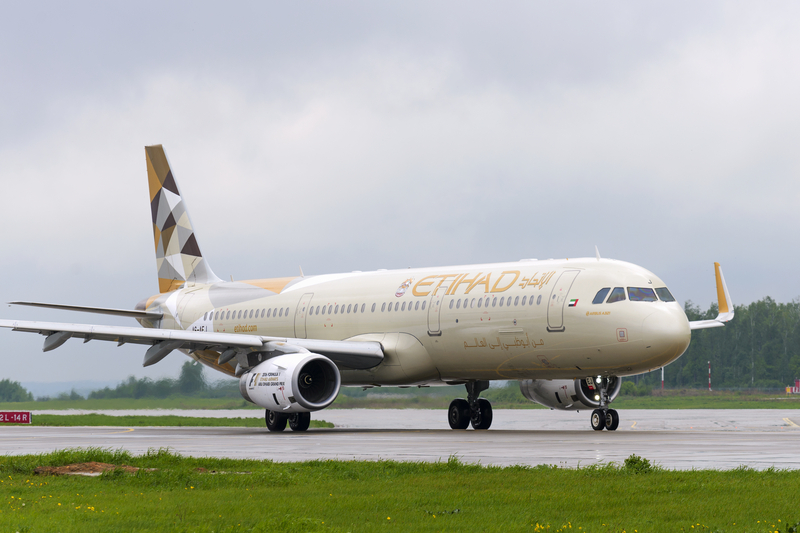
The Airbus A321LR is one of the most interesting parts of the Kraków and Palma launches.
Etihad’s A321LR has 160 seats. It includes two First Suites, 14 lie-flat Business seats, and 144 Economy seats.
That is not a typical narrowbody cabin.
The First Suites have sliding doors, lie-flat beds, 20-inch 4K screens, Bluetooth audio, and wireless charging. Business Class has fully flat beds in a 1-1 layout with direct aisle access. Economy has 13.3-inch 4K screens, USB charging, and high-speed Wi-Fi.
This gives Etihad a way to offer a widebody-style premium product on thinner long-haul and medium-haul routes.
That is why the aircraft matters.
It lets Etihad open cities such as Kraków and Palma without sending a larger Boeing 787, Airbus A350, or Boeing 777.
Damascus Returns To The Network
Etihad has also returned to Damascus International Airport (DAM).
The route links Abu Dhabi (AUH) with the Syrian capital four times weekly.
Etihad had announced the route as part of its wider regional expansion. The airline said the service reflects growing demand between the UAE, the Gulf, and Syria.
The route also has a strong community element.
The UAE has a large Syrian population. Direct flights can support family travel, business links, and broader regional connectivity.
For Damascus, Etihad’s return is another sign of international air links slowly rebuilding.
Damascus Uses A Smaller Narrowbody Product
Etihad’s announcement listed Damascus service with Airbus A320-family aircraft.
The original launch plan referenced an Airbus A320 with eight Business seats and 150 Economy seats. Later schedule filings and reports have also shown Airbus A321-family equipment on some services.
Either way, the strategy is clear.
Damascus does not need Etihad’s newest A321LR premium cabin. It needs reliable regional capacity and enough frequency to support the market.
A narrowbody aircraft is the right fit.
It keeps capacity controlled while giving passengers direct access to Abu Dhabi and onward connections.
Zanzibar Completes The Four-Route Run
Etihad also returned to Abeid Amani Karume International Airport (ZNZ) in Zanzibar on June 14.
The route operates four times weekly until September 6, 2026.
Etihad says flights are operated with Airbus A320 aircraft, offering Business and Economy cabins.
Zanzibar is a classic leisure route.
It is known for beaches, Stone Town, spice plantations, diving, and access to East African safari itineraries. For travelers from the Gulf and Europe, it is a popular Indian Ocean holiday destination.
The route also fits Etihad’s summer network strategy. It gives the airline a seasonal leisure market that can be fed through Abu Dhabi from multiple regions.
Zanzibar Also Supports Abu Dhabi Connections
Zanzibar is not only about UAE outbound demand.
Etihad says the route benefits from its larger European network. Passengers from Europe can connect through Abu Dhabi to reach Zanzibar.
That is important.
A seasonal route can be stronger when it draws traffic from more than one region. Abu Dhabi can feed the flight from Europe, the Gulf, India, and other parts of Asia.
This is the kind of route that works best when a hub has enough connecting depth.
Etihad’s growing network makes that easier.
Five Seasonal Routes Return
Etihad’s busy week does not stop with the four new routes.
The airline is also bringing back five seasonal destinations.
Mykonos (JMK) and Malaga (AGP) returned on June 15. Santorini (JTR) returned on June 16. Nice (NCE) returns on June 19. Al Alamein (DBB) is scheduled to return on July 16.
These routes all fit the summer leisure pattern.
They give travelers direct access to Mediterranean beach, island, and resort markets.
They also support Abu Dhabi’s role as a summer connecting hub for passengers moving between Asia, the Gulf, Europe, and North Africa.
Etihad’s Returning Seasonal Routes
| Destination | Airport Code | Restart Date | Frequency |
| Mykonos | JMK | June 15 | 2x weekly |
| Malaga | AGP | June 15 | Up to 4x weekly |
| Santorini | JTR | June 16 | 2x weekly |
| Nice | NCE | June 19 | 2x weekly |
| Al Alamein | DBB | July 16 | 2x weekly |
The list is heavily leisure-focused.
That is not a weakness. It is exactly where seasonal flying makes sense.
Summer demand to southern Europe, Greece, the Mediterranean, and Egypt can support routes that may not work year-round.
Etihad Is Growing With More Aircraft
The network growth is backed by fleet growth.
Etihad says it has 23 more aircraft than it did at the same time last year.
That extra capacity is important.
Airlines can announce routes quickly, but they need aircraft to operate them. They also need crews, maintenance, airport slots, and ground support.
Etihad says it is now operating more than 300 flights per day during the peak summer period.
That is a major step for an airline that spent several years rebuilding after earlier network and fleet restructuring.
The 2026 summer schedule shows Etihad is firmly back in growth mode.
A Narrowbody-Led Expansion
The aircraft choices are also notable.
Etihad is using narrowbodies for all four new launches in this wave.
That includes the A321LR on Kraków and Palma, and A320-family aircraft on Damascus and Zanzibar.
This tells us something about Etihad’s network strategy.
The airline is not using widebodies for every international route. It is using smaller aircraft to open or restore markets with lower capacity risk.
That gives Etihad more flexibility.
It can serve more destinations, test seasonal demand, and protect widebody aircraft for larger long-haul markets.
Abu Dhabi Benefits From The Growth
The expansion also supports Abu Dhabi’s tourism strategy.
Etihad is the national airline of the UAE and a key part of Abu Dhabi’s visitor economy.
More destinations mean more people can reach the city directly or connect through it.
The airline and Abu Dhabi tourism authorities are also trying to turn more transit passengers into stopover visitors.
That matters because Etihad’s growth is not only about airline revenue.
It also supports hotels, attractions, restaurants, events, and business travel in Abu Dhabi.
A Different Etihad From The Past
Etihad’s current expansion looks different from the airline’s earlier growth era.
Years ago, Etihad pursued a much wider equity-alliance strategy and invested in several foreign airlines. That model was later scaled back.
The current version is more disciplined.
Etihad is adding routes, aircraft, and capacity, but it is also using narrowbodies carefully and targeting markets with clearer demand.
The A321LR is especially useful in this approach.
It allows Etihad to bring premium service to routes that would be too thin for a widebody.
Regional Tensions Remain A Watchpoint
The expansion comes during a difficult geopolitical period in the Middle East.
Regional tensions can affect airspace, demand, insurance, fuel prices, and passenger confidence.
Etihad’s schedule shows confidence, but the operating environment still matters.
Airlines in the region must stay flexible. They may need to adjust routes, flight paths, or schedules if conditions change.
That said, Etihad’s current summer plan shows the airline is continuing to grow despite those pressures.
Bottom Line
Etihad Airways has launched four routes in four days, connecting Abu Dhabi (AUH) with Kraków (KRK), Palma de Mallorca (PMI), Damascus (DAM), and Zanzibar (ZNZ).
The launches took place between June 11 and June 14, 2026.
Kraków and Palma are operated with Etihad’s new Airbus A321LR. That aircraft has a premium 160-seat layout with First Suites, lie-flat Business seats, and Economy Class.
Damascus and Zanzibar use Airbus A320-family aircraft, giving Etihad the right capacity for regional and seasonal demand.
The new routes are part of Etihad’s largest-ever summer schedule. The airline says it is operating more than 300 daily flights, with capacity up 10% from last summer and 23 additional aircraft in service.
For Etihad, this is a clear growth signal.
For Abu Dhabi, it means more direct links, more inbound visitors, and stronger hub connectivity across Europe, the Middle East, Africa, and the Indian Ocean.
Keep reading FlyMag
Get the Daily Brief in the morning or the Route Watch weekly recap on Fridays. Or both.