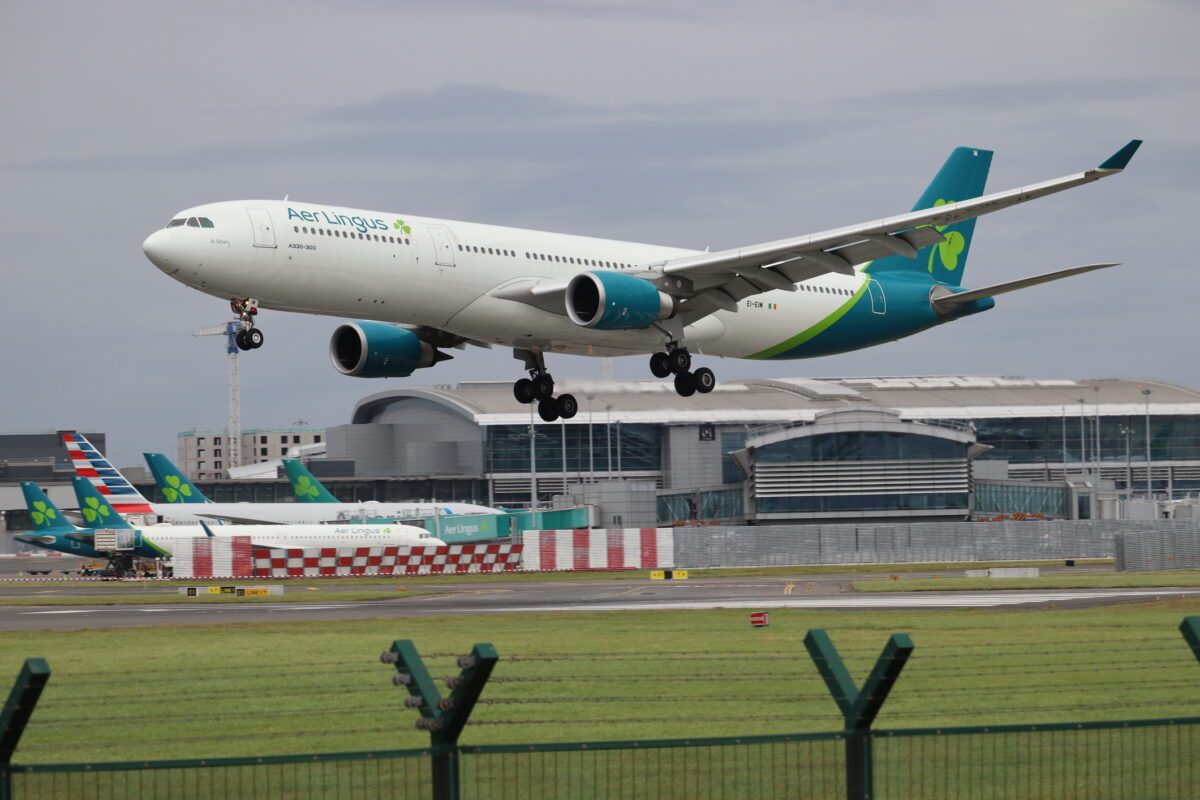
Aer Lingus is eliminating three nonstop routes between Dublin Airport (DUB) and the United States as part of a wider effort to remove lower-margin flying and reduce its overall network capacity by approximately 6%.

The Irish carrier will discontinue service from Dublin Airport (DUB) to Denver International Airport (DEN), Minneapolis–St. Paul International Airport (MSP), and Harry Reid International Airport (LAS) in Las Vegas between late September and early December 2026.
All three routes were either launched or restored within the past two-and-a-half years. Their removal represents a rapid reversal of Aer Lingus’ recent strategy of opening thinner U.S. markets with a mixture of Airbus A330 widebodies and its new Airbus A321XLR fleet.
Read our stories in your inbox
Two aviation newsletters. Zero fluff.
Aer Lingus has also confirmed that its Dublin Airport (DUB)–Seattle-Tacoma International Airport (SEA) route will become summer-seasonal rather than disappear completely.
The airline’s official travel update lists the exact changes and says affected customers will be contacted with rebooking or refund options.
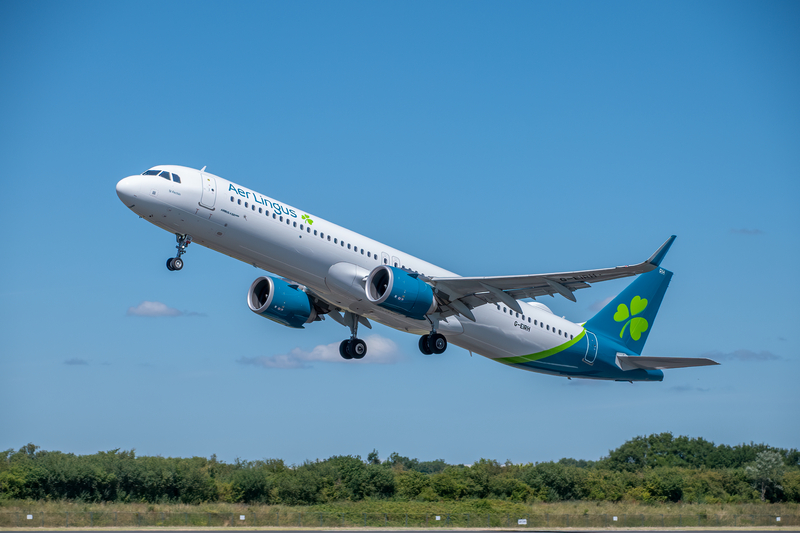
The Three U.S. Routes Aer Lingus Is Ending
| Route | Official Change | Current or Recent Aircraft | Route History |
|---|---|---|---|
| Dublin Airport (DUB)–Denver International Airport (DEN) | Discontinued after September 28, 2026 | Primarily Airbus A330-200 | Launched May 17, 2024 |
| Dublin Airport (DUB)–Minneapolis–St. Paul International Airport (MSP) | Discontinued after October 24, 2026 | Airbus A321XLR | Returned April 29, 2024 after an earlier 2019 launch |
| Dublin Airport (DUB)–Harry Reid International Airport (LAS) | Discontinued after December 3, 2026 | Airbus A330-200 and A330-300 | Launched October 25, 2024 |
The three dates are now confirmed by Aer Lingus rather than merely inferred from missing flights in future booking schedules. Denver ends after September 28, Minneapolis after October 24, and Las Vegas after December 3.
The October 24 date is also the final day of the northern aviation summer scheduling season. Aer Lingus is therefore using the normal seasonal transition to remove Minneapolis from the network and convert Seattle to a summer-only operation.
The Cuts Form Part of a Much Larger Restructuring
Aer Lingus is not withdrawing the routes in isolation.

The airline plans to reduce overall flying by approximately 6% while removing services that it considers insufficiently profitable. It is also considering the elimination of up to 500 positions across flight crews, cabin crews, and administrative departments.
Aer Lingus parent International Airlines Group reported that the Irish carrier recorded a €103 million operating loss during the first quarter of 2026, compared with a €55 million loss in the same period of 2025. IAG attributed much of the deterioration to higher fuel expenses and lower passenger revenue resulting from increased competition across the North Atlantic. (IAG’s first-quarter results)
Aer Lingus achieved an operating margin of 11.1% in 2025, below the levels generated by fellow IAG carriers British Airways and Iberia. The airline is now targeting a medium-term operating margin of between 12% and 15%, meaning routes must compete not only for aircraft but also for investment within the wider airline group.
The network changes extend beyond the United States:
| Route | Change |
| Dublin Airport (DUB)–Seattle-Tacoma International Airport (SEA) | Becomes summer-only after October 24, 2026 |
| Dublin Airport (DUB)–Split Airport (SPU) | Discontinued after September 29, 2026 |
| Dublin Airport (DUB)–Frankfurt Airport (FRA) | Becomes summer-only after November 2, 2026 |
| Dublin Airport (DUB)–Hamburg Airport (HAM) | Becomes summer-only after November 2, 2026 |
| Dublin Airport (DUB)–Malta International Airport (MLA) | Becomes summer-only after November 3, 2026 |
This combination is significant. Removing Denver, Minneapolis, and Las Vegas releases long-haul aircraft hours, while the European reductions decrease winter utilization of the airline’s Airbus A320-family fleet.
Denver Will End After Only Three Summer Seasons
Aer Lingus launched nonstop service between Dublin Airport (DUB) and Denver International Airport (DEN) on May 17, 2024.
The inaugural arrival marked the first scheduled nonstop passenger service between Colorado and Ireland. Aer Lingus initially operated four weekly flights, primarily using the Airbus A330-200. (Denver International Airport)
The route covers approximately 3,817 nautical miles and fits comfortably within the capabilities of the A330-200. Aer Lingus describes the type as the longest-range aircraft in its current A330 fleet, and its various configurations generally carry between approximately 260 and 280 passengers. (Aer Lingus Airbus A330-200)
Aer Lingus increased Denver capacity after its first season, offering as many as six weekly flights during portions of the 2025 schedule. The additional frequencies generated more passengers, but traffic did not grow quickly enough to absorb the increased seat supply.
U.S. Department of Transportation T-100 data cited in the original route analysis indicate that the service recorded a 73.7% load factor during its partial 2024 season. That fell to approximately 63.9% in 2025 and stood at roughly 64.1% for the 12 months ending in March 2026.
The Bureau of Transportation Statistics T-100 segment database measures passengers and available seats by airline, airport pair, aircraft type, and month. Its latest international data extend through April 2026.
A load factor in the mid-60% range does not automatically prove that a route is losing money. Premium-cabin revenue, cargo, connecting traffic, airport incentives, and average fares all affect profitability.
It nevertheless leaves a substantial amount of unused capacity on a large widebody aircraft. If Aer Lingus lowered fares to stimulate demand after adding frequencies, the financial result may have deteriorated even as the total number of passengers increased.
Denver International Airport (DEN) is also a major United Airlines hub, while Aer Lingus operates through the transatlantic joint business that includes American Airlines, British Airways, Iberia, and Finnair. Aer Lingus could sell connections through Dublin Airport (DUB), but it lacked a large local feeder operation at Denver.
The route therefore depended heavily on Colorado-originating passengers, Ireland-bound tourism, business traffic, and European connections through Dublin.
Denver’s Elevation Adds Another Operational Consideration
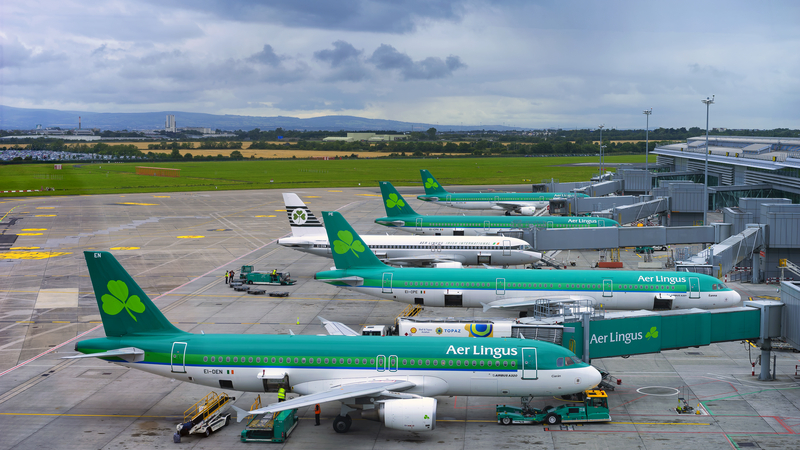
Denver International Airport (DEN) sits more than 5,400 feet above sea level.
High airport elevation reduces air density, which can affect engine performance and the amount of weight an aircraft can safely carry during takeoff. The effect becomes more pronounced on hot summer days.
The 3,817-nautical-mile Denver–Dublin sector is not near the A330-200’s maximum range, and Aer Lingus has operated it successfully without making payload restrictions a central public issue. Denver’s elevation can nevertheless make widebody scheduling and cargo planning less forgiving than at a sea-level airport.
For an airline evaluating marginal routes, even relatively small operational disadvantages matter when combined with low load factors, seasonal demand, and the high fixed cost of assigning an Airbus A330.
The last Denver service will operate during the normal conclusion of the summer schedule on September 28. Unlike a temporary winter suspension, Aer Lingus says the route is being discontinued and will not return for summer 2027.
Las Vegas Will Return for Only Two Final Months
Aer Lingus launched its nonstop route between Dublin Airport (DUB) and Harry Reid International Airport (LAS) on October 25, 2024.
The service was designed as a winter-seasonal operation and flew three times weekly on Tuesdays, Thursdays, and Saturdays. Aer Lingus initially assigned the Airbus A330-300, its largest aircraft type. (Aer Lingus’ Las Vegas launch)
The A330-300 offers more seats than the airline’s A330-200 and substantially more capacity than an Airbus A321XLR. Depending on the individual aircraft, Aer Lingus A330-300s generally accommodate more than 300 passengers in Business and Economy Class. (Aer Lingus Airbus A330-300)
Las Vegas is scheduled to return on October 2, 2026, but Aer Lingus will terminate the route after December 3 rather than continuing through the winter and spring as previously planned.
That produces an unusually short final season of approximately two months.
Aer Lingus may have retained the October and November flights because many customers had already booked fall travel and because operating the early part of the schedule could be less disruptive than canceling the entire season. The airline has not publicly explained why it chose December 3 as the final date.
The route carried approximately 33,448 passengers during the 12 months ending in March 2026 and filled about 71.3% of its available seats, according to the DOT data cited in the original analysis.
Its monthly performance was particularly weak during portions of the winter:
| Month | Reported Load Factor |
| November 2025 | 69.3% |
| December 2025 | 59.8% |
| January 2026 | 62.8% |
Las Vegas is a major global leisure and convention destination, but it can be difficult to serve profitably from a smaller European market.
Demand is heavily weighted toward leisure passengers, who are often highly price-sensitive. The route also operates nearly 5,000 statute miles each way, requiring an A330, two long-haul flight crews, substantial fuel, and extended aircraft time away from Dublin Airport (DUB).
Aer Lingus could carry connecting passengers from the United Kingdom and continental Europe through Dublin, but Las Vegas travelers also have numerous one-stop alternatives through London Heathrow Airport (LHR), Amsterdam Airport Schiphol (AMS), Paris Charles de Gaulle Airport (CDG), Frankfurt Airport (FRA), and major U.S. gateways.
Why Las Vegas Was a Winter Route
Aer Lingus deliberately scheduled Las Vegas during winter rather than summer.
Winter is traditionally a more difficult season for transatlantic airlines. Business demand softens around holidays, and leisure traffic to many European destinations declines. Airlines must decide whether to leave widebody aircraft underused or place them into warm-weather and entertainment markets.
Las Vegas offered a possible seasonal use for an Airbus A330 that might otherwise have flown fewer hours.
The route also complemented the summer-only Denver service. In theory, Aer Lingus could use some of the same aircraft capacity for Denver during the northern summer and Las Vegas during the winter.
The problem was that neither route generated sufficiently strong year-round economics. Denver reportedly struggled after Aer Lingus increased capacity, while Las Vegas produced weak load factors during some of the winter months it was intended to fill.
Ending both services removes the need to build an annual aircraft-utilization plan around two comparatively young and uncertain markets.
Minneapolis Is the Most Significant Strategic Retreat
The Minneapolis cancellation may be more revealing than either Denver or Las Vegas.
Aer Lingus first launched service between Dublin Airport (DUB) and Minneapolis–St. Paul International Airport (MSP) in July 2019. The route lasted only several months before the COVID-19 pandemic forced its suspension in 2020.
The airline restored the service on April 29, 2024, initially operating four weekly flights with an Airbus A330. The Metropolitan Airports Commission described Dublin as one of Minneapolis’ most requested international destinations and said the original route had generated strong demand before the pandemic.
Aer Lingus planned to transition the route to daily service using its new Airbus A321XLR once that aircraft entered the fleet.
The Airbus A321XLR appeared to be an ideal match for Minneapolis.
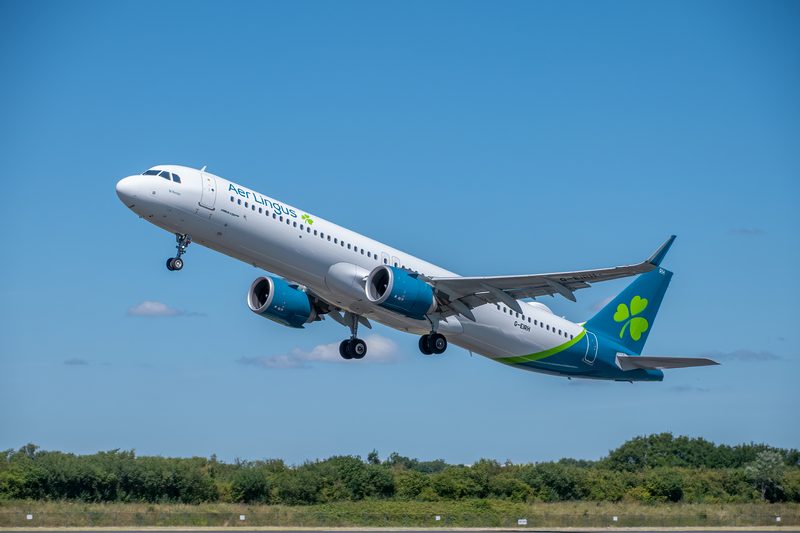
Aer Lingus configures the aircraft with 184 seats: 16 fully flat Business Class seats and 168 Economy Class seats. The XLR provides intercontinental range with far fewer seats than an A330, allowing the carrier to serve thinner transatlantic routes without exposing itself to as much capacity risk.
The aircraft also includes the Airbus Airspace cabin, larger overhead bins, seatback entertainment, and a long-haul product broadly comparable with Aer Lingus’ widebody service. (Aer Lingus Airbus A321XLR)
Despite using an aircraft designed specifically for markets like Minneapolis, the route remained one of Aer Lingus’ weakest U.S. performers.
Delta Changed the Minneapolis Market
Aer Lingus did not have Minneapolis–Dublin to itself after returning in 2024.
Delta Air Lines launched its own service between Minneapolis–St. Paul International Airport (MSP) and Dublin Airport (DUB) on May 9, 2024, only 10 days after Aer Lingus resumed flying.
Delta initially operated the route daily during the summer with a Boeing 767-300ER. (Metropolitan Airports Commission)
That created an uneven competitive environment.
Minneapolis–St. Paul International Airport (MSP) is one of Delta’s largest hubs. Delta can feed the Dublin flight from cities across the Upper Midwest and western United States, while also drawing from its extensive local frequent-flyer base, corporate contracts, airport lounges, and connecting schedule.
Aer Lingus offered connectivity across Ireland, the United Kingdom, and Europe through Dublin Airport (DUB), but it had no equivalent domestic network behind Minneapolis.
The Aer Lingus route’s published frequency varied by season, reaching daily service at peak periods and falling to approximately five weekly flights in parts of the winter.
DOT data for April 2025 through March 2026 reportedly show load factors below 50% during six of the 12 months. February 2026 was particularly weak, with only approximately 30% of the airline’s seats occupied.
Low winter loads are not unusual on seasonal transatlantic markets. The concern is that Aer Lingus attempted to operate Minneapolis throughout the year, including months when local demand was insufficient to support both Aer Lingus and Delta capacity.
The airline could have converted Minneapolis to a summer-seasonal route, as it is doing with Seattle. Its decision to eliminate the destination entirely suggests that Aer Lingus believes the aircraft can earn a better return elsewhere even during peak summer.
The A321XLR Could Not Save the Route
Minneapolis also demonstrates an important limitation of the Airbus A321XLR strategy.
The XLR lowers the number of seats an airline must fill, burns less fuel than an A330, and enables long, thin routes that would be difficult to operate with a traditional widebody.
It does not guarantee profitability.
A route still requires adequate fares, premium demand, cargo, connecting passengers, and year-round traffic. Lower operating costs cannot fully offset weak revenue or intense competition from a dominant hub carrier.
The 184-seat XLR reduced Aer Lingus’ exposure compared with the more than 260-seat A330s used when Minneapolis returned. Yet a 30% load factor would still leave approximately 129 seats empty on a typical 184-seat flight.
Even at a 60% load factor, roughly 74 seats would remain unsold.
Some of those empty seats may be offset by strong Business Class fares or cargo revenue, but the route becomes increasingly difficult to justify when aircraft are needed for other North American destinations.
The Minneapolis decision is therefore not an indictment of the A321XLR. It is evidence that the aircraft gives airlines more options, not immunity from poor route economics.
Seattle Is Being Reduced, Not Canceled
The original article asks whether other transatlantic routes will join Denver, Las Vegas, and Minneapolis.
Aer Lingus has already confirmed a significant change to Seattle-Tacoma International Airport (SEA), but the destination is not being eliminated.
Dublin Airport (DUB)–Seattle-Tacoma International Airport (SEA) will become summer-only after October 24, 2026.
That means Aer Lingus can preserve the stronger peak-season demand while avoiding the weakest winter months.
Seattle reportedly recorded an exceptionally low load factor of approximately 28.1% in February 2026. A seasonal schedule is a logical response if summer traffic remains commercially attractive but winter performance cannot cover the route’s direct and indirect costs.
Seasonality may also become more important across the Aer Lingus network. Operating fewer flights in winter can improve annual profitability, but it creates challenges involving aircraft utilization and year-round employment.
Airlines still incur ownership, leasing, maintenance, and staffing expenses when airplanes are not flying. Aer Lingus must therefore find alternative seasonal uses for aircraft or adjust the size and cost structure of its fleet.
Load Factor Does Not Tell the Complete Story
The load-factor figures explain part of the decision, but they should not be treated as a complete measure of route profitability.
A flight that is 65% full can be profitable if it carries high-fare Business Class passengers, valuable cargo, and strong connecting traffic. A flight that is 90% full can lose money if most passengers paid deeply discounted fares.
Important factors include:
- Average ticket price and passenger yield
- Business Class occupancy and fare levels
- Cargo revenue
- Connecting-passenger contribution
- Airport incentives and operating fees
- Fuel consumption
- Crew and hotel expenses
- Aircraft ownership or lease costs
- Seasonal pricing
- Disruption and recovery expenses
Aer Lingus does not disclose route-level revenue or profit, so outside analysis cannot establish precisely how much money Denver, Minneapolis, or Las Vegas earned or lost.
The airline’s decision provides the clearest conclusion: management believes the aircraft, crews, and capital assigned to these services can produce stronger returns elsewhere.
Dublin Connections Were Not Enough
Aer Lingus’ strategy relies on Dublin Airport (DUB) functioning as a connecting hub between North America and Europe.
Passengers from Denver, Las Vegas, and Minneapolis could connect through Dublin to destinations across the United Kingdom and continental Europe. Dublin also offers U.S. Customs and Border Protection preclearance, allowing U.S.-bound travelers to complete immigration and customs inspections before departure.
Flights arriving in the United States can therefore use domestic arrival facilities, which is particularly valuable at airports where international processing can add substantial time.
The hub model works best when flight schedules provide short, reliable connections and when local Irish traffic supplements connecting demand.
Thin U.S. markets can become vulnerable when too much capacity depends on price-sensitive connecting passengers. Aer Lingus must compete for those customers against much larger hubs operated by British Airways, Lufthansa, Air France-KLM, Turkish Airlines, Icelandair, and the Gulf carriers.
The Dublin connection can be convenient, but it must also be competitively priced. Heavy dependence on lower-fare connecting passengers may increase load factors without generating the yields required to cover long-haul operating costs.
New Routes Have Not Been Exempt From Review
Denver, Las Vegas, and Minneapolis were all central to Aer Lingus’ post-pandemic North American expansion.
Their quick removal shows that a recently launched route will not necessarily receive several years to mature if its performance falls below the airline’s financial targets.
That represents a more disciplined approach than continuing to operate marginal flights simply to preserve the size of the route map.
The airline is simultaneously expanding in selected markets. Aer Lingus launched new service from Dublin Airport (DUB) to Pittsburgh International Airport (PIT) in May 2026 and has added other North American destinations using the A321XLR.
The route cuts could release aircraft to strengthen those services, protect frequencies on established markets, or provide operational spare capacity.
Aer Lingus has experienced periods in which long-haul aircraft availability was tight. A smaller schedule can improve reliability by giving the airline more flexibility when an A330 or A321XLR requires maintenance.
What Happens to Booked Passengers?
Aer Lingus says it will contact affected passengers directly.
Customers booked through Aer Lingus may be offered alternative flights, rerouting, or a refund. Travelers who booked through a travel agency, partner airline, or tour operator should be contacted by the company that issued the ticket.
Possible replacement itineraries could include connections through other Aer Lingus U.S. gateways or travel on partner airlines within the IAG transatlantic joint business.
A Denver passenger, for example, might be rerouted through another U.S. airport or travel through London Heathrow Airport (LHR) on British Airways. Minneapolis and Las Vegas passengers could face similar one-stop alternatives.
European Union Regulation 261 may provide additional rights in some circumstances, although eligibility depends on the date of notification, itinerary, cause of the cancellation, and replacement offered.
Cancellations communicated more than 14 days before departure generally do not trigger the regulation’s fixed monetary compensation, but passengers remain entitled to rerouting or reimbursement when an airline cancels their flight.
Bottom Line
Aer Lingus will end three U.S. routes within a period of just over two months:
Dublin Airport (DUB)–Denver International Airport (DEN) will be discontinued after September 28, Dublin Airport (DUB)–Minneapolis–St. Paul International Airport (MSP) after October 24, and Dublin Airport (DUB)–Harry Reid International Airport (LAS) after December 3, 2026.
The airline is also converting Seattle-Tacoma International Airport (SEA) to summer-only service while reducing or eliminating several European routes.
Denver and Las Vegas lasted little more than two years. Minneapolis was a 2019 route restored in 2024, but it struggled after Delta Air Lines entered the market from its dominant Minneapolis hub.
The aircraft assignments make the decisions particularly revealing. Denver and Las Vegas required high-capacity Airbus A330 widebodies, while Minneapolis operated with the 184-seat Airbus A321XLR—the aircraft designed to make thinner long-haul markets sustainable.
Weak performance could not be solved by using a smaller and more efficient airplane.
Aer Lingus’ retrenchment does not signal the end of its North American growth strategy. It shows that the carrier is becoming more selective about where that growth occurs.
With higher fuel costs, intense North Atlantic competition, a €103 million first-quarter operating loss, and pressure to improve its financial return within IAG, Aer Lingus is prioritizing routes that can support stronger fares, premium demand, connecting traffic, and year-round profitability.
For Denver, Minneapolis, and Las Vegas, the nonstop connection to Dublin was strategically attractive but ultimately unable to earn a permanent place in the airline’s long-haul network.
Keep reading FlyMag
Get the Daily Brief in the morning or the Route Watch weekly recap on Fridays. Or both.