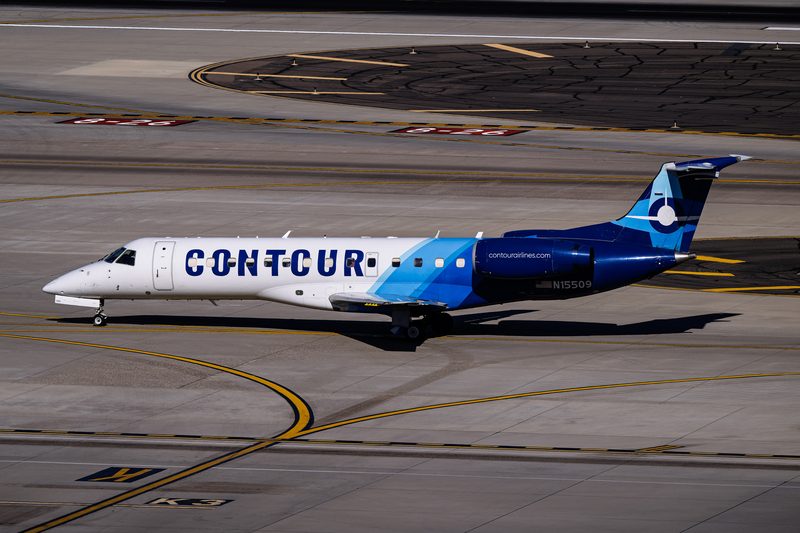
Contour Airlines is adding Merced Yosemite Regional Airport (MCE) to its route map this summer, giving California’s Central Valley a new commercial-service chapter with nonstop flights to Los Angeles International Airport (LAX) and Harry Reid International Airport (LAS).
The new service begins on July 1, with daily flights between Merced (MCE) and Los Angeles (LAX), plus five weekly flights to Las Vegas (LAS) on Mondays, Wednesdays, Thursdays, Fridays, and Sundays.
For a carrier like Contour, this is more than a simple station opening. It is another example of the airline’s core strategy: linking smaller regional communities with larger gateways where travelers can either terminate their trip or connect onward more easily.
Read our stories in your inbox
Two aviation newsletters. Zero fluff.
Merced Becomes A New Dot On Contour’s Map
Merced Yosemite Regional Airport (MCE) is the newest airport to join Contour’s network, and that matters because it gives the airline another foothold in a market that larger carriers often overlook.
Merced sits in the Central Valley, a region with a sizeable local population, business demand, university traffic, and tourism relevance tied to Yosemite and the wider Sierra gateway. But for scheduled air service, it has long been a smaller, more fragile market than California’s major coastal airports.
That is where Contour fits in. The airline’s model is built around markets like this, places where demand exists, but not necessarily at the scale or fare structure that would attract a larger mainline operator.
The Los Angeles Route Is The Bigger Strategic Play
The daily Merced (MCE) to Los Angeles (LAX) service is likely to be the more strategically important of the two routes.
LAX is not just a destination. It is a gateway. A daily connection into Los Angeles gives Merced-area travelers access to one of the largest domestic and international air travel hubs in the world, which significantly improves connectivity compared with relying solely on long surface journeys to larger California airports.
For Contour, that kind of route is valuable because it combines local traffic with connecting potential. A passenger flying from Merced Yosemite Regional Airport (MCE) to Los Angeles International Airport (LAX) is not only heading to Southern California. They may also be continuing onward across the United States or internationally.

That makes LAX a much stronger strategic anchor than a simple city-pair market alone would suggest.
Las Vegas Adds A Strong Leisure And Visiting-Traffic Option
The five-times-weekly service from Merced (MCE) to Las Vegas (LAS) is a different kind of route, but one that still makes sense.
Las Vegas has become one of the strongest short-haul air markets in the western United States because it blends leisure demand, event travel, visiting-friends-and-relatives traffic, and broad consumer recognition. For a regional community like Merced, a nonstop to Harry Reid International Airport (LAS) is the type of service that can stimulate demand rather than simply respond to it.

In other words, the route is not just there because existing traffic is large. It is there because nonstop service itself can create a more attractive travel proposition.
That is often how smaller-market route development works.
Contour’s 30-Seat Aircraft Are Well Suited To This Kind Of Market
Contour says the routes will be operated with its 30-seat regional aircraft, which is exactly the kind of capacity discipline that markets like Merced usually require.
A 30-seat airplane gives the airline a workable balance between frequency and risk. It allows Contour to offer a schedule that feels useful to travelers without flooding the market with more seats than demand can support. On routes such as Merced (MCE) to Los Angeles (LAX) and Merced (MCE) to Las Vegas (LAS), that matters far more than putting a larger aircraft on the route simply for scale.
Smaller gauge can often be the difference between a route surviving and a route struggling.
For regional airport communities, that kind of right-sized capacity is often more valuable than an oversized headline launch.
This Fits Contour’s Broader Expansion Pattern
The Merced announcement is not happening in isolation.
Contour has been steadily broadening its network across underserved and regional markets, with other recently announced additions including Fort Leonard Wood, Missouri; Macon, Georgia; Beckley, West Virginia; and Page, Arizona. That gives a clearer picture of what the airline is doing: building a niche network around communities that benefit from dependable scheduled links but may not support service from larger airlines.
In that sense, Merced Yosemite Regional Airport (MCE) is exactly the sort of airport Contour likes. It is a market where local relevance matters, route economics depend on careful capacity management, and the airline can become important quickly rather than merely one more carrier in a crowded field.
The Merced Move Is Also An Economic Development Story
Air service announcements at smaller airports are never just about aviation.
For Merced, the addition of nonstop flights to Los Angeles International Airport (LAX) and Harry Reid International Airport (LAS) carries wider local significance. Better connectivity can support local business travel, improve access for visitors, make the region more attractive for investment, and strengthen ties to both Southern California and Nevada.
That is why airports and local governments often treat these announcements as economic-development wins as much as transportation wins. A small-market route may not look large in national airline terms, but it can be disproportionately valuable to the community it serves.
Bottom Line
Contour’s decision to add Merced Yosemite Regional Airport (MCE) to its network with new nonstop flights to Los Angeles International Airport (LAX) and Harry Reid International Airport (LAS) is a well-targeted expansion move rather than a flashy one.
The daily LAX service gives Merced a meaningful gateway connection, while the five-times-weekly Las Vegas route adds a strong leisure and visiting-traffic option. Operated with 30-seat regional aircraft, the routes are sized in a way that gives them a realistic chance to work in a market that needs connectivity but does not demand oversized capacity.
For Contour, this is another smart niche addition. For Merced, it is a meaningful upgrade in air access.
Keep reading FlyMag
Get the Daily Brief in the morning or the Route Watch weekly recap on Fridays. Or both.