Air India will eliminate the Vienna fuel stop from its westbound service between Indira Gandhi International Airport (DEL) in Delhi and Toronto Pearson International Airport (YYZ), restoring a true nonstop operation in both directions from August 1, 2026.

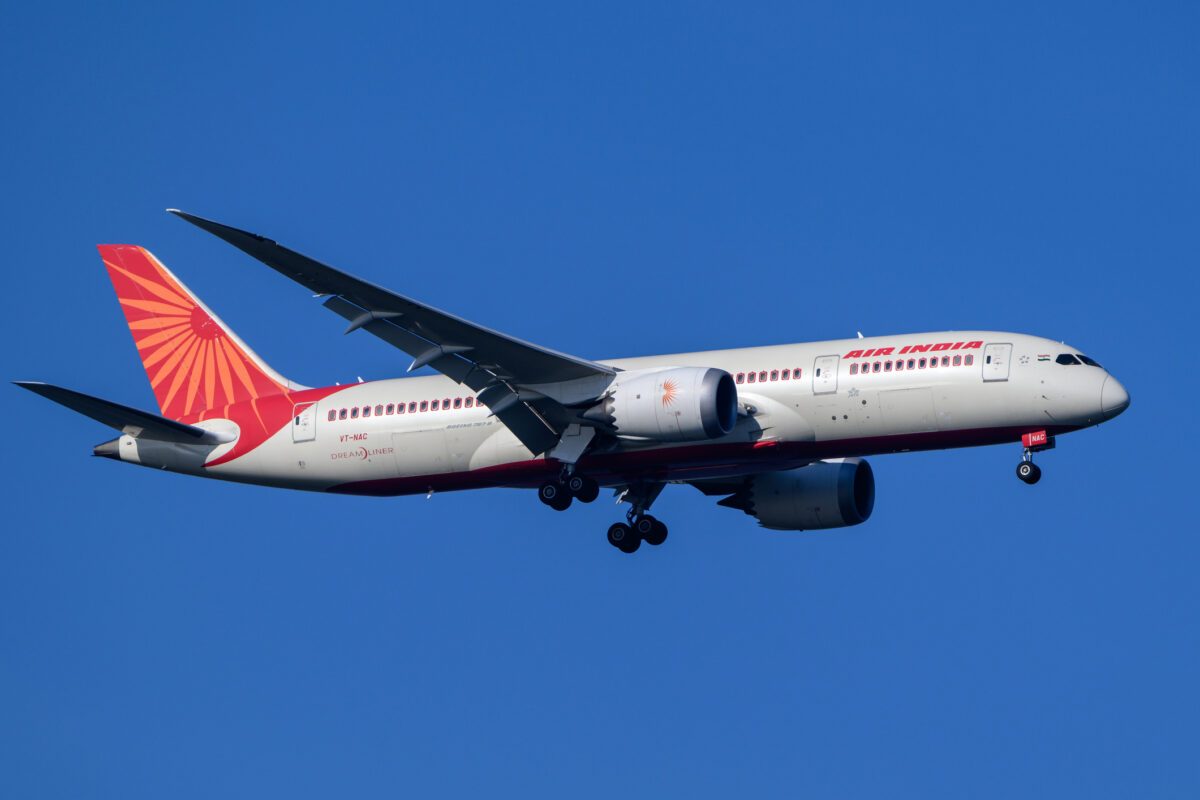
The airline will replace the Boeing 777-300ER currently assigned to the route with its new, purpose-built Boeing 787-9 Dreamliner. The aircraft change will allow Flight AI187 to operate directly from Delhi International Airport (DEL) to Toronto Pearson Airport (YYZ), subject to the continued availability of the necessary airspace corridors.
The revised operation will shorten the Delhi-to-Toronto journey by nearly three hours. Air India currently schedules approximately 20 hours for the westbound trip, including the technical stop at Vienna International Airport (VIE). Once the Boeing 787-9 takes over, the airline expects the nonstop flight to take about 17 hours.
Read our stories in your inbox
Two aviation newsletters. Zero fluff.
Air India will also restore daily service between Delhi International Airport (DEL) and Toronto Pearson Airport (YYZ), increasing the route from five to seven weekly flights. The carrier temporarily reduced frequencies during June and July 2026 because of higher fuel prices and geopolitical developments affecting its long-haul operating conditions.
WestJet’s 2026 International Expansion Adds Europe, South America And More Sun Flying
Vienna Fuel Stop No Longer Required
Air India introduced the fuel stop at Vienna International Airport (VIE) because the westbound Delhi International Airport (DEL)–Toronto Pearson Airport (YYZ) flight had become more operationally demanding under prevailing airspace restrictions.
Longer routings increase fuel consumption and can reduce the payload an aircraft can carry. The westbound sector is especially challenging because aircraft generally encounter stronger headwinds when flying toward North America, while the eastbound return often benefits from more favorable upper-level winds.
The Boeing 777-300ER could operate the route under normal conditions, but the combination of the extended routing, operating weight, winds and required fuel reserves made a technical stop necessary on some Delhi-to-Toronto flights.
The return service from Toronto Pearson Airport (YYZ) to Delhi International Airport (DEL) has continued to operate nonstop, with a flying time of up to 16 hours. Air India’s removal of the Vienna International Airport (VIE) stop therefore primarily addresses the more difficult westbound operation.
Air India cautioned that the nonstop schedule remains dependent on available airspace. A deterioration in regional operating conditions or the closure of additional flight corridors could again affect the aircraft’s planned routing.
New Delhi–Toronto Schedule
Air India will operate the following schedule beginning August 1, 2026, with all times local:
AI187: Delhi Indira Gandhi International Airport (DEL) 1:45 a.m. – Toronto Pearson International Airport (YYZ) 9:30 a.m.
AI188: Toronto Pearson International Airport (YYZ) 12:30 p.m. – Delhi Indira Gandhi International Airport (DEL) 2:05 p.m. the following day.
The morning arrival at Toronto Pearson Airport (YYZ) should provide useful onward connections across Canada and the United States. The early-afternoon departure from Toronto also allows Air India to reach Delhi International Airport (DEL) during the following afternoon, feeding into evening and overnight departures across its domestic and international network.
Daily service is particularly important in a market supported by business travel, family visits and the large Indian diaspora in the Greater Toronto Area. It also gives passengers greater flexibility than the temporary five-times-weekly schedule, especially when connecting from secondary cities at either end of the route.
Boeing 787-9 Brings Air India’s New Cabin to Canada
The equipment change is more than an operational solution. It will introduce Air India’s latest long-haul cabin product to Canada for the first time.
Air India’s new Boeing 787-9 accommodates 296 passengers across three cabins. The aircraft has 30 business-class suites, 28 premium-economy seats and 238 economy-class seats.
Business class is arranged in a 1-2-1 configuration, giving every passenger direct aisle access. Each private suite includes a fully flat bed measuring up to 79 inches, wireless charging, personal storage and a 17-inch 4K entertainment screen.
Premium economy will be offered between Delhi International Airport (DEL) and Toronto Pearson Airport (YYZ) for the first time. Its 28 seats are arranged in a 2-3-2 layout with 38 inches of pitch, adjustable leg and calf rests, additional recline and 13.3-inch entertainment screens.
The economy cabin uses a 3-3-3 configuration and provides 11.6-inch screens. All three cabins feature Air India’s Thales AVANT Up entertainment system, Bluetooth audio connectivity, USB-A and USB-C charging, power outlets and a library containing more than 3,000 hours of content.
The Boeing 787-9 also offers several inherent advantages on an ultra-long-haul route. Its composite-intensive structure, advanced aerodynamics and modern engines were designed to reduce fuel consumption while providing the range flexibility needed for long nonstop sectors. The Dreamliner also features larger windows, higher cabin humidity and a lower cabin altitude than many earlier-generation widebody aircraft.
Daily Flights Will Increase Overall Capacity
The Boeing 787-9 is smaller than Air India’s Boeing 777-300ER in total seating capacity, but the increase from five to seven weekly departures will result in more seats being offered across the week.
Air India publishes several Boeing 777-300ER configurations, ranging from 328 to 344 seats. At five weekly flights, those aircraft provide approximately 1,640 to 1,720 seats in each direction.
Seven weekly flights with the 296-seat Boeing 787-9 will provide 2,072 seats in each direction. Depending on which 777-300ER configuration had been used, that represents a weekly capacity increase of approximately 20% to 26%.
The new schedule therefore gives Air India more weekly capacity despite using a smaller aircraft. It also spreads those seats across every day of the week, which is generally more attractive to business travelers and passengers making onward connections.
The aircraft change should provide an operating-cost benefit as well. The 787-9 is optimized for long-range missions and is likely better suited than the larger 777-300ER to the route’s passenger volume, particularly when the additional frequency is considered.
A Major Upgrade for Air India’s Canadian Operation
Toronto Pearson International Airport (YYZ) is one of Air India’s most important North American gateways. The route connects Canada’s largest metropolitan area with Air India’s primary hub at Delhi International Airport (DEL), where passengers can continue to cities across India, South Asia, Southeast Asia and the Middle East.
The arrival of the new Boeing 787-9 also reflects Air India’s broader effort to replace or renovate the inconsistent cabins inherited across its legacy widebody fleet.
Air India’s first purpose-built 787-9 entered commercial service in February 2026. Unlike aircraft acquired from other carriers, these Dreamliners were delivered with interiors designed specifically for the airline’s new product standards.
Deploying the type to Toronto Pearson Airport (YYZ) gives Air India a much stronger premium offering in a competitive Canada–India market. Passengers will gain direct-aisle-access business suites, a dedicated premium-economy cabin and a more modern economy product, while the airline gains an aircraft better suited to operating the demanding route nonstop.
Bottom Line
Air India will remove the Vienna International Airport (VIE) fuel stop from its Delhi International Airport (DEL)–Toronto Pearson International Airport (YYZ) service on August 1, 2026.
The airline’s new 296-seat Boeing 787-9 will replace the Boeing 777-300ER, reducing the westbound journey from approximately 20 hours to about 17 hours. The Toronto-to-Delhi flight will continue operating nonstop with a flying time of up to 16 hours.
Air India will also increase the route from five weekly flights to daily service. Although the 787-9 has fewer seats than the outgoing 777-300ER, the higher frequency will increase total weekly capacity by approximately 20% to 26%.
For passengers, the biggest improvements will be a shorter westbound trip, daily scheduling and Air India’s newest cabin experience. For the airline, the Boeing 787-9 provides the efficiency, range and product quality needed to make one of its most important North American routes more competitive.
Keep reading FlyMag
Get the Daily Brief in the morning or the Route Watch weekly recap on Fridays. Or both.