A sudden closure of key Middle East airspace on February 28, 2026 turned routine long-haul flying into a real-time exercise in contingency planning. After fast-moving military escalation involving U.S. and Israeli strikes on Iran and regional retaliation, multiple states rapidly restricted or closed their skies, choking off one of the world’s densest east–west corridors.
The result was a rare aviation spectacle with very real consequences: widebody aircraft halfway across oceans reversing course, Gulf hubs going quiet, and diversion ramps from Rome (FCO) to Istanbul (IST) absorbing unexpected arrivals with hundreds of passengers onboard—often without a clear plan for onward travel.
The airspace domino effect: when “one closure” becomes a regional blackout
In isolation, a single-country closure is usually manageable—dispatch reroutes around it, ATC meters traffic, and schedules take a hit but remain intact. February 28 was different because the closures stacked.
Read our stories in your inbox
Two aviation newsletters. Zero fluff.
Airspace over Iran closed, and restrictions expanded across neighboring FIRs and Gulf states—including Iraq, Kuwait, Bahrain, and Qatar—with knock-on impacts to the most-used routings linking Europe with the Gulf, South Asia, and Southeast Asia. For airlines, that removed the “normal” set of tracks that keep block times predictable and fuel planning stable.
Once the corridor collapses, flights face three immediate problems:
-
No safe, legal route forward into their destination FIRs
-
No guaranteed alternates nearby with capacity, handling, and immigration bandwidth
-
Cascading crew legality risks as block times spike and diversions multiply
DXB and DOH: what happens when the world’s connection engines pause
The story wasn’t only about airspace—it was about hubs.
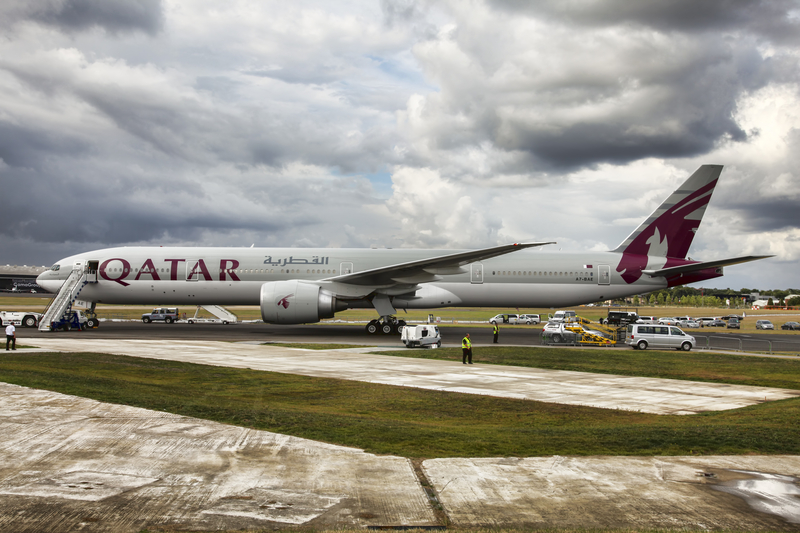
Dubai Airports suspended flight operations at Dubai (DXB) and Dubai World Central (DWC), urging passengers not to travel to the airport. Doha’s Hamad (DOH) also became a focal point, with Qatar Airways pausing operations as the situation evolved. When hubs like DXB and DOH stop moving, the disruption immediately turns global: aircraft are displaced, crews time out away from base, and connecting itineraries collapse by the tens of thousands.
These hubs run on tightly banked waves. If you miss a bank at DOH, you don’t just miss your flight—you miss your network, because the connection inventory that makes the Gulf model work evaporates until the next coordinated wave can be rebuilt.
The headline examples: EK220 and AA120 show how bad “bad day” can get
Aviation nerds watched the map; passengers lived it.
Emirates EK220 — Orlando (MCO) to Dubai (DXB)
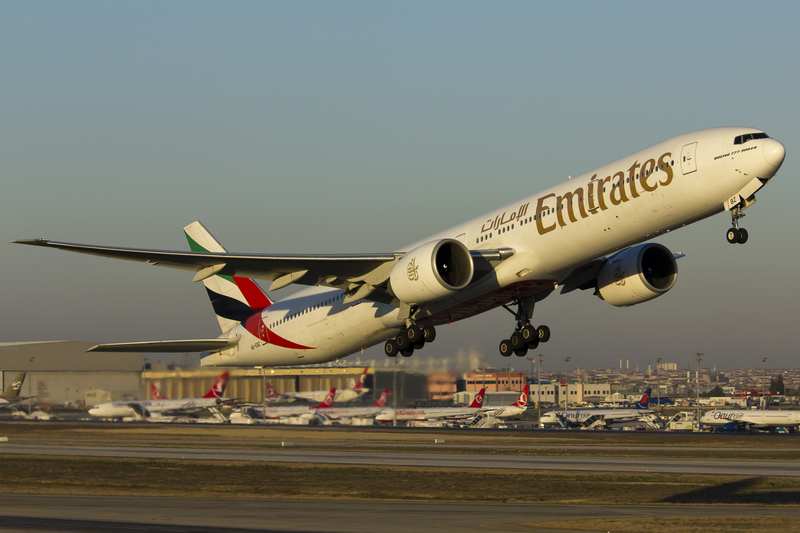
One of the most eye-catching cases involved Emirates EK220, normally operated with a Boeing 777-300ER on the MCO–DXB sector. With Dubai suspended, the flight ended up diverting to Istanbul (IST) after roughly 14 hours airborne—a classic “flight to nowhere,” except it still required full widebody handling, crew support, passenger processing, and a recovery plan at the diversion station.
American Airlines AA120 — Philadelphia (PHL) to Doha (DOH)
American’s AA120, a Boeing 787-9 Dreamliner service from PHL to DOH, illustrates the brutal economics of late-stage reversals. With DOH constrained, the aircraft reportedly turned back over the Atlantic after reaching western Europe, with the total airborne time trending into the 13+ hour range before returning toward PHL. That’s a long-haul duty day consumed without delivering a single passenger to destination—plus the follow-on problem of repositioning the aircraft and crew back into a disrupted network.
In both cases, the aircraft were doing what widebodies are designed to do: fly safely for long periods with stable systems performance. But operationally, they were burning the airline’s most precious resource—time—while consuming fuel, crew duty, and recovery capacity.
Why flights divert to Europe instead of “somewhere closer”
To the public, it can seem irrational that a flight bound for DXB or DOH would divert to places like FCO, IST, Vienna (VIE), or other European alternates rather than landing “near the Gulf.”
For dispatchers, the logic is straightforward:
-
Guaranteed widebody stands and services: airports used to handling A380/777/787/A350 volumes have the equipment, stairs/jet bridges, tow bars, catering, and manpower to park and deplane a full load quickly.
-
Passenger processing capacity: when a widebody arrives unexpectedly, immigration and border-control staffing becomes a real constraint. Large European gateways are simply better positioned to absorb surprise arrivals.
-
Safety and certainty: in fast-evolving security environments, “closer” can mean “less predictable.” Airlines will often prefer a longer diversion to a known, stable alternate over a short hop into uncertainty.
This is especially true when multiple diversions hit the same region simultaneously. The alternates that look “closest” on a map can become saturated in minutes.
The operational math: cancellations vs diversions—and why diversions are the costliest option
By late February 28, industry analytics indicated that a substantial share of Middle East-bound schedules had been canceled, with totals rising as the day progressed. Diversions also mounted—spanning dozens of alternate airports.
For airline operations centers, diversions are the worst kind of disruption because they create problems in every direction at once:
-
Aircraft displacement: the plane is now parked where you didn’t plan maintenance, catering, cleaning, or next-sector crew.
-
Crew legality: long-haul crews can time out quickly after an extended diversion, turning a one-flight problem into a multi-day aircraft recovery issue.
-
Passenger care: a 300-seat widebody suddenly needs hotels, ground transport, meals, rebooking—and often visa guidance—at an airport that wasn’t expecting them.
-
Bags and cargo: checked baggage access depends on local customs rules and handling capability; cargo can be delayed or offloaded depending on onward routing and fuel requirements.
That’s why, once the picture becomes clear, airlines often pivot from diversion-heavy operations to proactive cancellations. It’s painful for customers in the moment, but it prevents aircraft and crews from being scattered across the continent like chess pieces knocked off the board.
What passengers should expect next if the corridor stays unstable
Even when airspace reopens, the schedule does not “snap back.” Hubs restart slowly because the system has to be reassembled:
-
Aircraft must be repositioned from alternates back to base hubs (DXB/DWC/DOH).
-
Crews need legal rest and often must be ferried into place.
-
Rotations are out of sequence, and aircraft planned for one long-haul bank may now be on the wrong side of the globe.
-
Airports may impose flow controls as traffic surges back into constrained corridors.
For travelers connecting through the region—especially via DXB and DOH—the practical reality is that rebooking can stretch over days, not hours. A simple missed connection can become a multi-stop itinerary via Istanbul (IST), Muscat (MCT), Cairo (CAI), or European hubs depending on seat availability and carrier policies.
Bottom Line
February 28’s Middle East airspace shutdown was a stark demonstration of how fragile global aviation can be when a single corridor becomes unavailable. With Iran and multiple neighboring states closing or restricting airspace—and major hubs like Dubai (DXB/DWC) and Doha (DOH) forced to pause—airlines faced a brutal choice: divert, turn back, or cancel.
The most dramatic examples, like Emirates EK220 (MCO–DXB) diverting to Istanbul (IST) after roughly 14 hours and American AA120 (PHL–DOH) burning over 13 hours only to head back, weren’t anomalies—they were the inevitable outcome of a system built around a few critical hubs and corridors. When those hubs go quiet, the ripple isn’t regional. It’s global.
Keep reading FlyMag
Get the Daily Brief in the morning or the Route Watch weekly recap on Fridays. Or both.