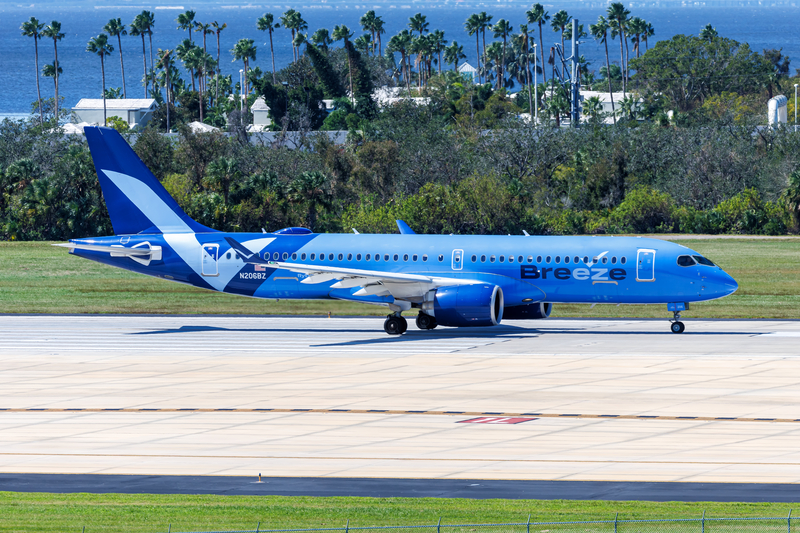
Breeze Airways (MX) is preparing to add two Learjet 45s to its operation—not for revenue flying, but as dedicated support aircraft to move maintenance parts, engineers, and reposition crews quickly when disruptions hit. The jets are expected to enter service in mid-February, based at Breeze’s maintenance hub at Charleston International Airport (CHS), with pilot training scheduled to begin February 2.

This is a very specific kind of airline tool: a fast-response “rescue jet” designed to protect the mainline schedule. And it’s a move that tells you Breeze is now thinking like a maturing network airline—one that can’t afford AOG downtime and crew mispositioning to cascade across the day.
Why Breeze is doing this now: A220 scale changes the disruption math
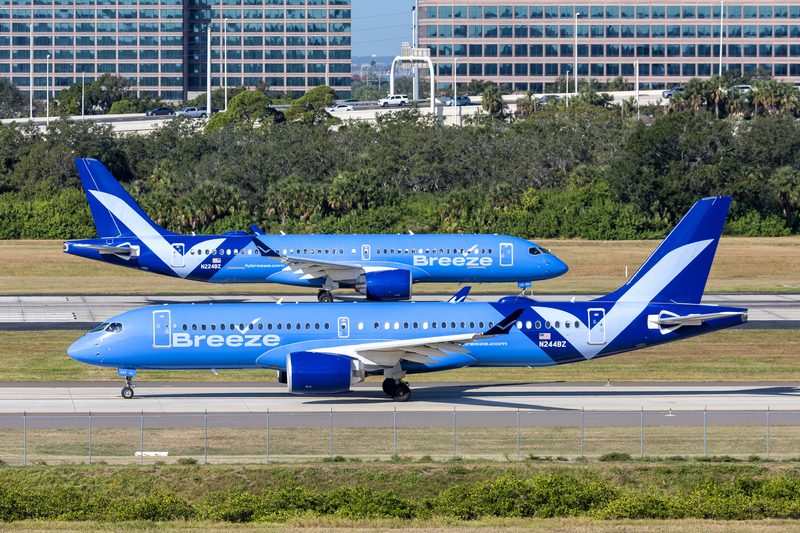
Breeze’s core fleet is the Airbus A220-300, and it’s operating 52 of the type, with 46 more on order and options for 30 additional aircraft. It also still has a small Embraer E190 subfleet—eight aircraft—scheduled for retirement in 2026.
Read our stories in your inbox
Two aviation newsletters. Zero fluff.
As your narrowbody fleet grows, your reliability challenges don’t grow linearly—they grow exponentially. A single “stuck aircraft” can strand crews, trap a critical part at the wrong station, and force knock-on cancellations when replacement lift isn’t immediately available. This is amplified in Breeze’s network model, which often includes thinner routes and smaller stations where there isn’t a deep bench of local maintenance support or spare aircraft coverage.
A dedicated quick-response jet is essentially an insurance policy against:
-
AOG events where a part or engineer needs to move now, not tomorrow
-
Crew legality problems when a crew ends up out of position and a flight must operate
-
Mechanical irregularities at outstations without robust MRO capability
-
Snowball disruptions that turn one cancellation into a multi-station schedule collapse
Why a Learjet 45 is the right kind of tool for this job
The Learjet 45 (LJ45) is a mid-size, high-speed business jet that fits this mission profile well. In airline terms, it’s valuable because it can:
-
Launch quickly and cruise fast (typically in the high 400-knot range)
-
Access a wide range of airports, including secondary and diversion fields
-
Carry a small team of engineers plus tooling, or reposition multiple crewmembers efficiently
-
Reduce “clock time” in a way airlines actually feel in dispatch metrics
This isn’t about seat count or passenger amenities. It’s about time-to-fix. If an A220 is down for a part that’s sitting at CHS (or needs an engineer flown in), the LJ45 can compress what might otherwise be a 12–24 hour problem into a same-day recovery—often the difference between a single cancellation and a rolling wave.
Charleston (CHS) as the base: a logical maintenance-centric decision
Basing the jets at Charleston (CHS) is consistent with how airlines build reliability infrastructure: put the “rapid response” asset where the people, tooling, and parts already live.
CHS is a smart choice because:
-
It’s Breeze’s maintenance hub, so parts and engineering support are naturally concentrated there
-
It offers geographic reach into the East Coast, Midwest, and South—key Breeze territory
-
It shortens response times to outstations that don’t have heavy maintenance capabilities
In practice, the jet becomes an airborne extension of the maintenance control center. When a call comes in—“we need this part,” “we need an engineer,” “we need a crew”—dispatch doesn’t have to hunt for ad-hoc lift or commercial seats. They have an internal solution.
The Azul influence: Neeleman’s playbook in action
Founder David Neeleman has done this before. He explicitly points to Azul—which he founded and still chairs—as the inspiration.
At Azul, the problem was similar in concept: a large network serving many markets with limited alternative lift and limited local support. In those conditions, when something breaks, it’s hard to solve quickly unless you can physically move the solution—people and parts—to the airplane.
Azul currently uses Pilatus PC-12 turboprops for these missions, including:
Those aircraft are listed for air-taxi/scheduled capability under Brazil’s RBAC 135 framework, while Azul’s main airline operation runs under RBAC 121.
Breeze is taking the same concept—but choosing a faster jet platform for the U.S. geography and its own mission tempo.
What this means for Breeze’s A220 operation
Breeze’s fleet strategy is already clear: the A220-300 is the growth engine, and the E190s are on the way out. But the hidden constraint in any fast-growing airline is reliability—especially when you’re building a brand around a “nice experience” and a schedule that customers can trust.
Adding two Learjet 45s is a back-office move that customers might never notice directly—except in the form that matters most:
-
fewer last-minute cancellations,
-
better recovery after mechanical delays,
-
and improved on-time performance when something goes wrong.
It also hints at Breeze’s internal maturity. Airlines don’t buy “support jets” when they’re small; they buy them when disruption costs become large enough that owning the solution is cheaper than renting the problem.
Bottom Line
Breeze’s plan to base two Learjet 45s at Charleston (CHS) for crew, engineer, and parts transport is a classic reliability investment aimed at reducing AOG downtime and preventing disruption cascades across its rapidly growing Airbus A220-300 operation. It’s an operational-control move borrowed from David Neeleman’s Azul playbook—optimized for Breeze’s network scale and the realities of fixing aircraft quickly when they break far from a maintenance base.