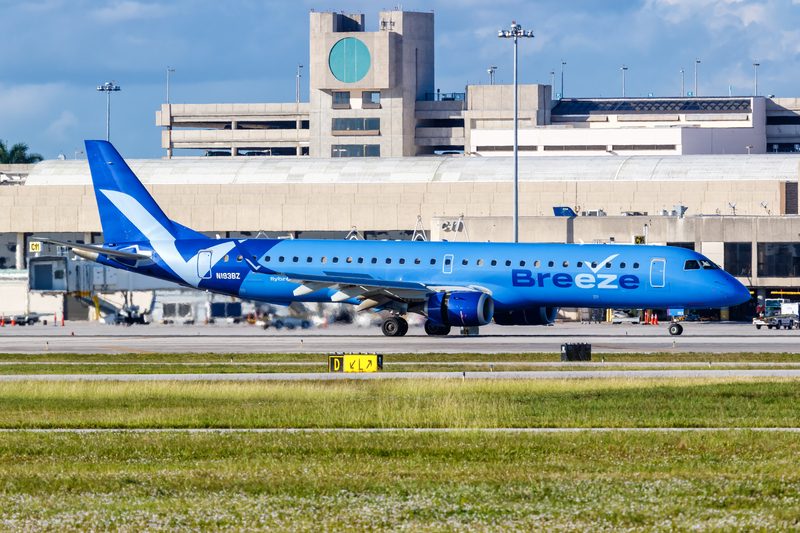
Breeze Airways is not finished with the Embraer E190 yet.

The carrier has tentatively scheduled the 108-seat regional jet on nine domestic routes between mid-July and early September 2026, extending the type’s presence in scheduled service even as Breeze continues to build its future around the Airbus A220-300.
The latest schedule filings show the Embraer E190 still being used on select short-haul and leisure-focused markets across the eastern United States. For Breeze, this is less a reversal of strategy than a practical fleet decision. The E190 remains useful where the airline needs smaller-capacity lift, especially during peak summer periods when every aircraft still has network value.
Read our stories in your inbox
Two aviation newsletters. Zero fluff.
The schedule update also shows how gradual fleet transitions can be in real airline operations. Breeze has made clear that the Airbus A220-300 is the aircraft that defines its long-term scheduled network. But the Embraer E190, one of the aircraft types that helped launch the airline, is still being asked to carry passengers on routes where its size and economics remain workable.
Nine Routes Keep the E190 Flying Into Early September
According to AeroRoutes, Breeze has filed E190 operations from July 11 through September 7, 2026. Most of the flying runs through August 31, with two additional routes appearing only during the Labor Day travel window from September 4 through September 7.
The planned E190 routes include Long Island MacArthur Airport (ISP) to Charleston International Airport (CHS), Louis Armstrong New Orleans International Airport (MSY) to Charleston (CHS), New Orleans (MSY) to Myrtle Beach International Airport (MYR), New Orleans (MSY) to Richmond International Airport (RIC), New Orleans (MSY) to Savannah/Hilton Head International Airport (SAV), Westchester County Airport (HPN) to Myrtle Beach (MYR), and Westchester County (HPN) to Savannah (SAV).
The two short September filings are Orlando International Airport (MCO) to New Orleans (MSY) and Orlando (MCO) to Wilmington International Airport (ILM) in North Carolina.
That route mix says a lot about how Breeze is using the airplane. These are not flagship long-haul A220 missions. They are shorter, lower-frequency routes connecting leisure markets, secondary airports, and Breeze focus cities. That is exactly the environment where a smaller aircraft can still make sense.
The E190 Still Fits Breeze’s Smaller-Market DNA
Breeze was built around a simple idea: connect underserved city pairs with nonstop flights rather than forcing passengers over the largest hubs. The E190 helped make that possible when the airline launched service in 2021, giving Breeze a right-sized aircraft for shorter regional routes before the A220 fleet matured.

The E190 is not new technology in the way the A220 is. It lacks the range, premium cabin, fuel efficiency, cabin width, and brand value that Breeze gets from the A220-300. But it still has advantages.
The aircraft is smaller, with 108 seats, and it uses a 2-2 cabin layout, meaning there are no middle seats. Breeze’s E190 seating includes 48 extra-legroom “Nicer” seats and 60 standard “Nice” seats, giving the aircraft a surprisingly generous mix of higher-comfort economy options for a short-haul jet.
For markets like Islip (ISP)-Charleston (CHS), New Orleans (MSY)-Savannah (SAV), or Westchester County (HPN)-Myrtle Beach (MYR), that size can be useful. The routes may not need the capacity of a 137-seat A220-300 on every date, but they can still justify nonstop service when the schedule is limited and demand is seasonal.
That is the E190’s remaining role at Breeze: not growth aircraft, but precision aircraft.
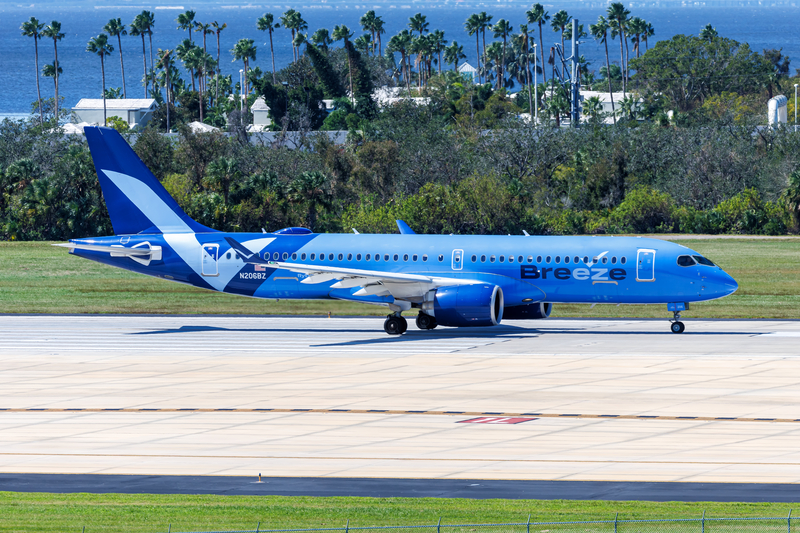
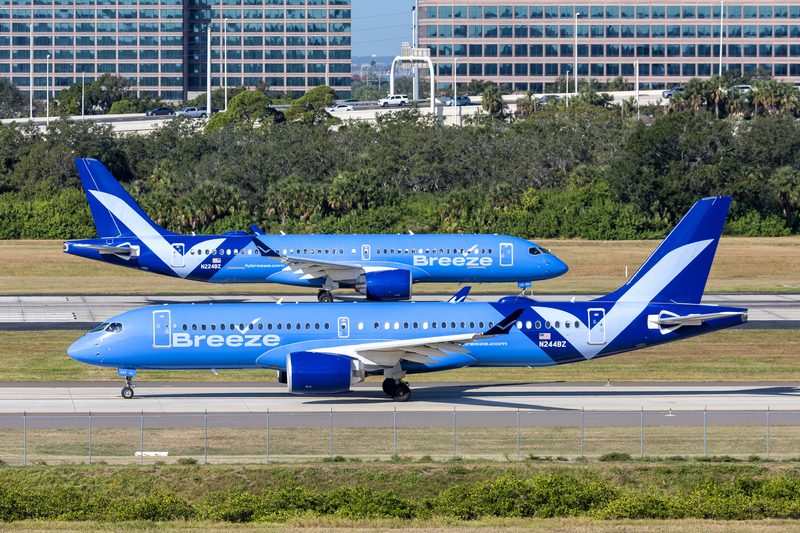
The A220 Is Still the Future
Breeze’s broader fleet strategy remains centered on the Airbus A220-300. The aircraft gives the carrier longer range, better fuel efficiency, a stronger passenger experience, and a real premium product through Breeze Ascent.
Breeze’s current A220-300 layout includes 12 Breeze Ascent seats, 45 extra-legroom Nicer seats, and 80 standard Nice seats, for a total of 137 seats. The cabin has a 2-3 economy layout, larger windows, strong passenger appeal, and high-speed Wi-Fi on A220 flights. That makes it a much stronger aircraft for longer thin routes, transcontinental flying, and markets where Breeze wants to compete on more than low fares.
The A220 also gives Breeze an aircraft that aligns with its newer network expansion. Recent Breeze schedule updates have assigned new routes overwhelmingly to the A220-300, including markets from Baltimore/Washington, Dayton, Trenton, Fort Myers, Vero Beach, Raleigh/Durham, and other cities.
That is the real direction of travel. The E190 may still be flying, but the A220 is the aircraft Breeze is building around.
Why the E190 Is Still Showing Up
The most likely answer is practical fleet planning.
Airlines do not retire aircraft from scheduled service simply because a newer type is preferred. They retire them when the network, lease terms, maintenance planning, crew availability, utilization, and replacement aircraft all line up. If the E190 is available, staffed, and economical enough for certain short missions, Breeze has a reason to use it during the busy summer period.
That is especially true in July and August. Summer demand is strong across leisure markets, and Breeze’s network includes many routes that peak during school breaks, beach travel, and long-weekend periods. Keeping the E190 in scheduled service allows the airline to protect capacity without necessarily pulling an A220 from a route where the larger aircraft is more valuable.
The September 4-7 Orlando (MCO) routes are a good example. Those filings appear around the Labor Day travel period, when short-term leisure demand can justify extra lift. Using the E190 on Orlando (MCO)-New Orleans (MSY) and Orlando (MCO)-Wilmington (ILM) gives Breeze a way to cover peak demand without making a broader, long-term fleet statement.
A Different Passenger Experience Than the A220
For travelers, the aircraft assignment matters.
Passengers booked on an E190 will not get Breeze Ascent, the airline’s premium front-cabin product available on the A220. They also will not get the full A220 experience that Breeze has increasingly used to define its brand on longer routes.
But the E190 is not a poor passenger aircraft. The 2-2 seating layout means no middle seats, and the jet is well matched to the short sectors where Breeze is deploying it. For a flight such as New Orleans (MSY)-Charleston (CHS) or Westchester County (HPN)-Savannah (SAV), the E190’s cabin is entirely adequate, especially if passengers select the extra-legroom Nicer rows.
The key difference is product depth. The A220 is Breeze’s flagship aircraft. The E190 is a practical short-haul tool.
What This Says About Breeze’s Network
The E190 schedule also reflects the nature of Breeze’s route map. Breeze does not operate like a traditional hub carrier. It builds many routes around underserved city pairs, leisure flows, and secondary airports. That creates opportunities, but it also creates variable demand.
A traditional hub carrier can fill aircraft with a mix of local and connecting traffic. Breeze relies more heavily on local point-to-point demand. That makes aircraft size especially important. Too much capacity can quickly pressure fares. Too little capacity can leave revenue on the table during peak weeks.
The E190 gives Breeze another lever. It can keep certain routes alive, test demand, or cover seasonal peaks with fewer seats than the A220. That flexibility is valuable, even if the aircraft is no longer central to the airline’s future.
Retirement Is Coming, But Not Cleanly
The long-term direction remains clear: Breeze is moving toward an A220-led scheduled operation. The E190 is increasingly a support aircraft rather than the face of the airline’s route development.
Still, the latest filings show that aircraft retirements are rarely tidy. Breeze’s Embraer fleet has been expected to fade from scheduled service, but the E190 continues to appear where it can serve a useful purpose. That may frustrate passengers expecting the newer A220, but it also shows disciplined capacity management.
In many ways, the E190 is doing exactly what a transitional aircraft should do. It is filling gaps, supporting seasonal flying, and allowing Breeze to keep service in markets that might be too thin for larger aircraft at certain times of year.
Bottom Line
Breeze Airways’ Embraer E190 is not done yet. The airline has tentatively scheduled the 108-seat aircraft on nine routes from July 11 through September 7, 2026, keeping the type in scheduled service a little longer than many expected.
The move does not change Breeze’s long-term strategy. The Airbus A220-300 remains the airline’s growth aircraft, flagship product, and preferred platform for new scheduled routes. But the E190 still has value on shorter, lower-frequency, leisure-heavy city pairs where smaller capacity can be the smarter choice.
For Breeze, this is not nostalgia. It is network discipline. The A220 is the future, but for a few more summer routes, the E190 still has a job to do.